Shopify vs WooCommerce: Which Is Actually Cheaper for Your Profit Margins?
Shopify starts at $29/month. WooCommerce is "free." Neither number tells you which platform actually costs less to run. Here's the total cost of ownership comparison across three store stages — subscription, apps, processing fees, hosting, and developer time — with verified 2026 figures and a clear profit verdict at each level.

The headline comparison is always the same: Shopify starts at $29/month, WooCommerce is free. That framing is almost useless for making an actual decision, because neither number reflects what either platform really costs at scale.
Shopify's true cost includes processing fees, app subscriptions, and the third-party transaction penalty you pay for using any gateway that isn't Shopify Payments. WooCommerce's true cost includes hosting, security, premium plugins, maintenance, and the developer time that replaces what Shopify handles automatically. The question isn't which platform has the lower sticker price. It's which one leaves more profit after every real cost — and the answer depends almost entirely on your technical capability, order volume, and how you use each platform.
This is a total cost of ownership comparison. No feature lists, no dashboard screenshots. Just what each platform actually costs, at three stages of a real ecommerce business.
The Cost Categories That Actually Matter
Before the numbers, here's what belongs in a true platform cost comparison — and what most articles leave out.
Platform subscription or hosting — Shopify's monthly fee vs. WooCommerce's hosting bill. The most visible cost and, at small scale, the most misleading one.
Payment processing fees — both platforms pay 2.9% + 30¢ per transaction on domestic standard cards. The difference is Shopify's extra transaction fee on non-Shopify Payments gateways.
Apps and plugins — the real equaliser. Shopify stores pay monthly app subscriptions; WooCommerce stores pay annual plugin licences. Both stacks add up fast.
Developer and maintenance time — Shopify's managed infrastructure means near-zero maintenance. WooCommerce on self-hosted WordPress requires updates, security monitoring, backups, and occasional developer intervention. This is the cost most WooCommerce comparisons omit entirely.
Theme and design cost — one-time for both, but WooCommerce customisation often requires ongoing developer involvement that Shopify's visual editor doesn't.
Shopify: What It Really Costs
Subscription
Shopify offers five pricing plans in 2026: Agentic ($0/mo), Starter ($5/mo), Basic ($39/mo), Grow ($105/mo), and Advanced ($399/mo). Annual billing saves 25% — bringing Basic to $29/mo, Grow to $79/mo, and Advanced to $299/mo. For most small Shopify stores, Basic at $29/month (annual) is the starting point.
Payment Processing
On Shopify Payments: 2.9% + 30¢ per transaction on Basic, dropping to 2.7% on Grow and 2.5% on Advanced. If you use a third-party gateway instead, Shopify adds an extra transaction fee on top of whatever your processor charges — 2% on Basic, scaling down on higher plans. On a $100 sale using Basic with a third-party gateway, you might pay $2.90 to your processor plus $2.00 to Shopify, totaling $4.90 in fees. Using Shopify Payments on the same sale costs $3.20.
This transaction fee is Shopify's most significant hidden cost. Merchants who use PayPal, Stripe, or any other external processor without switching to Shopify Payments pay a permanent 2% tax on every sale on the Basic plan.
Apps
Most Shopify stores accumulate 3–8 paid apps within six months: email marketing, reviews, upsells, subscriptions, analytics, inventory. At mid-market revenue levels, Shopify app marketplace costs can significantly increase total cost of ownership beyond the headline subscription price. Realistic monthly app spend: $100–$300 for a growing store, $300–$600 for an established one.
What Shopify Doesn't Cost You
Zero hosting management. Zero security patching. Zero server monitoring. Zero backup configuration. Shopify's infrastructure is fully managed — uptime, SSL, PCI compliance, CDN — and all of it is included in the subscription. This has a real dollar value that's easy to miss because you never receive a bill for it.
WooCommerce: What It Really Costs
Hosting
WooCommerce hosting ranges from $3.99/month for budget shared hosting to $30+/month for premium managed hosting. Most growing stores settle in the $11 to $40/month range with cloud-managed providers like Cloudways, which balances performance and cost.
Budget shared hosting ($5–$10/month) works for very low traffic but degrades significantly under real ecommerce load. A serious WooCommerce store doing 200+ orders a month needs managed cloud or VPS hosting at $25–$80/month to maintain performance and uptime.
Payment Processing
WooCommerce itself never charges a transaction fee. Payment processing costs come entirely from your chosen gateway. WooPayments and Stripe both charge 2.9% + $0.30 per domestic transaction, with an additional +1.50% for international cards and +1.00% for currency conversion. The card rate is identical to Shopify Payments — the difference is WooCommerce has no platform transaction fee on top.
Plugins
Essential premium plugins typically cost $100 to $500/year for a small store. Stores needing subscriptions ($279/year), advanced shipping ($119/year), marketing automation ($159/year), and bookings ($249/year) can spend $600 to $900/year on extensions alone.
Unlike Shopify's monthly app fees, WooCommerce plugins are mostly annual licences — which means a smaller monthly feel but a larger annual renewal event. The renewal trap is real: introductory plugin prices are often discounted, and renewal rates can be significantly higher.
Developer and Maintenance Time
This is the cost WooCommerce comparisons consistently undercount. WooCommerce developer hourly rates range from $50–$100/hour for entry-level work to $100–$200+/hour for experienced specialists. A basic WooCommerce store costs between $1,500 and $5,000 for professional development, plus $200–$1,000/year in platform costs.
Even for merchants who self-manage, WordPress and WooCommerce require regular plugin updates, theme compatibility checks, database backups, security scanning, and periodic performance optimisation. Seahawk's WooCommerce maintenance plans include checkout testing, staged plugin updates, daily backups, and 24/7 uptime monitoring. Plans start at $49/month. Whether you pay a developer or spend your own time, maintenance is a real ongoing cost that has no equivalent on Shopify.
The Full Cost Comparison: Three Store Stages
Here's what each platform actually costs annually at three realistic business stages.
Stage 1 — Early Store (50–100 orders/month, $30 AOV)
| Cost item | Shopify Basic | WooCommerce |
|---|---|---|
| Subscription / hosting | $348/yr ($29/mo annual) | $180/yr ($15/mo managed) |
| Domain | $15/yr | $15/yr |
| SSL | Included | Usually included |
| Payment processing (2.9% + 30¢) | Same rate | Same rate |
| Platform transaction fee | $0 (Shopify Payments) | $0 |
| Apps / plugins | $600/yr ($50/mo) | $300/yr (annual licences) |
| Theme | $0–$350 one-time | $0–$100 one-time |
| Maintenance / dev time | $0 | $600/yr ($50/mo est.) |
| Annual platform cost | ~$963 | ~$1,095 |
At this stage the two platforms are broadly comparable in annual cost, with Shopify marginally cheaper once maintenance is factored in. WooCommerce's lower plugin cost is offset by hosting and developer time.
Stage 2 — Growing Store (300 orders/month, $50 AOV, $180k/yr revenue)
| Cost item | Shopify Grow | WooCommerce |
|---|---|---|
| Subscription / hosting | $948/yr ($79/mo annual) | $480/yr ($40/mo managed VPS) |
| Payment processing (2.7% + 30¢) | Same rate | Same rate |
| Platform transaction fee | $0 (Shopify Payments) | $0 |
| Apps | $2,400/yr ($200/mo) | $800/yr (plugin stack) |
| Maintenance / dev time | $0 | $1,200/yr ($100/mo) |
| Annual platform cost | ~$3,348 | ~$2,480 |
| Monthly platform cost | ~$279 | ~$207 |
At mid-market revenue levels, WooCommerce's total cost of ownership is often lower once you factor in Shopify app marketplace costs. At 300 orders a month, WooCommerce's savings on apps — paying annual licences instead of Shopify's recurring monthly fees — more than offset the hosting and maintenance costs. WooCommerce saves roughly $870/year at this stage.
Stage 3 — Established Store (1,000+ orders/month, $60 AOV, $720k/yr revenue)
| Cost item | Shopify Advanced | WooCommerce |
|---|---|---|
| Subscription / hosting | $3,588/yr ($299/mo annual) | $1,200/yr ($100/mo managed) |
| Payment processing (2.5% + 30¢) | Same rate | Same rate |
| Platform transaction fee | $0 (Shopify Payments) | $0 |
| Apps | $5,400/yr ($450/mo) | $1,200/yr (full plugin stack) |
| Maintenance / dev | $0 | $2,400/yr ($200/mo) |
| Annual platform cost | ~$8,988 | ~$4,800 |
| Monthly savings on WooCommerce | — | ~$349/mo |
At scale, WooCommerce's cost advantage compounds significantly. The per-order platform cost on Shopify Advanced at 1,000 orders/month works out to about $0.75/order in subscription alone, plus apps. WooCommerce's total platform cost at the same volume is roughly half — entirely because app costs don't scale with order volume the way Shopify's monthly app bills do.
The Transaction Fee Trap: When Third-Party Gateways Destroy the Comparison
Everything above assumes you use Shopify Payments. If you don't — because you use PayPal, Stripe directly, a buy-now-pay-later provider, or any gateway not native to Shopify — the Basic plan's 2% transaction fee rewrites the comparison at every stage.
At $180,000/year in revenue on Shopify Basic with a third-party gateway, that 2% costs $3,600/year in pure platform tax. On the Grow plan it's $1,800/year. WooCommerce charges zero — your processor's rate is your only fee.
Zero platform fees or sales commissions is WooCommerce's genuine financial advantage at scale. You pay only payment processing, which saves hundreds or thousands per year compared to Shopify's fee on non-Shopify Payments transactions.
This is the number that most definitively changes the answer for merchants who need gateway flexibility — international sellers, businesses using specific BNPL providers, or stores where checkout optimisation requires multiple gateway options.
What the Cost Comparison Doesn't Capture
Shopify's Time Advantage at Launch
For straightforward stores using standard features, Shopify can be faster and cheaper to launch. A Shopify store can be live in days. A properly configured WooCommerce store — with reliable hosting, security, caching, performance optimisation, and a full plugin stack — takes weeks at minimum and often requires professional help. That setup time has a real cost that the annual cost tables above don't include.
WooCommerce's Ownership Advantage at Scale
WooCommerce gives you complete code ownership. You can migrate your store to any host, hire any developer, and customise every pixel without platform restrictions. You own your data, your customer records, your checkout experience, and your entire codebase. On Shopify, everything lives on Shopify's infrastructure — and if Shopify changes pricing, removes a feature, or discontinues a plan, you have limited recourse.
The Developer Dependency Risk on WooCommerce
WooCommerce's flexibility is real. So is the dependency it creates. A Shopify store can be managed by a non-technical founder indefinitely. A WooCommerce store eventually needs developer intervention — for plugin conflicts, custom integrations, performance degradation, or security issues. If you are a business not comfortable managing everything in-house, you will keep pushing the WooCommerce operating costs closer to the higher end.
Which Platform Leaves More Profit: The Verdict
There's no single answer — but there are clear situations where each wins.
Shopify leaves more profit when:
- You're early-stage and need to launch fast without technical overhead
- You use Shopify Payments (eliminating the transaction fee entirely)
- Your monthly order volume is under 200 and app costs are modest
- You have no developer resource and maintenance time would be a real cost
WooCommerce leaves more profit when:
- You need a third-party gateway and can't use Shopify Payments — the 2% fee savings alone often cover a year's worth of WooCommerce hosting
- You're past 300 orders/month where app cost savings compound significantly
- You have developer access, in-house or affordable, who can manage maintenance
- You need deep customisation that Shopify's architecture won't accommodate at any price
In the short term, Shopify is almost always cheaper. In the long term, it depends. A high-traffic WooCommerce store with a well-managed plugin stack can cost significantly less than an equivalent Shopify store once app fees and transaction fees are fully counted.
The Real Question: Which Platform's Costs Can You See?
Both platforms have hidden costs — Shopify's live in app invoices, processing statements, and transaction fees; WooCommerce's live in hosting bills, developer invoices, and plugin renewal emails. The merchant who wins isn't the one on the cheaper platform. It's the one who can see what every order actually earns after every platform cost is deducted.
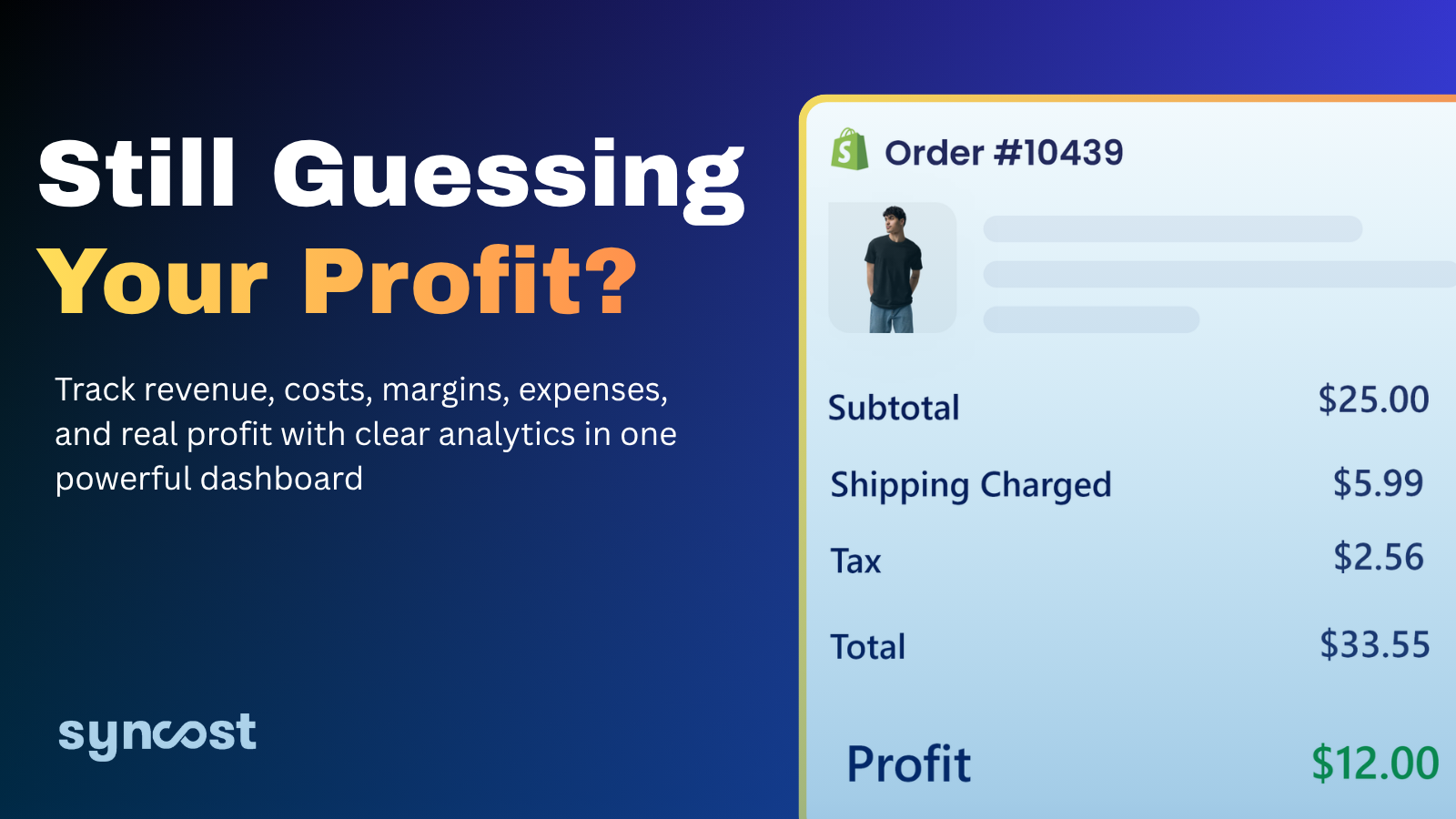
That's exactly what Syncost does for Shopify merchants — it pulls together your product costs, Shopify fees, shipping, and ad spend into one view on every order, so instead of guessing your net margin from a revenue dashboard, you see the real profit each sale generated. The right platform decision starts with knowing your actual cost structure. Syncost makes sure you always do.
Platform pricing, app costs, and developer rates reflect publicly available 2026 data. Actual costs vary significantly by store complexity, plugin selection, hosting provider, and payment gateway. Verify current pricing with each platform before making decisions.