Facebook Ads for Dropshipping: A Profit-First Playbook
A 3x ROAS means something completely different at 25% margin (losing money) versus 60% margin (profitable). This is the profit-first Facebook ads playbook for dropshippers — break-even ROAS calculation, minimum viable test budgets, campaign structure, creative frameworks, and the exact scaling rules that protect margin while you grow.

Facebook ads are how most dropshipping stores get their first sales — and how most of them lose their first $500 without understanding why. The mechanics of the platform aren't the problem. Running ads is straightforward. Running ads that generate profit is what most beginners miss, because the default way the platform measures success — ROAS — doesn't account for your costs.
This playbook is built around one principle: know your break-even point before you spend a dollar, and measure every campaign against it. Everything else — campaign structure, testing budgets, scaling rules — follows from that foundation.
Step 1 — Calculate Your Break-Even ROAS Before You Open Ads Manager
Break-even ROAS is the revenue return on ad spend at which your ad campaign earns exactly zero profit — not a loss, not a gain. Every ROAS above break-even is profit. Every ROAS below it is a loss, regardless of how healthy the number looks in isolation.
The formula is simple:
Break-even ROAS = 1 ÷ Gross margin %
On a product with a 40% gross margin: Break-even ROAS = 1 ÷ 0.40 = 2.5x
That means you need $2.50 in revenue for every $1 spent on ads just to cover your product costs and platform fees. Any ROAS below 2.5x on that product is a losing campaign. Any ROAS above 2.5x is profit — at the rate of (ROAS − break-even ROAS) × ad spend.
| Gross margin | Break-even ROAS | At 3x ROAS you keep... |
|---|---|---|
| 25% | 4.0x | Nothing — you're losing money |
| 35% | 2.86x | ~5% of ad spend as profit |
| 40% | 2.5x | ~17% of ad spend as profit |
| 50% | 2.0x | ~33% of ad spend as profit |
| 60% | 1.67x | ~44% of ad spend as profit |
The table shows why product selection and margin are the most important Facebook ads decisions you'll ever make — more important than creative, targeting, or campaign structure. A 3x ROAS means something completely different at 25% margin (losing money) versus 60% margin (highly profitable). Run this calculation on every product before you test it.
What Counts in Your Gross Margin
Gross margin for this calculation should include every cost except ad spend:
Gross margin = (Sell price − Supplier cost − Shipping − Payment fees) ÷ Sell price
On a $45 product with $12 supplier cost, $5 shipping, and $1.61 in Shopify payment fees (2.9% + 30¢):
Gross profit = $45 − $12 − $5 − $1.61 = $26.39 Gross margin = $26.39 ÷ $45 = 58.6% Break-even ROAS = 1 ÷ 0.586 = 1.71x
At 58.6% margin, this product can sustain a relatively modest ROAS and still be profitable — giving you more room to test, iterate, and scale than a low-margin product that requires 4x+ ROAS just to break even.
Step 2 — Structure Your Testing Campaign
Campaign Objective
Always use the Sales objective (Purchase conversion) for dropshipping. Traffic and Engagement campaigns find people who click — not people who buy. Purchase-optimised campaigns cost more per click but train the algorithm on buyers, not browsers. The difference in quality is significant.
Budget: What It Actually Takes to Learn
Meta's median ecommerce CPA in 2026 is $29.99. The platform needs approximately 50 conversion events per ad set to fully exit the learning phase — at a $25 target CPA, that means $1,250 in spend before the algorithm is truly optimised.
For most new dropshipping tests, you won't wait for full optimisation before making decisions. The practical testing framework:
Minimum viable test per product: $300–$500
- Below $300, you'll see too few conversions to distinguish signal from noise
- $300–$500 over 7–10 days produces enough data to make a go/no-go decision
Decision threshold (not optimisation threshold): 2–3 purchases
- If you've spent 2× your break-even CPA with zero purchases, kill the ad set
- If you have 2–3 purchases at or below break-even CPA, continue and gather more data
- If you have 2–3 purchases significantly above break-even CPA, kill and retest creative or product
Break-even CPA (the per-acquisition equivalent of break-even ROAS):
Break-even CPA = Sell price × Gross margin %
On the $45 product above: $45 × 0.586 = $26.37
If it costs you more than $26.37 to acquire a customer, that campaign is losing money at any ROAS it reports.
Campaign Structure for New Products
Keep it simple during testing. Complexity obscures signal.
1 campaign → 3–5 ad sets → 3 ads per ad set
- Each ad set tests one variable: different audience, different age range, or different placement
- Each ad within an ad set tests different creative: hook variation, format variation, or angle variation
- Budget: $20–$30/day per ad set minimum — below this, the algorithm doesn't receive enough impressions to learn
For audiences, start broad. In 2026, creative has become the primary targeting mechanism. A well-crafted hook that speaks directly to your ideal customer does more targeting work than interest stacks. Broad targeting (age + gender only, or one to two relevant interests) lets Meta find buyers; narrow targeting limits the pool before the algorithm can identify who converts.
The Advantage+ Alternative
Advantage+ Shopping Campaigns now represent 62% of ecommerce conversion spend on Meta and deliver 17% lower CPA than manual campaigns for brands meeting qualifying criteria: 30+ catalogue SKUs, 15+ active creatives, and established conversion history.
For new dropshipping products with no conversion history, run manual campaigns first. Once you have 30+ purchases on a pixel, test Advantage+ Shopping on your proven products. The algorithm's ability to find lookalikes and optimise placements is valuable once it has data — premature use of Advantage+ with insufficient history produces expensive, unoptimised delivery.
Step 3 — Creative That Converts Without a Large Budget
The Hook Is Everything
Creative fatigue signals include frequency above 3.5, CTR declining 25%+ from peak, and CPA rising despite consistent budget. Brands testing 20+ new creatives monthly achieve 65% higher ROAS than brands testing fewer than 10.
For a new dropshipping store with a limited creative budget, this doesn't mean producing 20 polished videos. It means testing 20 variations of hooks — the first three seconds of a video or the headline of a static ad — with simple, product-focused content that can be produced cheaply.
Hook types that work for dropshipping products:
- Problem-first: "If you've ever struggled with [problem]..." — identifies the customer before showing the solution
- Curiosity/pattern interrupt: Unexpected visual or statement that stops the scroll
- Social proof open: "50,000 people have already bought this — here's why..."
- Before/after: Show the problem state, then the product in use, then the outcome
Test the hook first. If CTR is below 1%, the hook isn't stopping the scroll — fix that before testing anything else. If CTR is strong (2%+) but conversion rate is weak, the issue is the landing page or the offer, not the ad.
Creative Formats by Cost and Performance
| Format | Production cost | Performance in 2026 |
|---|---|---|
| UGC-style video (selfie/unboxing) | Very low | Best for cold traffic — high authenticity |
| Static image with text overlay | Very low | Strong for retargeting and simple products |
| Carousel (3–5 product images) | Low | Good for multi-product or feature-heavy items |
| Professional product video | High | Useful once creative angle is validated |
Start with UGC-style video and static images. Produce professional creative only on creative angles that have already proven they convert at the hook level.
Step 4 — The Scaling Rules
Scaling a campaign that's profitable is how dropshipping stores generate real income. Scaling prematurely — before the unit economics are confirmed at the test budget — is how most stores spend their way into loss.
The Three Conditions for Scaling
Scale a campaign only when all three are true:
- CPA is below your break-even CPA over at least 7 days and at least 10 purchase events — not 2, not 5, not a single good day
- The trend is stable or improving — CPA not creeping upward as you've been running
- The creative hasn't fatigued — frequency below 3.5, CTR not declining significantly from peak
If any of these three are false, fix the problem before scaling budget. Scaling a fatiguing creative or a borderline CPA accelerates the problem, not the solution.
How to Scale Without Breaking What's Working
Budget increases should not exceed 20–30% per increase, spaced 3–5 days apart, to avoid triggering the learning phase and resetting algorithmic optimisation.
The 20% rule is the most important scaling constraint. A campaign running well at $50/day does not automatically run well at $150/day — the budget increase forces the algorithm into a new learning cycle where delivery efficiency temporarily drops. Aggressive budget increases are one of the most common reasons profitable campaigns become unprofitable overnight.
Scaling ladder for a profitable ad set:
| Stage | Daily budget | Condition to proceed |
|---|---|---|
| Test | $25–$50 | Break-even CPA confirmed over 7 days |
| Scale 1 | $60–$70 | CPA holds within 20% for 3–5 days |
| Scale 2 | $80–$100 | CPA holds within 20% for 3–5 days |
| Scale 3 | $120–$150 | CPA holds within 20% for 5–7 days |
| Horizontal scale | Duplicate ad set, new audience | When single ad set hits performance ceiling |
Horizontal scaling — duplicating the winning ad set with a new audience or creative variation — often outperforms vertical budget increases once you're past $100/day per ad set.
When to Kill a Scaling Campaign
A campaign that was profitable at $30/day won't necessarily stay profitable at $150/day. Watch for:
- CPA creeping above break-even CPA over 3+ consecutive days — pause and retest at lower budget
- Frequency above 3.5 — the audience is saturating; introduce new creative before continuing to scale
- CTR dropping 25%+ from peak — creative fatigue; pause the ad set and rotate in fresh creatives
The discipline to kill a scaling campaign that has crossed break-even CPA is what separates merchants who build profitable ad programmes from those who scale revenue while the margin disappears.
Step 5 — Know What Your Campaigns Are Actually Earning
Facebook Ads Manager shows you CPA — what Meta's attribution model thinks each conversion cost. It doesn't show you gross profit per conversion, contribution margin per order, or net profit after your supplier costs, Shopify fees, and shipping. A campaign with a $22 CPA against a break-even CPA of $26.37 looks profitable by the metric. But if your supplier raised prices last month and you haven't updated your cost model, your real break-even CPA is now $21.50 — and the same campaign is losing money.
This is the gap that lives between Facebook Ads Manager and your bank account, and it's where most scaling decisions go wrong. The CPA is a proxy for profitability. True profitability requires knowing, on each order, what you actually kept after every cost cleared.
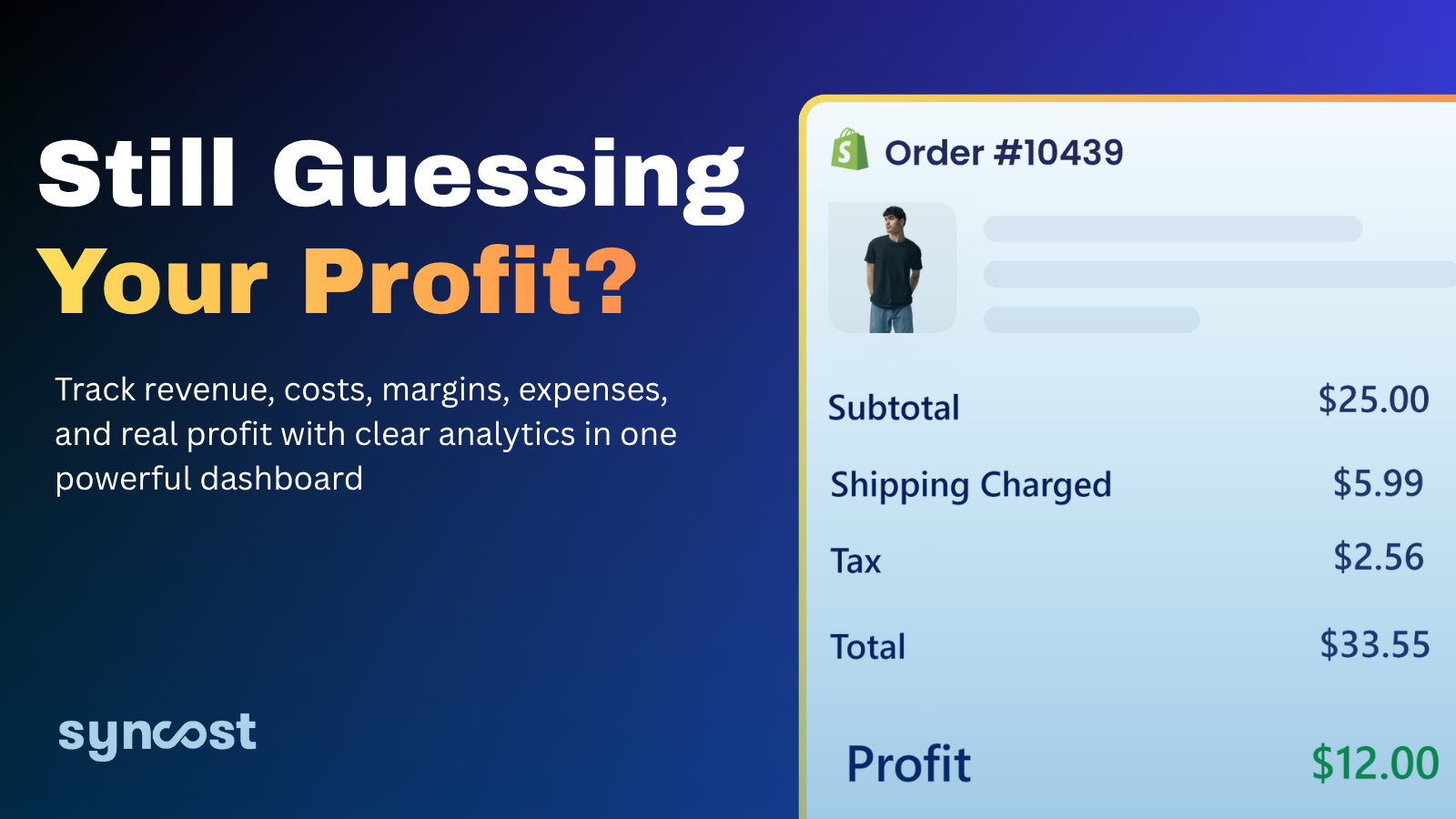
That's what Syncost shows Shopify merchants. It combines your real product costs, Shopify fees, and shipping with your actual Facebook ad spend to show true net profit per order — so the break-even ROAS you calculated in Step 1 is validated against real order data, not estimated against assumptions that may have drifted. When you scale, you scale on confirmed profit — not on a CPA that looks right but is measured against a cost model that hasn't been updated since last quarter.
Facebook/Meta ad benchmarks reflect published 2026 data. CPA, CPM, and ROAS figures vary by product category, creative quality, account history, and target market. All cost calculations should be verified against your specific product economics before making spend decisions.