Ecommerce Conversion Rate Optimization: The Profit-First Guide
A higher conversion rate only helps if the orders are profitable. Here's the profit-first CRO guide: seven tactics ranked by margin impact, not just conversion lift — checkout friction, page speed, and product pages before discounting — with 2026 benchmarks and the math that shows which improvements convert at full margin and which give it back.

A higher conversion rate is one of the most valuable things you can build into your store. Convert 3% of your visitors instead of 2%, and you've just grown revenue by 50% without spending an extra dollar on traffic. That arithmetic is why CRO gets talked about so often.
What gets talked about less: not every conversion is equally profitable. A CRO tactic that lifts conversion by adding an aggressive discount converts more visitors but at lower margin per order. A tactic that simplifies checkout converts more visitors at full margin. Both lift the conversion rate. Only one improves profit.
Shopify's data suggests that if you're above 3.2%, you're in the top 20% of stores. The gap between an average store and the top 20% is worth closing — but the way you close it determines whether the conversion lift translates into profit or just revenue. This guide ranks CRO tactics by their profit impact, not just their conversion lift, so you know which ones to prioritise first.
What Ecommerce Conversion Rate Actually Means
The global average ecommerce conversion rate in 2026 sits in a 1.4%–3.0% band. The spread comes from methodology differences, panel bias, and denominator choice rather than true contradiction.
More useful benchmarks break down by vertical:
| Category | Typical 2026 conversion rate |
|---|---|
| Food & beverage | 4.5–6.1% |
| Beauty & personal care | 3.5–4.9% |
| Fashion & apparel | 1.5–2.5% |
| Health & wellness | 1.0–2.0% |
| Electronics | 0.5–1.5% |
| Luxury goods | 0.9–1.5% |
Stores with AOV under $50 convert at 3–4%, while stores with AOV over $500 average 0.8–1.2%. Higher consideration cycles require different optimisation strategies.
Your conversion rate benchmark is your category and AOV tier — not the global 2.5% number. A luxury goods store converting at 1.4% may be outperforming its peers; a food and beverage store at the same rate is underperforming badly.
The other benchmark worth knowing: mobile accounts for 70% of all ecommerce traffic, yet mobile conversion rates still lag significantly at 1.8%–2.8% compared to desktop's 3.2%–3.9%. The mobile traffic/conversion gap is the most underutilised opportunity in most ecommerce stores — and the highest-ROI improvement available if your mobile experience is underperforming.
Why Conversion Rate and Profit Must Be Tracked Together
Before the tactics, the principle that makes this guide different from every other CRO list.
A conversion is a sale. A profitable conversion is a sale that earns more than it costs. The distinction matters because some CRO tactics generate both; others generate the first without the second.
A 15% discount that raises your conversion rate from 2% to 2.8% is a 40% conversion lift. On a $50 product with 50% gross margin, the pre-discount order earns $25 gross profit. The discounted order earns $17.50 — the cost stays at $25, but revenue drops to $42.50. You're converting 40% more visitors and earning 30% less per conversion. Whether that's a net profit win depends on where those extra conversions came from: if paid traffic drove them, the discount may not have covered the CAC. If organic traffic drove them, the margin compression still reduces the profit benefit significantly.
A store invests $8,000 in a checkout redesign. Conversion rate improves from 2.1% to 2.8% on 50,000 monthly sessions at $85 AOV. That's roughly 350 additional orders per month, around $29,750 in additional monthly revenue before costs and refunds. That checkout redesign has no margin impact — the extra orders come at full margin. It's a pure profit win.
The question to ask before any CRO investment: does this tactic convert more visitors at the same margin, or does it convert more visitors by reducing margin?
The CRO Tactics, Ranked by Profit Impact
1. Fix Checkout Friction — Highest Profit Impact
Why it's first: Checkout optimisation converts visitors who were already committed to buying. No discount required. No product margin touched. It's the purest profit-positive CRO available.
Cart abandonment is stable at 70.19% globally. Roughly 48% of cart abandonment is caused by unexpected costs at checkout — the single most common reason visitors who reached the cart didn't complete the purchase.
The highest-impact checkout fixes:
Show total cost before the final step. Unexpected shipping or tax at the last checkout screen causes abandonment more than any other single factor. Show estimated shipping on the product page or cart. If you offer free shipping above a threshold, display it everywhere.
Enable guest checkout. Forced account creation is the second most common checkout abandonment reason. Shopify enables guest checkout by default — if yours is disabled, it's one setting change with an immediate conversion impact.
Add accelerated payment options. Shop Pay, Apple Pay, and Google Pay replace the entire checkout form with a single tap for customers who have these set up. Mobile now accounts for 70% of all ecommerce traffic, yet mobile conversion rates still lag significantly. Accelerated checkout options are the fastest way to close this gap because they eliminate the mobile keyboard form-filling friction that kills mobile conversion.
Reduce form fields. Simplify checkout flow to 7 or fewer form fields. Every field you remove is friction removed. Address autocomplete, hiding fields until they're needed, and auto-formatting (phone numbers, card numbers) all reduce abandonment without reducing the information you need.
Profit impact: Every abandoned checkout you recover through friction removal converts at full product margin. No discount, no CAC. The best CRO investment in the stack.
2. Page Speed Optimisation — High Profit Impact
Why it matters: Page speed is the highest-ROI technical lever in CRO. The data cites +8.4% retail conversion lift from a 0.1-second mobile speed improvement, around -7% conversions from a 1-second delay.
Speed improvements convert more visitors at full margin — and they also improve SEO rankings, which can reduce CAC on organic traffic. It's the rare CRO investment with double-stacked returns.
Target benchmarks for 2026: Largest Contentful Paint under 2.5 seconds, Interaction to Next Paint under 200ms, and Cumulative Layout Shift under 0.1.
Practical speed improvements for Shopify stores: compress and lazy-load images, reduce third-party app scripts, enable Shopify's native CDN, and use a lightweight theme. For stores on heavy themes with 10+ installed apps, a speed audit often reveals 3–6 seconds of page load time recoverable through script optimisation.
Profit impact: Converts additional visitors at full margin. Also improves organic ranking, reducing paid traffic dependency over time — a compound profit benefit.
3. Product Page Quality — High Profit Impact
Why it matters: The product page is where purchase decisions are made or abandoned. A visitor who reaches the product page but doesn't add to cart is a conversion you lost without any checkout involvement. Improving product page conversion is upstream of checkout — every additional add-to-cart at this stage flows through the entire subsequent funnel.
High-impact product page improvements:
Product images: Multiple angles, lifestyle context, and zoom capability. For fashion and beauty, model shots across size ranges. For home goods, in-situ styling shots. Poor product imagery is the leading cause of "I couldn't tell if it was right for me" abandonment.
Product descriptions that answer purchase objections: The most common objections are "will it fit?", "what's it made of?", "how long will it take?" and "what if it doesn't work?". Descriptions that answer these four questions reduce uncertainty — and uncertainty is what stops committed visitors from adding to cart.
Social proof above the fold: Star rating and review count visible immediately, without scrolling. Trust signals are among the highest-ROI CRO investments alongside page speed and checkout simplification. A product page with 200 reviews and a visible 4.8-star rating converts meaningfully better than the same product with no reviews — across every category studied.
Profit impact: Converts at full margin. Improving product page conversion is equivalent to acquiring more high-intent traffic — the visitors arriving are already in buying mode.
4. Trust Signals — Medium-High Profit Impact
Why it matters: First-time visitors to an unfamiliar store face a trust deficit. They don't know whether your products are quality, whether your shipping is reliable, or whether a return will be honoured. Trust signals reduce this uncertainty without requiring a price concession.
High-impact trust elements: SSL badge and secure payment icons at checkout, clear and visible return policy ("free returns within 30 days" in the cart), real customer reviews with dates, press mentions or social proof ("as seen in X"), and a recognisable phone number or live chat that demonstrates a real business exists behind the store.
What to avoid: Generic trust badges ("100% Satisfaction Guaranteed") that visitors have learned to ignore, and manufactured urgency ("Only 3 left!" when you have 300 in stock) that trains customers not to trust your store.
Profit impact: Converts at full margin. Trust signal improvements tend to particularly improve conversion on mobile cold traffic — the lowest-converting, highest-volume segment — which makes their profit impact disproportionately large.
5. Email and SMS Capture Optimisation — Medium Profit Impact
Why it matters: A visitor who doesn't convert today but joins your email list has near-zero CAC on future conversions. Improving list signup rate converts a percentage of non-purchasing traffic into a high-value future asset. Every subscriber who eventually buys represents a sale at effectively zero customer acquisition cost.
The standard signup incentive is a 10–15% discount on the first order. The margin cost of the discount is real — but spread across all subscribers who eventually purchase (not all will), the discount cost per converting subscriber is often lower than the CAC from paid channels.
Higher-margin capture alternatives: early access to new products, a free buying guide or sizing tool, free shipping on first order (which may cost less than a percentage discount depending on your shipping economics), or entry into a prize draw.
Profit impact: Medium per-signup. High over time as subscribers convert at near-zero CAC. The profit multiplier on email capture improvement grows with your store's age and email programme maturity.
6. Personalisation and Product Recommendations — Medium Profit Impact
Why it matters: A visitor who sees the products most relevant to their session behaviour is more likely to convert than one who sees your default catalog sort. Product recommendation engines, "recently viewed," and "frequently bought together" all reduce discovery friction.
Across 30+ Shopify Plus A/B tests, the biggest wins rarely come from cosmetic changes like button colours or font sizes — they come from experience relevance and funnel friction reduction.
What to prioritise: Recommendations on product pages for cross-sell, dynamic collection sorting that surfaces highest-converting products, and personalisation on the homepage for returning visitors. Start with the highest-traffic pages.
Profit impact: Medium. Rarely degrades margin (no discount required) but requires more upfront implementation cost than the tactics above.
7. Conversion-Based Discounting — Low Profit Impact
Why it last: Discounts convert visitors. They also reduce margin on every conversion, including conversions that would have happened anyway at full price. The net profit impact depends heavily on what proportion of discount-driven conversions were incremental (visitors who wouldn't have purchased without the discount) versus cannibalistic (visitors who would have bought at full price).
Exit-intent popups offering 10% off, sitewide promotional banners, and urgency-based discount emails all lift conversion rate. They also train customers to expect discounts, reduce perceived price anchors, and compress margin on your highest-intent customers.
When discounting for CRO makes sense: on the abandoned cart Email 3 (where visitors have already demonstrated high intent and still didn't convert — a discount as a closing mechanism is rational), for first-time subscribers as an acquisition cost, and for specific products where price sensitivity is genuinely the conversion barrier.
When to avoid it: sitewide, as a default conversion lever, in exchange for email signups (when non-discount alternatives are available), or on your highest-margin products.
Profit impact: Low-to-negative per order. High conversion lift. Use last, after all friction-based improvements have been made.
The CRO Priority Order for Profit
| Tactic | Conversion lift | Margin impact | Profit priority |
|---|---|---|---|
| Fix checkout friction | High | None (full margin) | #1 |
| Page speed (mobile) | High | None (full margin) | #2 |
| Product page quality | Medium-High | None (full margin) | #3 |
| Trust signals | Medium | None (full margin) | #4 |
| Email capture | Low-Medium | Small (incentive cost) | #5 |
| Personalisation | Medium | None | #6 |
| Conversion-based discounts | High | Negative | #7 |
The pattern: every tactic above discounting converts additional visitors at full margin. Discounting converts additional visitors at reduced margin. The profit-first order is to exhaust the full-margin tactics before reaching for a discount as a conversion lever.
A Higher Conversion Rate Only Helps If the Orders Are Profitable
The conversion rate in your Shopify analytics is the percentage of sessions that became orders. It doesn't tell you the gross profit on those orders, whether ad-attributed conversions cleared their CAC, or whether the discount that drove last month's conversion spike eroded your margin. A CRO programme that measures only conversion rate can optimise toward a metric that obscures whether the resulting orders are actually good for the business.
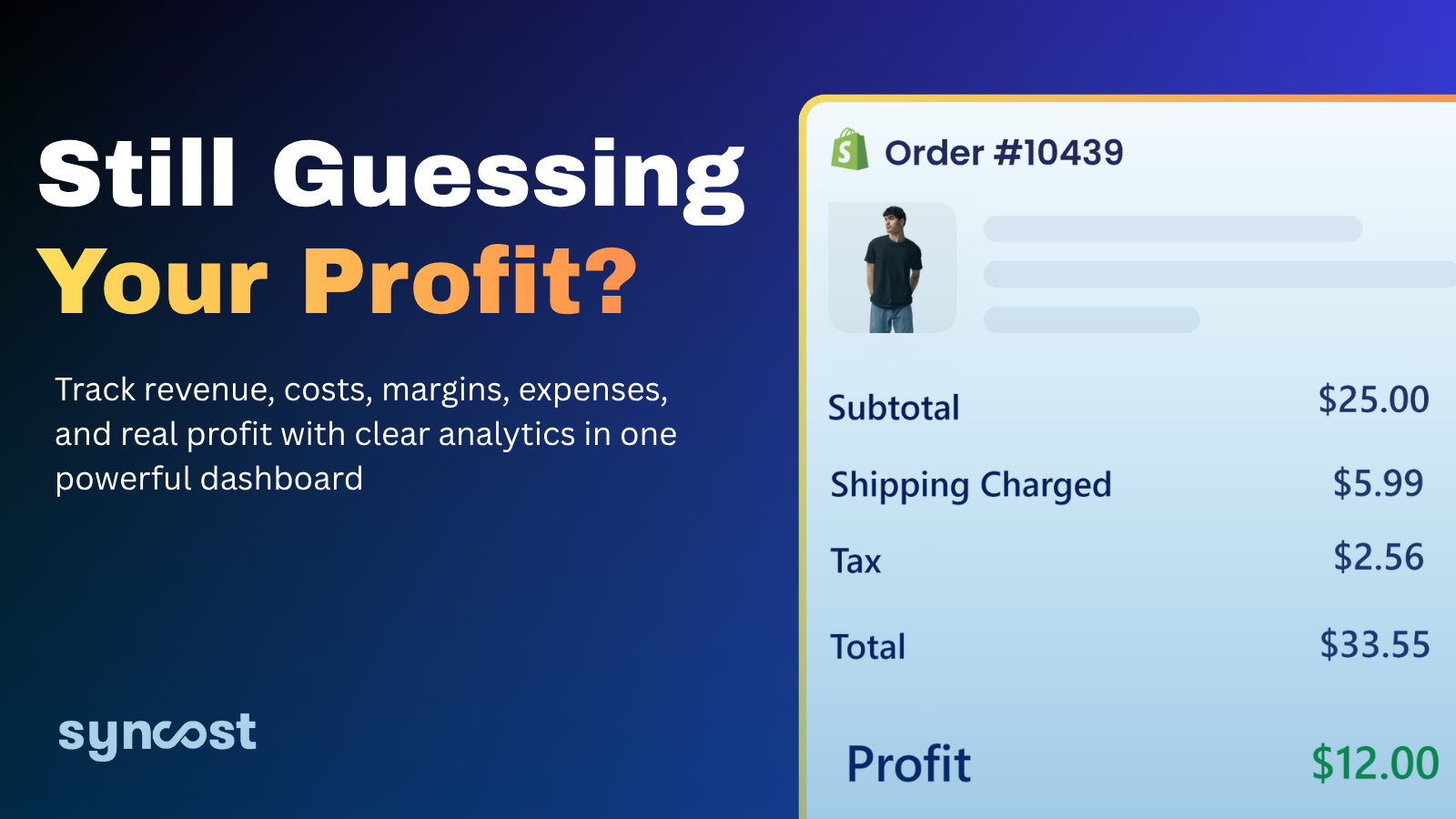
That's the gap Syncost closes for Shopify merchants. It shows true net profit per order — so when a checkout optimisation lifts your conversion rate from 2.1% to 2.8%, you can see in the order data whether those additional 350 monthly conversions came at full margin (checkout friction removal) or at reduced margin (discount-driven). CRO that improves conversion at full margin is a compound business asset. CRO that improves conversion by giving away margin is a different calculation — and Syncost is what shows you which one you've built.
Conversion rate benchmarks reflect 2026 data from Littledata, Dynamic Yield, IRP Commerce, and Blend Commerce/Shopify research. Benchmarks vary by methodology and should be compared against sources using consistent definitions. Verify your own baseline before setting targets.