Hi

Revenue is up. Orders are strong. The Shopify dashboard looks exactly the way you want it to look. And yet, at the end of the month, the bank account doesn't reflect any of it. The money that should be there is not — or not as much of it as the numbers suggested.
This is not bad luck. It is a measurement problem.
The number most Shopify merchants track — revenue — is not the number that determines whether a business is healthy. Revenue is what customers paid you. Profit is what you kept after every cost was subtracted. The gap between those two numbers is where most ecommerce stores either win or quietly lose. And it is a gap that Shopify's native analytics was never designed to close.
Syncost was built specifically to close it.
What Syncost Does
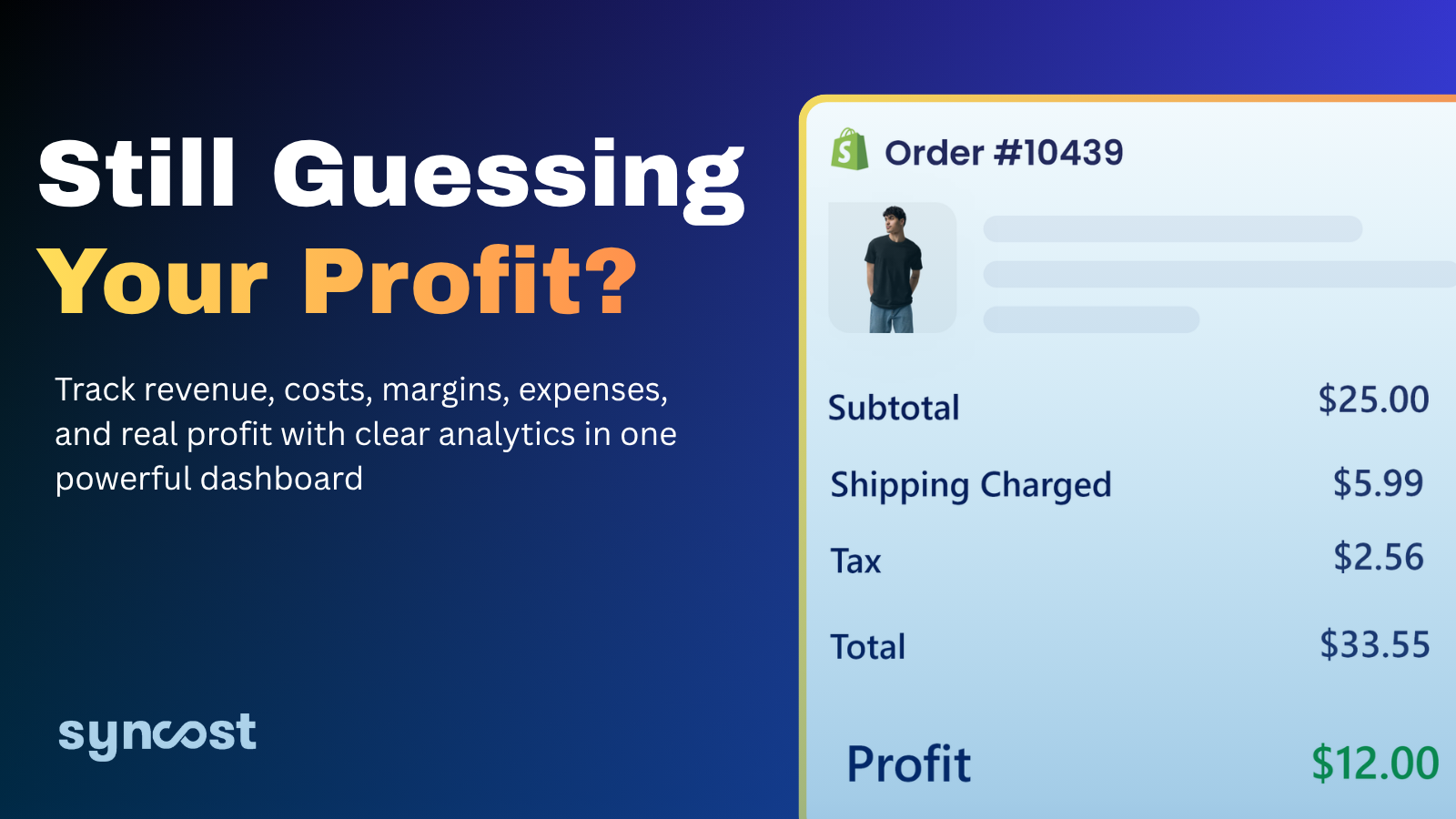
Syncost is a profit analytics and financial tracking platform designed for Shopify merchants. It consolidates data from multiple sources into a centralised dashboard to provide a real-time view of business performance. By connecting marketing platforms and supply chain costs, it calculates net profit and margins at both the store and individual order levels.
In plain language: Syncost connects the six systems your costs are hiding in — Shopify, Meta and Google ad platforms, POD providers (Printify, Printful, Gelato), carrier accounts, and app billing — and shows you what every order actually earned after every cost has been deducted.
Not gross revenue. Not estimated gross margin. Real net profit, per order, in real time.
The Problem Syncost Solves
Shopify's analytics dashboard is excellent at what it does. Sessions, conversion rates, top products by revenue, traffic sources — all of it is accurate and updated in real time. But it was built to answer questions about customer behaviour, not business profitability.
The costs that determine whether any given sale was actually profitable live in different places:
- Product cost (COGS) → supplier invoices and POD platform charges
- Payment processing fees → Shopify Payments payout reports
- Outbound shipping → carrier accounts and 3PL invoices
- Advertising spend → Meta Ads Manager, Google Ads, TikTok
- App subscriptions → individual billing emails
- Chargebacks and dispute fees → Shopify payout deductions
No single screen in any of these systems shows you what one order actually earned. The merchant who knows they are making $11.40 per order on Product A and $3.20 per order on Product B — after every cost — makes a different inventory and marketing decision than the merchant who sees $45 revenue on Product A and $38 revenue on Product B and assumes A is more profitable.
That gap, compounded across a year of business decisions, is the difference between a store that scales profitably and one that scales revenue while margin quietly compresses.
How This Connects to What Zipchat Does
If you use Zipchat to convert more visitors and handle more support tickets autonomously, you are already investing in revenue efficiency. Zipchat achieves a 16.3% chat-to-conversion average — meaning customers who engage with the AI chatbot convert at significantly higher rates than those who don't.
But here is the question that follows every conversion Zipchat drives: was that order profitable?
A sale recovered by an abandoned-cart chat at midnight is a win. Whether it was a profitable win depends on the product's margin, the shipping cost to that customer, the processing fee on the transaction, and whatever advertising spend brought that customer to the store in the first place. Zipchat shows you that the conversion happened. Syncost shows you what it was worth.
The two tools answer different questions. Together, they answer the complete one.
| Tool | The question it answers |
|---|---|
| Zipchat | Are we converting the visitors we have? |
| Syncost | Are those conversions actually profitable? |
What Syncost Tracks Per Order
When an order comes in, Syncost automatically pulls and combines:
Product cost — for POD merchants, it pulls production costs directly from Printify, Printful, and Gelato. For inventory stores, it uses the cost fields you set and flags when supplier invoices suggest they may be outdated.
Shopify payment fees — the actual per-transaction fee, including the premium card and international card surcharges that differ from the headline plan rate.
Outbound shipping — what you paid to fulfil the order, not what you charged the customer.
Ad spend — attributed to the order from your connected ad platforms, so contribution margin (gross profit minus customer acquisition cost) is visible at the order level.
Returns and chargebacks — including the $15 dispute fee on Shopify Payments that most merchants miss when it lands as a payout deduction rather than an itemised expense.
The result is a per-order profit figure that reflects reality rather than the estimate Shopify's dashboard implies.
A Concrete Example
Take a print-on-demand store selling a Bella + Canvas t-shirt at $29.99. Here is what the order looks like in Shopify's dashboard versus what it looks like in Syncost:
| Line item | Shopify shows | Syncost shows |
|---|---|---|
| Sale price | $29.99 | $29.99 |
| Printful base cost | — | −$12.50 |
| Outbound shipping | — | −$3.99 |
| Payment processing fee | — | −$1.17 |
| Shopify subscription (÷ orders) | — | −$0.15 |
| Meta ad spend attributed | — | −$10.00 |
| Shown as | $29.99 revenue | $2.18 net profit |
The Shopify dashboard shows a $29.99 sale. Syncost shows a $2.18 profit. Neither number is wrong — they are measuring different things. But only one of them tells you whether scaling that product on paid traffic makes sense. (In this case, it barely does — a $1 rise in Meta CPCs would turn it into a loss.)
This is the information Syncost makes visible. And for a Shopify store in 2026 — where ad costs have risen 20–40% in two years and margins are tighter across every category — it is not optional intelligence. It is the foundation of every pricing, sourcing, and advertising decision you make.
Who Syncost Is Built For
Syncost is designed for Shopify merchants across three business models:
Print-on-demand stores — Syncost pulls production costs directly from Printify, Printful, and Gelato, eliminating the spreadsheet reconciliation that POD merchants otherwise do monthly to understand their real margin. If you are building a POD brand alongside an AI chatbot that converts visitors into buyers, Syncost tells you whether those buyers are profitable.
Dropshipping stores — supplier cost, shipping, and ad spend are the three variables that determine whether a dropshipping campaign makes money. Syncost tracks all three at the order level, so you can see which products and which campaigns are margin-positive and which ones only look good on a ROAS dashboard.
DTC inventory stores — with multiple SKUs, multiple channels, and multiple fulfilment methods, per-order margin becomes impossible to track manually at any meaningful scale. Syncost automates the calculation and surfaces it in real time, so the decisions about which products to restock, promote, and price for are made on actual margin data rather than estimated gross profit.
Key Features
Real-time profit dashboard — every order shows net profit as it comes in, not at month-end after a manual reconciliation.
Per-product margin view — rank your products by net profit, not revenue. The bestseller by sales volume is often not the most profitable product in the catalog.
Ad spend attribution — connect Meta, Google, and TikTok to see contribution margin (gross profit minus CAC) on every order, so ROAS gives way to the metric that actually matters.
POD platform integration — direct connection to Printify, Printful, and Gelato pulls production costs per order automatically, including plan discounts.
Automated cost sync — no more updating spreadsheets when supplier costs change. Syncost pulls current costs from connected platforms and flags when your cost fields may be out of date.
Free trial available — you can test Syncost against your own store data before committing to a paid plan.
Getting Started
Homepage: syncost.com
Shopify App Store: Install Syncost on Shopify
Syncost blog — if you want to understand the concepts behind what Syncost measures before installing, the Syncost blog covers unit economics, P&L structure, and profit margin in plain English for Shopify merchants:
- Why Every Shopify Store Needs a Profit Analytics App — the case for profit tracking in 2026
- Shopify Analytics: What It Shows You (and the Profit Data It Hides) — exactly what Shopify's dashboard misses and why it matters
- How to Build a Real P&L Report for Your Shopify Store — the step-by-step guide to assembling a real profit and loss statement
The Connection Between Conversion and Profit
Zipchat's mission is to convert more of the visitors your store already has — turning browsers into buyers through AI conversations that answer questions, handle objections, recover abandoned carts, and guide customers to checkout at any hour, in any language. If you are not familiar with how Zipchat works, the AI chatbot for Shopify complete guide covers the full picture.
But a converted visitor is only half the story. The other half is whether that conversion generated real profit for the business.
This is the blind spot most merchants carry: they optimise hard for conversion rate and traffic, then discover that scaling either one didn't improve profitability as much as expected — because the per-order economics were never right in the first place.
Zipchat and Syncost close both halves. Zipchat handles the conversion. Syncost handles the accounting. Together they give Shopify merchants the complete picture that neither platform can provide alone: not just how many customers you won, but what each one was actually worth.
For more on building a profitable Shopify store alongside smart customer engagement tools, see:
- Post-purchase upsell strategies for Shopify — how to increase order value from customers Zipchat just converted
- Ecommerce customer service best practices 2026 — the operational framework for AI-first support
- AI product recommendation apps for Shopify — the tools that surface the right products to the right buyers
- WhatsApp marketing for ecommerce — recovering carts and driving repeat revenue through the channel your customers already use
Auther: Muaddh
The founder of Syncost