What Is a Chargeback? A Merchant's Guide to How They Work (and What They Cost You)
A chargeback isn't just a lost sale — it's a $45 order that quietly costs you $93. This is the merchant-side guide to how chargebacks actually work: the full lifecycle, every hidden cost (fee, product, shipping, ad spend), the card network thresholds that put your account at risk, and how to prevent the disputes that are winnable.
Most articles about chargebacks are written for cardholders. They explain how to dispute a charge, what rights you have as a consumer, and how long the process takes. That's useful if you're a shopper. If you're a merchant, it's the wrong side of the transaction entirely.
From the seller's side, a chargeback isn't a customer service issue — it's a profit event. A single dispute triggers a chain of costs that most merchants never fully account for: the refund itself, a platform fee on top of it, the product that already shipped, the shipping you paid, and the ad spend you invested to win that customer in the first place. By the time a chargeback resolves, what looked like a $40 sale has often cost you $60–$80 in total losses.
This guide explains how chargebacks work from the merchant's side — the lifecycle, the fees, the real cost of every dispute — and how to quantify the profit leak most sellers never measure.
What Is a Chargeback?
A chargeback is a forced reversal of a payment transaction, initiated by a cardholder through their bank or card issuer rather than through you as the merchant. Unlike a standard refund — where a customer contacts you directly and you issue the return — a chargeback bypasses you entirely. The cardholder calls their bank, disputes the charge, and the bank takes the money back from your account while the dispute is investigated.
The chargeback system was designed in the 1970s to protect consumers from fraudulent merchants and billing errors. In the modern ecommerce context, it's also widely used — and frequently misused — for situations that have nothing to do with fraud, from buyer's remorse to a package the customer forgot they ordered.
Chargebacks vs. Refunds: The Critical Difference
A refund is voluntary. You decide to return money to a customer, you process it through your payment gateway, and the transaction is settled. You lose the revenue but control the process.
A chargeback is involuntary. The bank initiates it, freezes the funds immediately, and you're on the defensive from the moment it's filed. You can dispute it and win — but even when you do, you've spent time, documentation, and energy to recover money that was already yours.
That distinction matters because chargebacks carry consequences refunds don't: platform dispute fees, potential damage to your merchant account standing, and the risk of being placed on industry watchlists if your chargeback rate climbs too high.
The Chargeback Lifecycle: What Actually Happens
Understanding the process step by step is the foundation of managing it. Here's the full lifecycle from the moment a customer decides to dispute a charge.
Step 1 — The Customer Contacts Their Bank
The cardholder calls, messages, or logs into their bank and initiates a dispute. They provide a reason — "I didn't receive this item," "I don't recognise this charge," "the product wasn't as described" — and the bank records it against a standardised reason code.
You may have no idea this is happening yet. Banks don't notify merchants in real time.
Step 2 — The Bank Issues a Provisional Credit
While the dispute is open, the bank typically issues a provisional credit to the cardholder — they get their money back immediately, before any investigation concludes. The bank then debits your merchant account for the disputed amount.
This is the moment the chargeback fee is triggered on platforms like Shopify Payments. The $15 chargeback fee (for US merchants) is deducted from your next payout at the same time as the disputed transaction amount.
Step 3 — You Receive a Chargeback Notification
Your payment processor notifies you of the dispute, usually via email and in your dashboard. You're given a response window — typically 7–21 days depending on the card network — to submit evidence if you want to contest it.
If you do nothing, the chargeback is automatically decided in the customer's favour. The provisional credit becomes permanent, and you lose both the revenue and the chargeback fee.
Step 4 — You Submit Evidence (or Accept the Loss)
If you choose to contest the chargeback, you compile and submit a response package: proof of delivery, order confirmation, communication records, your shipping and return policy, photos of the product if relevant. The strength of your evidence and the reason code determine your likelihood of winning.
Some chargebacks are essentially unwinnable — especially those coded as "card not present" fraud, where a customer claims their card was used without their authorisation. Others — "item not received" disputes with delivery confirmation — are more winnable with the right documentation.
Step 5 — The Bank Decides
The issuing bank reviews your evidence and makes a decision: uphold the chargeback (you lose) or reverse it (you win). The process takes 30–120 days depending on the card network and the complexity of the dispute.
If you win, the disputed amount is returned to your account — but the chargeback fee is typically not refunded unless you're on a platform with specific protection policies. If you lose, the reversal stands and all costs are permanent.
Step 6 — Arbitration (Rare, but Expensive)
Some disputes escalate beyond the initial decision to arbitration. This is rare but costly — fees of $250–$500 or more make it uneconomical to contest low-value orders even when you're clearly in the right.
What a Chargeback Actually Costs You
Here's where most merchant guides stop at "you lose the sale amount." The real cost is significantly higher, and understanding every component is essential for knowing how much chargebacks are actually costing your business.
Let's take a $45 order — a standard ecommerce transaction — and run the full cost of a lost chargeback:
| Cost component | Amount | Notes |
|---|---|---|
| Revenue lost (refunded) | $45.00 | The disputed sale amount |
| Chargeback fee (Shopify Payments, US) | $15.00 | Deducted at dispute initiation |
| Product cost (COGS) | $14.00 | Already manufactured or purchased |
| Shipping cost | $5.50 | Already paid, non-recoverable |
| Payment processing fee (non-refunded) | $1.61 | 2.9% + 30¢, typically not returned |
| Customer acquisition cost | $12.00 | Ad spend used to win this customer |
| Total true cost of one chargeback | $93.11 | |
| Net loss beyond face value | $48.11 | What you lose above the $45 sale |
A $45 order that gets charged back doesn't cost you $45. It costs you $93. You lose the revenue, you pay a fee on top, you've already spent money making and shipping a product the customer keeps, and you've wasted the marketing spend it took to acquire them in the first place.
At a 2% chargeback rate on 300 monthly orders at $45 average order value, that's 6 chargebacks a month — a $558 monthly loss that shows nowhere in your revenue dashboard.
The Processing Fee That Doesn't Come Back
Most merchants assume that when a chargeback reverses a sale, the processing fee is refunded too. It usually isn't. The 2.9% + 30¢ Shopify Payments charged when the customer originally paid is typically non-recoverable once a chargeback is filed, regardless of outcome. You paid to process a payment you no longer received.
The Chargeback Fee Is Just the Starting Point
The $15 Shopify Payments dispute fee is the most visible chargeback cost — but as the table above shows, it's not the largest one. The product you shipped, the customer acquisition cost, and the processing fee you can't recover together dwarf the platform fee on most transactions. The $15 is the line item merchants notice; the other $33 in hidden costs is what actually determines how damaging chargebacks are to your margin.
Why Chargeback Rates Matter Beyond Individual Orders
A single chargeback is a cost. A pattern of chargebacks is an existential risk to your merchant account.
Chargeback Rate Thresholds
Card networks set chargeback rate thresholds that trigger monitoring programs and account reviews:
| Card network | Standard threshold | High-risk threshold |
|---|---|---|
| Visa | 0.65% | 0.90% |
| Mastercard | 1.0% | 1.5% |
Breach the standard threshold and you enter a monitoring program — typically 3–6 months of additional oversight, fees, and required remediation. Breach the high-risk threshold and you risk account termination: losing the ability to process card payments entirely, which for most ecommerce stores is effectively a business closure.
Merchants placed on industry watchlists (Visa MATCH, Mastercard MATCH) can find it difficult to open new merchant accounts for up to five years.
Your Chargeback Rate Is Calculated Monthly
Chargeback rate = chargebacks in a month ÷ transactions in that month
At 500 monthly transactions, you can sustain roughly 3 chargebacks before hitting Visa's standard threshold. That's not a large margin for error — a single bad supplier batch, a shipping delay that triggers a wave of "item not received" disputes, or a viral promotion that attracts fraudulent orders can push you over the line in one month.
Common Chargeback Reasons — and Which Ones Are Winnable
Not all disputes are created equal. Understanding reason codes helps you know where to invest documentation effort and where to accept the loss.
Winnable Disputes
Item not received — winnable with delivery confirmation (carrier tracking showing delivered). Submit tracking, order confirmation, and your shipping policy. Item not as described — winnable if your listing is accurate and detailed. Weak product descriptions are a liability. Duplicate charge — straightforward with clean transaction records.
Difficult Disputes
Fraud / card not present — the hardest to win. You can prove someone with the card details made the purchase, but not that the actual cardholder did. AVS matching and 3D Secure reduce these but don't eliminate them. Subscription not cancelled — winnable with clear cancellation records and visible terms, but frequently disputed by customers who claim they couldn't find the cancellation option.
How to Reduce Chargebacks
Prevention is far cheaper than dispute management. Three areas drive most preventable chargebacks.
Recognisable Billing Descriptors
A significant portion of "I don't recognise this charge" disputes happen because the merchant name on the bank statement doesn't match the store name the customer remembers. If your store is called "NightOwl Designs" but your billing descriptor shows "NiteOwl LLC Digital," customers file disputes rather than searching their email. Set your billing descriptor to match your store name exactly.
Proactive Shipping Communication
Most "item not received" disputes are impatience, not fraud. A shipping confirmation with tracking, a day-before delivery notification, and a delivery confirmation email eliminate most of these before they become formal disputes. Set these up and automate them — they cost nothing to send and prevent the most common chargeback reason.
Clear Product Descriptions and Return Policies
"Not as described" chargebacks are almost always a listing problem. Accurate photos, honest size guides, clear material descriptions, and a visible, fair return policy reduce both the dispute rate and the sympathy the card network has for the customer's claim.
Fraud Screening
AVS (Address Verification System) matching, CVV requirements, 3D Secure authentication, and velocity checks (flagging multiple orders from the same IP or device) intercept fraudulent transactions before they ship. Shopify Payments includes Shopify Protect for eligible orders, which covers both the dispute amount and the chargeback fee for qualifying fraud cases — the most direct financial protection available within the platform.
The Hidden Profit Leak Most Sellers Never Quantify
The insidious thing about chargebacks is that their true cost never appears in a single line on any dashboard. The disputed amount shows as a refund. The platform fee shows as a separate deduction. The product cost was recorded weeks earlier when you ordered inventory. The shipping was paid through a different account. The ad spend was a Facebook invoice last month. No screen in Shopify, no standard report, shows you what any given chargeback actually cost you — so most merchants underestimate the damage and underinvest in prevention.
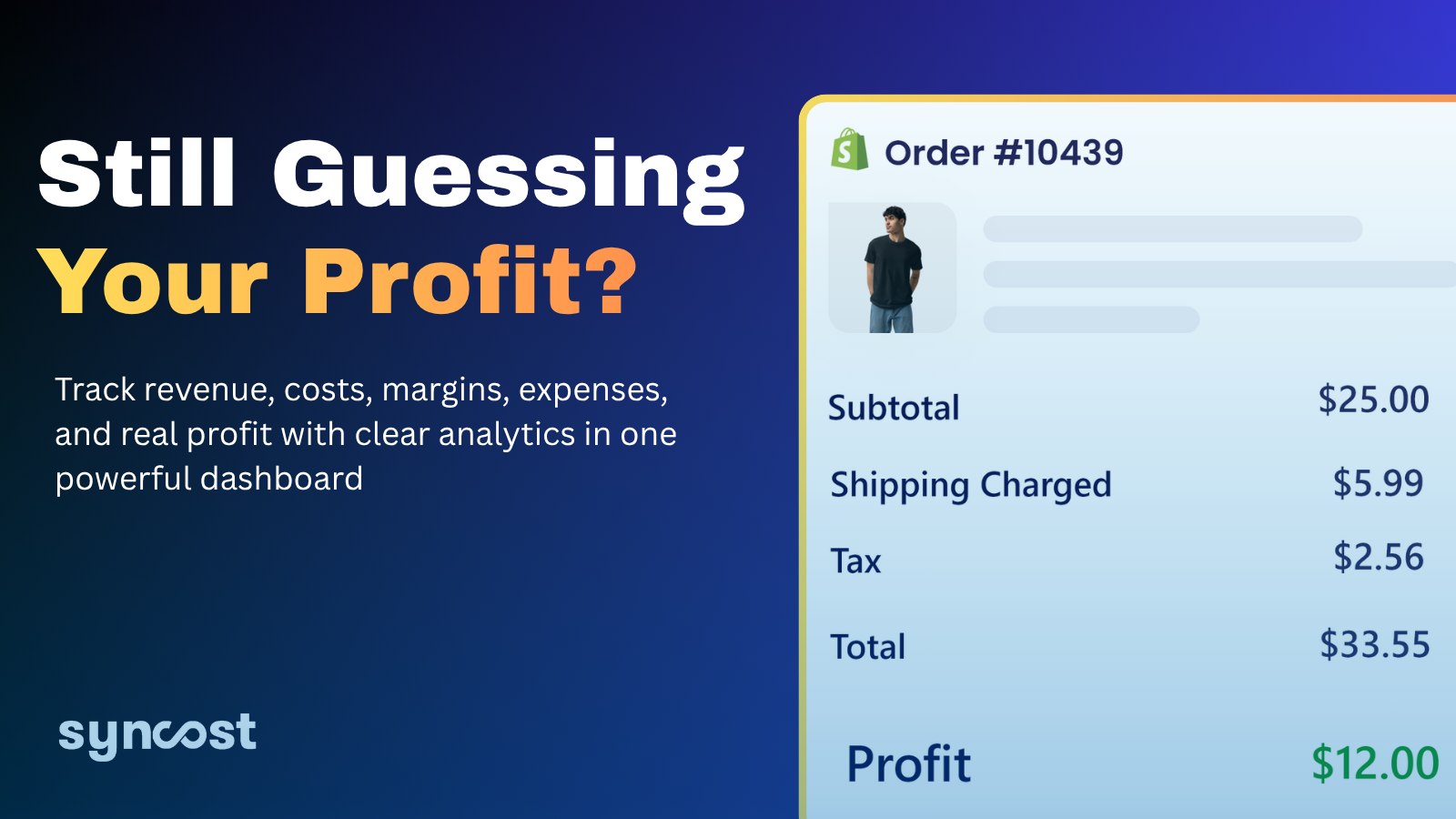
That's exactly the blind spot Syncost closes for Shopify merchants. It brings together your product costs, shipping, Shopify fees, and ad spend into one view, so every order — including disputed ones — shows its real net impact on your profit. When chargebacks are costing you $93 per incident instead of the $45 you're mentally tracking, Syncost is the tool that surfaces the real number. Quantify your chargeback loss accurately, and preventing it becomes an easy business decision instead of a vague operational priority.
Chargeback fees, timelines, and card network thresholds reflect publicly available 2026 information. Specific fees and policies vary by payment processor, card network, and merchant agreement. Verify current terms with your payment provider.