The Chaos of Scaling: Why Multiple Storefronts and App Bloat Are Destroying Your Margins
Scaling from one Shopify store to a multi-brand empire sounds great until the hidden costs compound. Discover how app bloat, cross-platform ad spend, and invisible refund losses are quietly eating your true net profit.

There is a dangerous myth in the e-commerce space that scaling your business simply means launching more stores, running more TikTok ads, and watching the revenue multiply.
The reality? Scaling without surgical profit tracking doesn't multiply your success—it multiplies your operational chaos.
If you are expanding into multiple storefronts, testing new niches, or running a high-volume Print-on-Demand operation, you are no longer just fighting for sales. You are fighting against a massive, tangled web of hidden fees, software bloat, and decentralized data that is secretly draining your bank account.
Here is the brutal truth about what actually happens to your margins when you scale, and why relying on default dashboards across multiple stores is a guaranteed way to lose money.
The Multi-Storefront Margin Nightmare
Running two, three, or four different Shopify storefronts is a great way to dominate multiple niches. It is also a logistical nightmare for your accounting.
Let’s say you have one store selling custom apparel and another testing a new Print-on-Demand accessories brand. Shopify’s default analytics isolate your data per store. You might log into Store A and see a great revenue day, then log into Store B and see a slight loss.
But what is your actual bottom line across the entire business?
When your data is decentralized, your financial reality is fractured. You cannot make strategic decisions if you have to open five different tabs, log into Printify or Printful separately to check routing costs, and manually stitch the math together. By the time you consolidate your revenue across multiple stores, the data is already outdated, and the money is already spent.
Death by a Thousand App Subscriptions
Take a hard look at your Shopify app stack right now. How many subscriptions are you paying for?
When you start scaling, it is incredibly easy to fall victim to "app bloat." You install an upsell app for $29/month, a review widget for $15/month, an email marketing tool for $49/month, and a currency converter for $10/month.
Multiply that app stack across two or three different storefronts, and you are suddenly burning hundreds—or thousands—of dollars a month in fixed operational overhead.
Are you actually factoring those monthly app costs into your daily net profit calculations? Most merchants do not. They calculate their Cost of Goods Sold (COGS) and their ad spend, but they completely ignore their operational overhead. If your daily profit is $50, but your daily fractional cost for apps and software is $45, you are practically working for free.
The Hidden Bleed of Refunds and Returns
Let’s talk about a massive blind spot that default dashboards try to hide: refunds.
When a customer demands their money back, issuing a refund inside Shopify feels like a simple click of a button. But a refund is not just a reversal of revenue; it is a multi-layered financial loss that completely wrecks your margin calculations if not tracked properly.
When you issue a refund, you do not just lose the sale.
-
You still paid the original Payment Gateway Fee (Stripe and PayPal do not refund their transaction fees).
-
You still paid the Cost of Goods Sold (especially in Print-on-Demand, where the supplier already printed and shipped the item).
-
You still paid the TikTok or Instagram ad spend required to acquire that customer.
If your dashboard simply subtracts the revenue but doesn't accurately recalculate the wasted COGS and ad spend for that specific order, your net profit data is lying to you. You need a system that instantly updates your true net profit the exact second a refund is processed.
The Social Media Ad Disconnect
Scaling means running aggressive, cross-platform marketing campaigns. But Facebook, TikTok, and Instagram do not talk to each other.
If you are running high-velocity video ads on TikTok while retargeting on Instagram, your ad spend is split. Your social media dashboards will gladly take credit for every sale, often double-counting conversions and inflating your Return on Ad Spend (ROAS).
You cannot trust a TikTok dashboard to tell you if your Shopify store is actually profitable. They don't know your Print-on-Demand base costs, they don't know your shipping variables, and they don't care about your app subscriptions. They only care that your credit card clears.
Centralize Your Data to Survive
Scaling your revenue is useless if you cannot scale your profit.
You cannot manage a growing e-commerce empire using a mess of Google Sheets, disjointed Shopify tabs, and misleading social media dashboards. You need a single source of truth.
To stop the bleeding, you need an automated profit-tracking engine like Syncost.
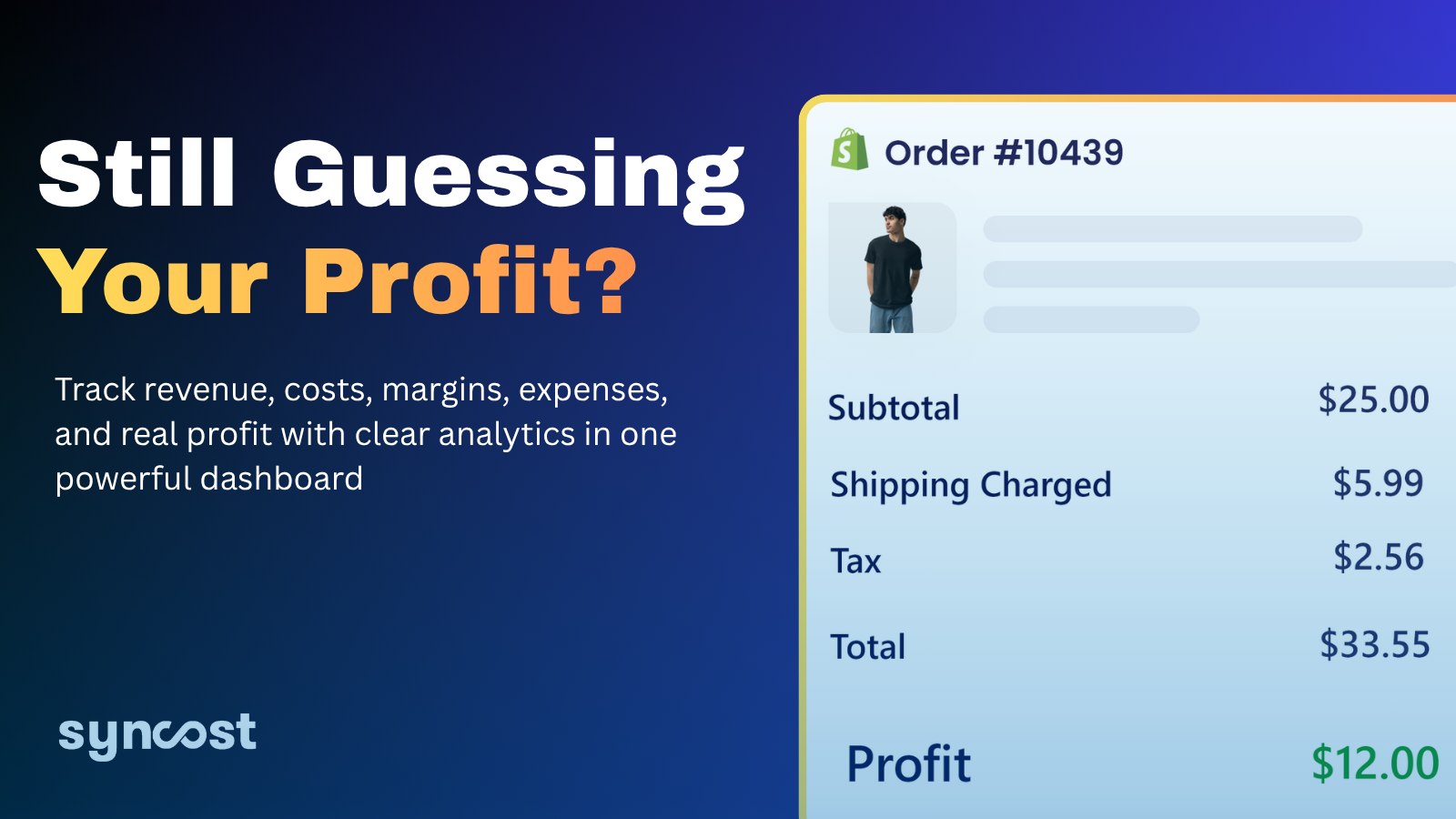
Syncost is built for the reality of modern e-commerce. It pulls your live COGS, dynamically tracks your variable Print-on-Demand fulfillment costs, subtracts your cross-platform ad spend, and instantly accounts for every single refund. It takes the chaos of running a multi-layered, multi-app business and distills it down to one undeniable number: your exact, real-time Net Profit.
Stop guessing across multiple dashboards. Centralize your data, track every hidden penny, and start scaling with ruthless efficiency.