The Attribution War: Why Facebook, Google, and Shopify Are Lying About Your Sales
Facebook claims 100 sales. Google claims 80. Shopify says 90. Your bank account shows 50. Learn how cross-platform double-counting, payment holds, and coupon leaks are secretly bankrupting your e-commerce store.

Every scaling Shopify merchant experiences the exact same nightmare: you open your laptop in the morning, check your dashboards, and nothing matches.
Facebook Ads Manager says you made 100 sales. Google Ads claims it drove 80 sales. Your Shopify dashboard says you only had 90 total orders. And when you look at your actual bank account, the cash deposit doesn't match any of them.
Who is telling the truth? None of them.
If you are relying on advertising platforms to tell you how profitable your business is, you are being played. Ad platforms are designed to take credit for everything so you keep spending money.
Here is the brutal truth about how ad platforms double-count your sales, how cash flow illusions convince you to scale into bankruptcy, and how to finally find your single source of financial truth.
The Double-Counting Death Spiral
Advertising platforms do not care about your Shopify store’s profit. They care about their own.
When you start running omni-channel marketing (using Facebook, TikTok, and Google Ads at the same time), you introduce the most dangerous data flaw in e-commerce: The Attribution Overlap.
Here is exactly how ad platforms team up to destroy your margins:
-
A potential customer sees your video on TikTok and clicks the link. They browse, but they don't buy.
-
Two days later, that same customer is targeted by your Facebook retargeting ad. They click it, add the item to their cart, but get distracted and leave.
-
The next day, they sit down at their computer, type your brand name into Google, click your branded search ad, and finally purchase the $50 product.
What happens next will destroy your accounting.
-
TikTok claims 1 conversion at a $15 Customer Acquisition Cost (CAC) because they clicked within the 7-day window.
-
Facebook claims 1 conversion at a $20 CAC because they clicked yesterday.
-
Google claims 1 conversion at a $5 CAC because they closed the sale.
If you look at your separate ad dashboards, you see three wildly profitable campaigns. You think you just made three sales and generated $150 in revenue!
The devastating reality? You made ONE sale for $50. But you spent $40 across three platforms to get it. Once you subtract your $15 Cost of Goods Sold (COGS), you didn't make money. You lost $5 on that order. But because your ad dashboards lied and claimed the credit independently, you will probably double your daily budget on all three platforms tomorrow. You are literally scaling your own bankruptcy.
The "View-Through" Conversion Trap
It gets worse. Ad platforms do not just take credit for clicks—they take credit for people merely looking at their screen.
This is called "View-Through Attribution." By default, if a customer scrolls past your Facebook ad without even stopping, but then goes to your website three days later and buys your product organically, Facebook claims 100% credit for that sale.
They tell you their ad worked. They show you a massive Return on Ad Spend (ROAS). But that customer was already going to buy from you. You are paying Facebook a premium for a sale you earned yourself. If you are basing your profit margins on view-through ROAS, your numbers are entirely fictional.
The Coupon Extension Leak
Let’s talk about a silent profit killer that is completely invisible on your Shopify revenue dashboard: automatic coupon extensions.
Millions of shoppers use browser extensions like Honey, Capital One Shopping, or RetailMeNot. Let's say you give a 20% off promo code to a specific Instagram influencer, expecting to only lose that margin on the traffic they bring in.
Within 24 hours, one of their followers submits that code to Honey. Now, every single organic customer who visits your store is automatically getting 20% off at checkout without you doing anything.
If your profit margin was only 25% to begin with, Honey just wiped out your entire business model. Your Shopify dashboard will still show high order volume, but your net profit has been secretly slashed to zero. If you wait until the end of the month to run your profit reports, the damage will already be irreversible.
The Cash Flow vs. Profit Illusion
Profit is a theory. Cash flow is a reality.
One of the biggest reasons profitable Shopify stores go bankrupt is because they confuse their Shopify dashboard revenue with available cash.
Let’s say you finally track your numbers correctly. You had a massive $10,000 revenue day, and your calculated net profit is a healthy $2,500. You immediately tell Facebook to scale your daily ad budget by $2,000 to keep the momentum going.
But here is what the dashboard didn't tell you:
-
Stripe takes 3 to 5 business days to deposit that money into your checking account.
-
PayPal just put a 21-day "rolling reserve" hold on 15% of your funds because your sales spiked too fast.
-
Your Print-on-Demand supplier requires upfront payment via credit card to actually print and ship those orders.
You have $10,000 in "Shopify revenue," but you only have $1,000 in your actual checking account. Because you scaled your ads based on dashboard revenue instead of actual liquid cash, your credit card gets declined by your supplier, your orders do not ship, your customers issue chargebacks, and your business dies.
You Need a Single Source of Truth
You cannot run a multi-channel e-commerce brand by looking at five different dashboards that are all actively lying to you.
To survive, you must abandon top-down tracking (looking at ad platforms to see what they claim) and switch entirely to bottom-up tracking (looking at the exact Shopify order and subtracting the exact costs).
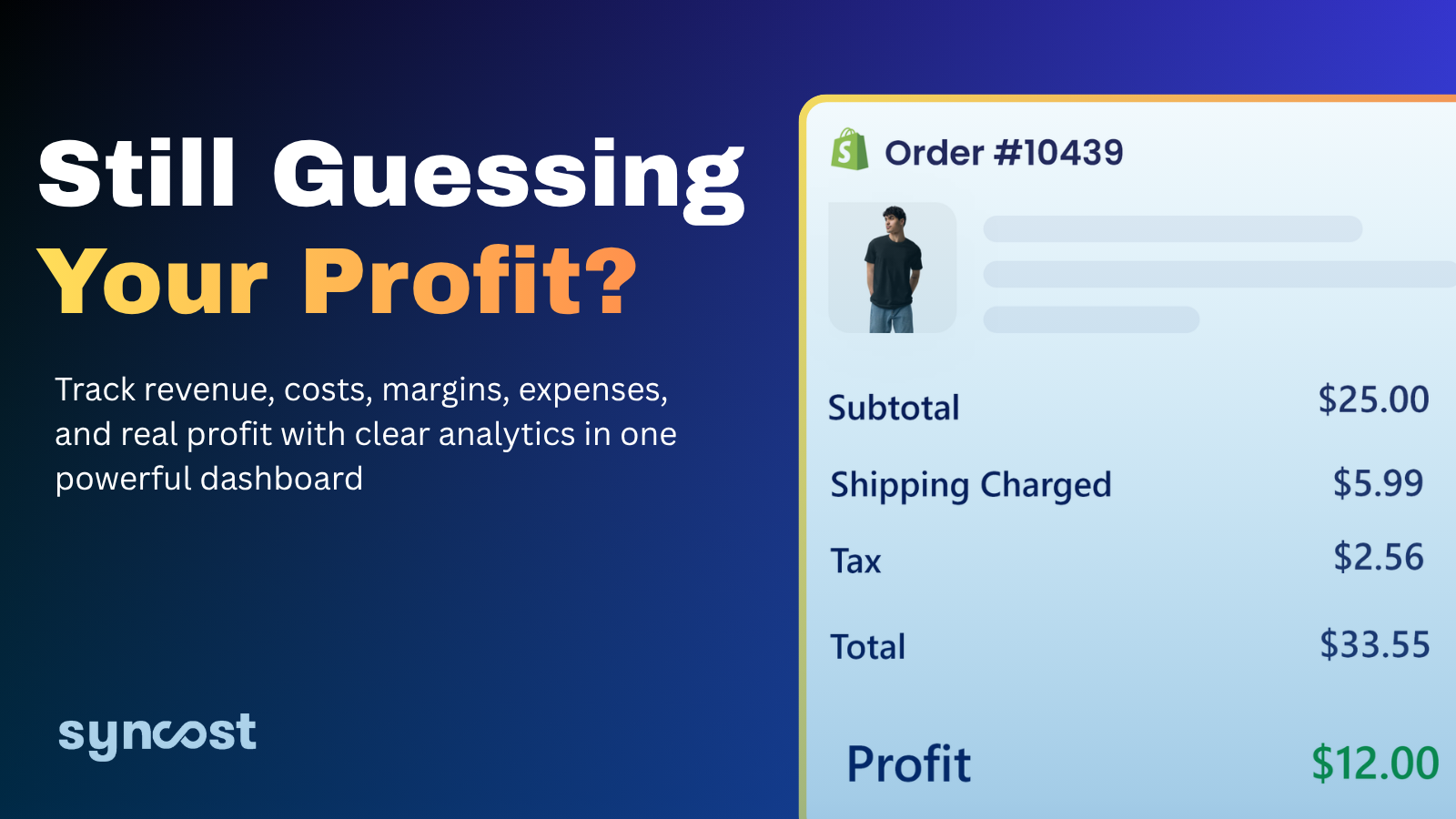
This is the exact operational leverage Syncost gives you.
Syncost ignores the lies of the ad platforms. It looks at the actual, verified Shopify checkout. It instantly identifies the exact discount code used. It pulls the real-time fulfillment cost from your supplier. It factors in the payment gateway hold fees. It consolidates your cross-platform ad spend and divides it by your actual total orders, not the inflated numbers Facebook claims.
Syncost gives you the one number that actually matters: your True Net Profit.
Stop letting ad platforms steal credit for your hard work. Stop letting invisible coupons eat your margins. Consolidate your data, automate your profit tracking, and start making decisions based on financial reality.