The Pricing Delusion: Why Flat Markups Are Bankrupting Your Shopify Store
Are you using the "3x markup" rule? Discover why static pricing strategies fail in modern e-commerce, how free shipping and discounts secretly destroy your margins, and how to price for actual profit.

The quickest way to destroy an e-commerce business is to guess your pricing.
Walk into any Shopify or Print-on-Demand (POD) Facebook group, ask how to price a product, and you will get the exact same terrible advice from hundreds of amateur sellers: "Just multiply your product cost by three" or "Just add $15 to whatever the supplier charges."
This lazy, static pricing strategy is the exact reason why 90% of new Shopify merchants fail.
If you are setting your retail prices based on a flat markup without ruthlessly calculating your real-time customer acquisition costs, fluctuating shipping zones, and daily operational overhead, you are playing Russian Roulette with your bank account.
Here is a brutally honest breakdown of why your pricing strategy is likely failing, how discounts are accelerating your losses, and how to finally price your products for true net profit.
The Fallacy of the "Flat Markup"
Let's completely dismantle the popular "multiply by 3" pricing rule.
Imagine you are selling a custom POD hoodie. Your supplier charges you $15 to print it. Using the amateur rule, you price it at $45 on your Shopify store. A $30 gross margin looks fantastic on paper.
But let's look at what actually happens when you generate a sale:
-
Retail Price: $45.00
-
Cost of Goods Sold (COGS): -$15.00
-
Payment Gateway Fee (Stripe/Shopify Payments): -$1.60
-
Customer Acquisition Cost (Facebook/TikTok Ads): -$22.00 (It is highly competitive out there)
-
Shipping Variance (Supplier charged $8, you charged customer $5): -$3.00
-
Operational Overhead (Apps, hosting, email marketing fraction): -$1.50
Your $30 "guaranteed profit" just turned into a net profit of exactly $1.90.
You just did all the work of sourcing, designing, marketing, and selling a product just to make less than two dollars. And that is on a good day. If your ad costs spike even slightly, or your supplier routes the order to a backup facility that charges $2 more for printing, you are instantly losing money on every single sale.
The "Free Shipping" Death Trap
Every marketing guru on YouTube will tell you that offering "Free Shipping" is mandatory to increase your conversion rates.
What they don't tell you is that Free Shipping is a financial weapon that will turn on you if you don't know your exact margins.
When you offer Free Shipping, the cost of shipping doesn't disappear; it simply transfers from the customer's wallet to yours. If you are absorbing an $8 shipping fee on a product that only has a $10 true net profit margin, you are completely wiping out your business to appease the customer.
If you want to offer Free Shipping, it must be baked into your product’s retail price. But you cannot accurately bake a variable cost into a fixed retail price without real-time tracking. If your supplier increases their shipping rates by 15% before Q4 and you don't immediately adjust your storefront pricing to compensate, your "Free Shipping" offer will quietly bleed your cash reserves dry.
Discounting Yourself to Death
What happens when sales slow down? The panic sets in. And when merchants panic, they run a "20% OFF SITEWIDE" sale.
Running a discount when you do not know your exact Breakeven Point is financial suicide. Discounts do not come out of your gross revenue; they come directly, 100%, out of your Net Profit.
Let's go back to the $45 hoodie that was making you $1.90 in true net profit. If you offer a 20% discount to boost your conversion rate, you are taking $9.00 off the retail price.
Your ad costs did not get cheaper. Your supplier did not give you a discount on the blank hoodie. Stripe still took their fee. That $9.00 discount wiped out your entire $1.90 profit and put you negative $7.10 on every single order.
You might see your Shopify dashboard light up with a massive spike in order volume, but in reality, you are paying $7.10 out of your own pocket every time a customer checks out.
You Must Know Your Daily Breakeven Point
You cannot set profitable prices if you do not know your true Breakeven Point.
Your Breakeven Point is the exact dollar amount it costs to deliver a product to a customer, including COGS, shipping, payment fees, fractional app overhead, and maximum allowable ad spend (CPA).
The problem? In modern e-commerce, your Breakeven Point changes every single day.
-
TikTok ad costs fluctuate daily.
-
Print-on-Demand supplier base costs change based on facility routing.
-
International exchange rates impact your multi-currency checkouts.
You cannot track daily, fluctuating Breakeven Points on a static Excel spreadsheet. If you are basing your pricing off a spreadsheet you updated three weeks ago, your pricing is wrong.
Data-Driven Pricing: Stop Guessing, Start Syncing
If you want to survive, your pricing strategy must be dynamic, and your profit tracking must be automated.
To price confidently, you need total visibility into your margins at a microscopic level. You need to know exactly what your true net profit is on a per-product, per-order, and per-campaign basis.
This is the exact problem Syncost solves.
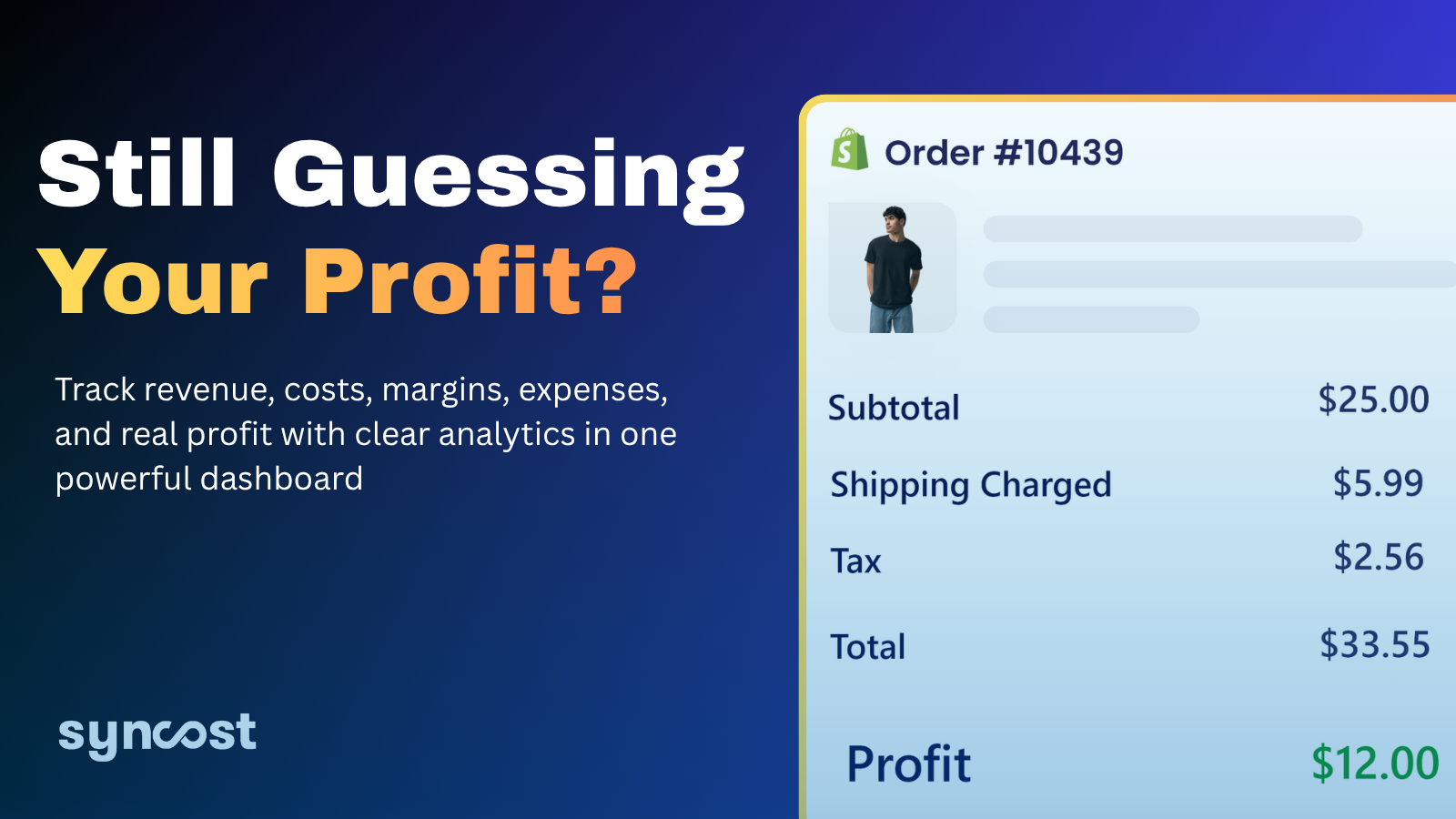
Instead of guessing your markups, Syncost pulls your live fulfillment costs, exact shipping fees, payment gateway cuts, and real-time ad spend into one centralized dashboard. It instantly calculates your true Net Profit and your actual Breakeven Point.
When you have absolute clarity on your numbers, pricing becomes a weapon instead of a liability. You can confidently raise the price on a high-acquisition-cost item to force it into profitability. You can safely offer Free Shipping because you know exactly how much margin you have left to absorb it. You can confidently kill losing products that are secretly draining your budget.
Stop guessing your markups. Stop discounting yourself to death. Automate your profit tracking with Syncost and take absolute control of your pricing strategy.