Is Dropshipping Profitable? The Honest Numbers Behind the Business Model
Dropshipping is profitable — and most dropshipping stores don't make money. Both are true, and here's the math behind both: gross margins, real net margins after ad spend, three scenarios from $1,468/month organic to $15,960/month at scale, and the break-even formula you should run before you spend anything.

The honest answer is yes — and the honest answer is also that most people who start a dropshipping store don't make money from it. Both things are true at the same time, and understanding why is more useful than picking a side.
Dropshipping is profitable in the same way that restaurants are profitable: the model works, successful operators exist, and the business is genuinely viable. It also has high failure rates, thin margins, and structural challenges that surprise people who didn't study the economics before committing. This guide gives you the real numbers — typical margins, ad costs, return rates, and break-even scenarios — so you can answer the question for your specific situation rather than trusting a headline.
What Dropshipping Margins Actually Look Like
The first place most people go wrong is confusing gross margin with profit. They're different numbers, and in dropshipping the gap between them is where most stores either survive or quietly fail.
Gross Margin: The Starting Point
Gross margin is what's left after you subtract the cost of goods from your revenue — the product price, shipping from your supplier, and platform fees. For a standard dropshipping store using a Chinese supplier through AliExpress or a similar platform and selling on Shopify Basic:
| Sell price | Supplier cost | Shipping | Shopify fee | Gross profit | Gross margin |
|---|---|---|---|---|---|
| $29.99 | $8.00 | $3.50 | $1.17 | $17.32 | 57.8% |
| $49.99 | $14.00 | $5.00 | $1.75 | $29.24 | 58.5% |
| $79.99 | $22.00 | $7.00 | $2.62 | $48.37 | 60.5% |
Shopify fee = 2.9% + 30¢ on Basic plan with Shopify Payments.
Gross margins in the 50–60% range look genuinely healthy. And they are — at this level, the product economics are sound. The problem is that gross margin is what you earn before the costs of actually running and growing the business. Those costs are what most profit claims conveniently skip.
Net Margin: The Real Number
Net margin is what you keep after every cost is accounted for — including advertising, apps, subscription, and returns. Here's the same $29.99 order with the full cost stack:
| Line item | Cost |
|---|---|
| Sell price | $29.99 |
| Supplier cost | −$8.00 |
| Shipping | −$3.50 |
| Shopify payment fee | −$1.17 |
| Shopify plan (÷ 200 orders/mo) | −$0.15 |
| Apps (÷ 200 orders/mo) | −$0.50 |
| Customer acquisition cost (CAC) | −$10.00 |
| Returns reserve (3%) | −$0.90 |
| Net profit | $5.77 |
| Net margin | 19.2% |
A store showing 58% gross margin is actually running at around 19% net — and that assumes a $10 CAC, which is optimistic in many categories. At a $15 CAC the net profit drops to $0.77 (2.6% net margin). At a $20 CAC the store loses $4.23 on every sale behind healthy-looking revenue.
This is why "dropshipping has 50% margins" and "most dropshipping stores fail" are both true statements. The gross margin is real. The net margin, after advertising, is where most stores run into trouble.
The Ad Spend Problem
Advertising is the variable that determines whether a dropshipping business is profitable or not — and it's the one most beginners underestimate most severely.
Why Paid Ads Are Almost Mandatory
A new Shopify dropshipping store has no organic traffic. No SEO authority, no email list, no social following. To generate sales from day one, you pay for every visitor — through Meta, Google, TikTok, or influencer partnerships. The cost of those visitors, divided by your conversion rate, is your customer acquisition cost.
What CAC Actually Costs in 2026
In competitive categories — pet products, fitness, beauty, home gadgets — average CPCs on Meta run $0.80–$2.50 and conversion rates for cold traffic on a new store run 1–2.5%. Working through the math:
CAC = CPC ÷ Conversion rate
At $1.50 CPC and 1.5% CVR: CAC = $1.50 ÷ 0.015 = $100
At $1.00 CPC and 2.0% CVR: CAC = $1.00 ÷ 0.02  = $50
At $0.80 CPC and 3.0% CVR: CAC = $0.80 ÷ 0.03  = $27
A $27–$50 CAC on a product with $17 gross profit per unit produces a net loss on every sale regardless of volume. This is why stores can spend $3,000 on ads in a month, generate 150 orders, and bank nothing — or less than nothing.
The stores that make paid ads work do it by either raising AOV (selling bundles, subscriptions, or higher-priced products) until gross profit per order comfortably exceeds CAC, or by building enough organic leverage — email lists, repeat customers, social content — that CAC on incremental orders drops dramatically.
The Organic Alternative
Dropshipping through organic channels changes the economics entirely. Etsy organic search, TikTok organic, Pinterest, and SEO-driven stores all have the same unit economics at the product level — but CAC approaches zero on organic sales. A $17 gross profit with a $0 CAC is a $16-something net margin per order after apps and platform costs.
The catch: organic takes time. Etsy organic can produce first sales within weeks in the right niche; SEO takes months to years. Organic is the better economics; paid is the faster feedback loop. Most profitable dropshipping businesses use both — organic to build the base, paid to accelerate proven products.
How Profitable Is Dropshipping, Really? Three Scenarios
Let's answer "how profitable is dropshipping" with real numbers across three store profiles.
Scenario A — Organic-First, Etsy-Based Store
A seller running 5 products on Etsy, driving traffic through optimised listings and Pinterest.
| Metric | Figure |
|---|---|
| Monthly orders | 120 |
| Average order value | $32 |
| Gross margin | 52% |
| Etsy fees per order | ~$3.20 |
| CAC (organic) | ~$0 |
| App costs (÷ 120 orders) | $0.25 |
| Returns (3%) | $0.96 |
| Net margin | ~38% |
| Monthly net profit | ~$1,468 |
A legitimate, consistent $1,459/month net profit on a part-time organic operation. Scaleable by improving listings, adding products, or layering in a light paid retargeting budget once the store has traffic.
Scenario B — Paid-Traffic Shopify Store, Finding Its Feet
A seller 60 days in, running Meta ads to a Shopify store. One winning product identified, CAC still being optimised.
| Metric | Figure |
|---|---|
| Monthly orders | 200 |
| Average order value | $39.99 |
| Gross margin | 56% |
| Shopify fees and apps | $1.00/order |
| CAC | $14 |
| Returns (4%) | $1.60 |
| Net margin | ~14.5% |
| Monthly net profit | ~$1,158 |
Profitable, but barely. One uptick in Meta CPCs or a product quality issue moves this store into the red. The next 60 days are about reducing CAC through creative iteration, building an email list for free repeat traffic, and raising AOV through upsells. This is the real picture of month two for a working paid-traffic store — not the $10k/month screenshots, not zero either.
Scenario C — Scaled Store With Repeat Customers
A seller 18 months in, with an email list of 8,000 subscribers, winning creative that's been iterated down to a $9 blended CAC, and a 15% returning customer rate.
| Metric | Figure |
|---|---|
| Monthly orders | 800 |
| Average order value | $54 |
| Gross margin | 58% |
| Shopify fees and apps | $0.75/order |
| Blended CAC (new + returning) | $9 |
| Returns (3%) | $1.62 |
| Net margin | ~37% |
| Monthly net profit | ~$15,960 |
This is what a scaled, profitable dropshipping store looks like — and note what it took to get here: 18 months of iteration, a built email list, returning customer infrastructure, and creative that converts well enough to bring CAC down to $9. Not a store launched on a Tuesday that hits five figures by Friday. The ~$16k/month net is real; so is the 18 months it took to reach it.
Is Dropshipping Still Profitable in 2026?
Yes — with more specific conditions than it required in 2019. Three things have changed:
Ad costs are higher. Meta and Google CPCs have risen steadily as more advertisers compete for the same inventory. The era of $0.30 CPCs and effortless $5 CACs is over. Margins that worked in 2018 on a $29.99 product often don't clear at today's ad rates on the same product.
Customer expectations are higher. Shipping times that felt acceptable in 2019 (2–4 weeks from China) now drive refund requests. Stores that can't offer 5–10 day delivery — through US/EU warehouse suppliers, POD platforms with local production, or similar — face structurally higher return and chargeback rates than they would have five years ago.
Competition is more sophisticated. The "find a winning product on AliExpress, run a broad audience" playbook is crowded. Stores that win in 2026 have genuine differentiation — better creative, brand positioning, community, or supplier relationships that aren't easily replicated from a competitor's ad library.
What hasn't changed: the underlying model still works. Margins are available. Suppliers are accessible. The tools are better than ever. The bar is just higher — which means the businesses that survive are the ones that treat it as a real business from day one.
The Break-Even Calculation You Should Run Before You Spend
Before you commit budget to a dropshipping store, run this calculation once. It takes five minutes and will save you months of confusion.
Step 1 — Calculate gross profit per order: Sell price − supplier cost − shipping − payment fee = gross profit
Step 2 — Subtract fixed costs per order: Gross profit − (monthly platform + app costs ÷ expected orders) = contribution margin
Step 3 — Identify your maximum viable CAC: Contribution margin − target net profit per order = maximum CAC you can afford
Step 4 — Calculate break-even revenue: Monthly fixed costs ÷ net margin % = monthly revenue needed to cover all costs
A store with $200/month in fixed costs and a 20% net margin needs $1,000/month in revenue just to break even — before paying yourself anything. Add $800 in ad spend and that break-even jumps to $5,000. Running this before launch makes "is dropshipping profitable?" a question you can answer for your specific numbers, not a general debate.
Know Your Real Numbers Before You Commit
The scenarios above show a real range: from $640/month while finding your feet to $12,000/month at scale, with a legitimate organic alternative that produces $1,459/month without advertising. None of these outcomes are guaranteed. All of them depend on knowing your actual unit economics — not estimated, not hoped-for, but tracked on every order as it happens.
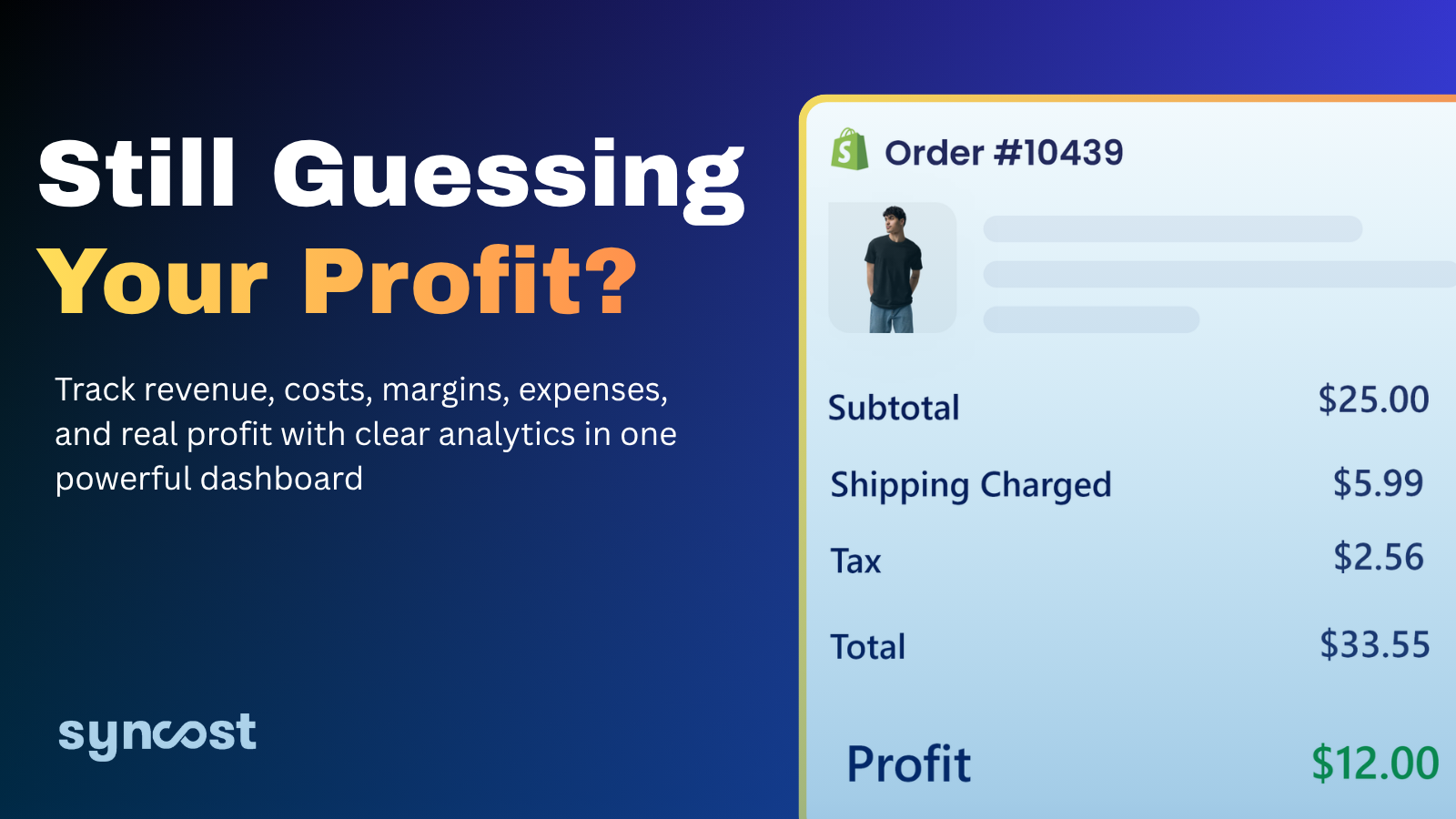
That's the gap Syncost closes for Shopify merchants. It automatically pulls together product cost, shipping, Shopify fees, and ad spend into one view, so every order shows its true net profit in real time. When your CAC creeps up, you see it in your margin before it costs you a month's budget. When a product is genuinely winning, you see that too — and you scale with confidence instead of guessing. Dropshipping is profitable when you know your real numbers. Syncost makes sure you always do.
Margin figures, CAC estimates, and scenario projections are illustrative based on representative 2026 ecommerce data. Actual results vary by niche, product, supplier, and execution. Verify your own cost structure before making business decisions.