How Much Does It Cost to Start Dropshipping? A Real Budget Breakdown
"Almost zero" is not a startup budget — it's how stores fail in month two. Here's a real, itemised cost breakdown for starting a dropshipping business in 2026: three scenarios from $280 to $3,500, covering platform, apps, samples, ad testing, and cash buffer, with the break-even formula you should run before you spend anything.

Most dropshipping content tells you the startup cost is "almost zero." That's technically true in the same way it's true that you can run a marathon on no training — possible in theory, painful in practice, and unlikely to end where you want.
The real answer is more useful: starting a dropshipping business costs between $270 and $2,500 in the first month, depending on the approach you take. Below that floor, you're missing something that will cost you more later. Above the high end, you're over-spending on tools and ads before you've validated a single product.
This guide breaks down every startup cost, line by line, across three realistic scenarios — lean, mid-range, and serious — so you can budget honestly before you spend a dollar.
The Full Cost Stack of Starting a Dropshipping Business
There are six cost categories every new dropshipping store needs to account for. Most beginners think about one or two. All six shape whether the business survives its first 90 days.
1. Ecommerce Platform
Your platform is the non-negotiable foundation. For dropshipping, Shopify is the dominant choice — it has the deepest integration with dropshipping apps, the most reliable checkout, and enough plan flexibility to start lean and scale without migrating.
Shopify plan costs in 2026 (annual billing):
| Plan | Monthly cost (annual) | Best for |
|---|---|---|
| Basic | $29 | Most new dropshippers |
| Grow | $79 | Multi-staff, growing volume |
| Advanced | $299 | High-volume, advanced reporting |
Annual billing saves 25% versus monthly — on Basic that's $120/year back in your pocket for a one-line decision. New stores can also take advantage of Shopify's trial period before committing.
Budget range: $29–$79/month
2. Domain Name
A custom domain costs roughly $10–$20/year through Shopify, GoDaddy, Namecheap, or similar registrars. Some premium one-word .com domains cost hundreds — don't chase them. A clear, pronounceable brand name with a .com or .co extension is all you need at launch.
Budget range: $10–$20/year (~$1–$2/month)
3. Dropshipping App or Supplier Platform
Unless you're managing supplier relationships entirely by hand (not recommended), you'll need an app to automate order forwarding, inventory sync, and tracking updates. The main options and their costs:
| App | Free tier | Paid tier | Key strength |
|---|---|---|---|
| DSers | Yes (AliExpress) | From $19.90/mo | Best free AliExpress integration |
| AutoDS | No | From $26.90/mo | Automation, multi-supplier |
| Zendrop | Yes (limited) | From $49/mo | US suppliers, faster shipping |
| Spocket | Yes (limited) | From $39.99/mo | US/EU supplier focus |
| CJ Dropshipping | Yes | Paid features extra | Wide product range, US warehouse |
A free tier gets you started but usually limits product count or order volume. Most active stores upgrade to a paid tier within the first month.
Budget range: $0–$49/month
4. Sample Orders
This is the cost most guides omit and most beginners skip — then regret. Before you list a product, you need to hold it. Ordering samples lets you assess quality, packaging, print accuracy (for POD), and shipping time from the customer's perspective. Listing products you've never touched is how stores accumulate one-star reviews and refund requests in month one.
Budget for 3–5 samples across your initial product range. At $15–$50 per sample including shipping, that's $45–$250 upfront. It's the best money you'll spend before launch because it eliminates products that don't pass inspection before a real customer receives one.
Budget range: $45–$250 (one-time)
5. Paid Advertising Budget
This is where most of the variance in startup cost lives. Paid ads are not mandatory — Etsy search, TikTok organic, and Pinterest can drive traffic with zero ad spend — but if you plan to use Meta or Google to generate sales from day one, you need a testing budget.
The purpose of early ad spend isn't to be profitable immediately — it's to gather data. You need enough budget to test 2–3 audiences per product, see which creative performs, and find your baseline CAC before scaling. Spending less than $300–$500 on initial testing gives you too little data to make decisions; you'll either quit too early or scale the wrong product.
The trap: many beginners spend $50 on ads, get no sales, and conclude dropshipping doesn't work. What actually happened is they ran an underfunded test on an unvalidated product with untested creative. That's not a business failure — it's a methodology failure.
If you plan to use paid traffic:
- Minimum viable test budget: $300–$500 per product tested
- Mid-range test budget: $500–$1,000 (enough to test 2 products properly)
- Serious launch budget: $1,000–$2,000 (enough to iterate)
If you plan to use organic traffic only (Etsy, TikTok, content):
- Ad budget: $0 — but factor in time, and consider a small retargeting budget once you have store visitors.
Budget range: $0–$2,000/month (first month)
6. Miscellaneous: Apps, Themes, and Legal
Beyond the core stack, a realistic store needs a few additional tools:
Free Shopify theme: Shopify's free themes (Dawn, Sense, Refresh) are genuinely good. You don't need a paid theme to launch a professional-looking store. Save the $180–$380 on premium themes until you have revenue.
Email marketing app: Klaviyo and Omnisend both have free tiers that cover a new store's needs. Budget $0 at launch, expect $20–$45/month once your list grows.
Reviews app: Judge.me has a solid free plan. Loox starts at $9.99/month. Social proof is important enough to pay for, but the free tiers cover early-stage stores.
Business registration: Depending on your country and structure, forming an LLC or registering a business costs $50–$500. Not mandatory in the first week, but required before you're processing meaningful revenue.
Budget range: $0–$100/month in tools; $50–$500 one-time legal
The Three Startup Scenarios
Here's what the full cost stack looks like assembled into three realistic first-month budgets.
Scenario 1 — Lean ($270–$400)
The leanest viable start. Organic traffic only, free app tiers, free theme, and minimal tooling. Right for someone testing the model before committing, using Etsy or TikTok for traffic, or bootstrapping with limited capital.
| Line item | Cost |
|---|---|
| Shopify Basic (annual billing) | $29 |
| Domain (annual ÷ 12) | $1 |
| Dropshipping app (free tier) | $0 |
| Sample orders (3 products) | $75 |
| Paid ads | $0 |
| Email app (free tier) | $0 |
| Reviews app (free tier) | $0 |
| First month total | ~$105 + $75 samples = $180 |
| Cash buffer (1–2 months runway) | $100–$200 |
| Realistic total | $280–$380 |
What you get: A functional store, tested products, and organic traffic strategy. What you don't get: Paid traffic data, speed to first sale.
Scenario 2 — Mid-Range ($800–$1,500)
The most common realistic starting point. Includes a modest ad testing budget, a paid app tier for automation, and enough sample coverage to launch confidently. Right for most first-time dropshippers with a small business mindset rather than a side-hustle mindset.
| Line item | Cost |
|---|---|
| Shopify Basic (annual billing) | $29 |
| Domain | $1 |
| Dropshipping app (paid tier) | $30 |
| Sample orders (5 products) | $150 |
| Meta/Google ads (initial test) | $500 |
| Email app | $0–$20 |
| Reviews app | $10 |
| Legal / business registration | $100 |
| First month total | ~$820–$840 |
| Cash buffer (2 months runway) | $300–$600 |
| Realistic total | $1,120–$1,440 |
What you get: Real traffic data, automation in place, a tested product range, and enough runway to iterate. What you don't get: Certainty of profit — this is still a testing phase.
Scenario 3 — Serious ($2,000–$3,500)
For someone building a business, not a side project. Includes a meaningful ad budget to properly test multiple products, better tooling, professional store setup, and 3 months of cash runway. Appropriate if you're leaving income behind to do this full time, or treating it as a primary income project from day one.
| Line item | Cost |
|---|---|
| Shopify Basic or Grow | $29–$79 |
| Domain | $1 |
| Dropshipping app (paid tier) | $49 |
| Sample orders (8–10 products) | $300 |
| Meta/Google ads (multi-product test) | $1,500 |
| Email app | $20–$45 |
| Reviews app | $10–$15 |
| Legal / business registration | $200–$500 |
| First month total | ~$2,109–$2,489 |
| Cash buffer (3 months runway) | $500–$1,000 |
| Realistic total | $2,609–$3,489 |
What you get: Enough data to make real decisions, proper legal structure, full automation, and runway to find a winning product without panicking at month two. What you don't get: A guarantee — the budget gives you the right conditions; execution and product selection still determine the outcome.
The Costs That Catch New Dropshippers Off Guard
The "It Didn't Work" Ad Budget Trap
Spending $50–$100 on ads and getting no sales is the most common beginner mistake. The problem isn't the ads; it's the sample size. You need enough spend to reach statistical significance on a single audience. A $50 Facebook test on an untested product in an untested market isn't a verdict — it's noise. Budget to learn, not just to try.
Supplier Float
Some dropshipping setups require you to pay your supplier before Amazon or Shopify pays you out. Shopify pays out on a rolling 1–3 day schedule for Shopify Payments, which is manageable. But if you're doing volume, the float between paying your supplier per order and receiving your payout can tie up hundreds to thousands of dollars in working capital. Factor this in as your volume grows.
The Return and Refund Reserve
Even the best suppliers produce defective orders. Budget for a refund reserve — roughly 2–5% of revenue — from day one. At low volume this is small; at 200 orders a month at $35 average order value ($7,000 revenue), a 3% refund rate means $210/month in expected refunds. Not planning for it doesn't make it not happen.
App Creep
Every month new apps promise to improve conversion, automate reviews, recover carts, or personalise the shopping experience. Many are worth their cost; many aren't. New stores routinely accumulate $200–$400/month in app subscriptions within six months without auditing whether each one is actually generating returns. Audit quarterly — cancel anything that isn't directly trackable to revenue or cost savings.
Know Your Break-Even Before You Spend a Dollar
Every number in this guide tells you what you'll spend. The number that decides whether the business works is different: your break-even point — the monthly revenue at which your total costs are covered and every dollar above that is profit.
Before you spend your first dollar on ads or apps, calculate it:
Break-even revenue = Fixed monthly costs ÷ Net margin %
If your fixed monthly costs (Shopify, apps, subscription) are $120 and your net margin per order is 25%, you need $480/month in revenue just to cover platform costs before advertising. Add $500 in ad spend and that break-even moves to $2,480. Understanding that number before you launch tells you exactly what "working" looks like — and stops you from concluding the business failed when you simply hadn't reached the break-even yet.
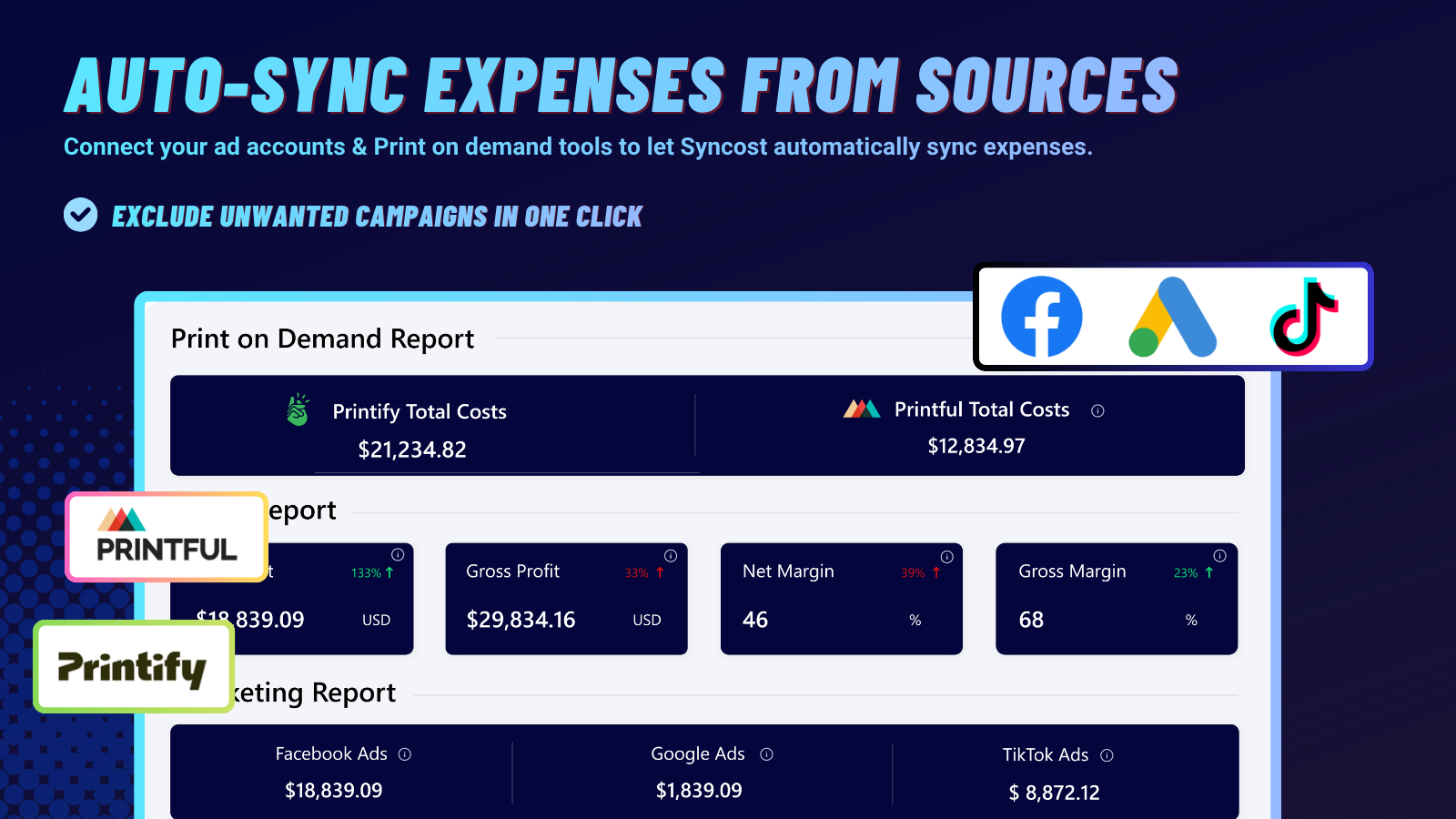
That break-even calculation is a one-time exercise at launch. Monitoring it continuously — as supplier costs shift, ad costs rise, and fees change — is where Syncost earns its place for Shopify merchants. It automatically combines your product costs, shipping, Shopify fees, and ad spend on every order, so your real net margin is a live number rather than a monthly spreadsheet estimate. Know your break-even before you launch. Then use Syncost to confirm you're hitting it on every order you ship — and catch the moment you're not, before it costs you a full month's budget to find out.
Costs are representative 2026 figures for US-based sellers. Platform pricing, app costs, and advertising rates vary. Verify current pricing before committing to any plan.