The Discount Cannibalization Trap: How Promo Code Abuse is Secretly Liquidating Your LTV
You think your "WELCOME20" discount sequence is a highly tuned customer acquisition machine, but coupon browser extensions and leaked influencer codes are secretly conditioning your most loyal buyers to never pay retail price again. Discover how unchecked discount cannibalization destroys your First-Order Margin, permanently amputates your Customer Lifetime Value, and how to mathematically quarantine your promotional strategy.

The Hook & The Silent Problem
Look, I am going to tell it to you exactly like it is. You just launched a massive influencer campaign with a 20% off code to drive new top-of-funnel traffic. For the first 48 hours, your Shopify dashboard looks incredible. Your conversion rate has spiked from 2.5% to 5.1%, and your gross merchandise volume (GMV) is hitting record highs. You think you just engineered a brilliant acquisition strategy.
But when you actually download the transaction data and look at who is using that code, the financial delusion shatters.
Over 60% of the orders utilizing that specific "new customer" influencer code came from your existing, returning customer base. They did not discover you through the influencer. They had items sitting in their cart, went to Google, typed in "[Your Brand] discount code," found the influencer's code on a scraping site, and applied it at checkout. Or worse, the Honey browser extension automatically injected it for them.
You just subsidized purchases for highly motivated customers who were going to buy at full price anyway.
Founders constantly look at discounts as a cheap marketing expense—a minor concession to increase conversion rates. This is a fatal miscalculation. Discounting is not a marketing expense; it is a direct, dollar-for-dollar amputation of your net profit margin. Every time a loyal returning customer uses a hijacked top-of-funnel promo code, you are paying them to buy a product they already wanted. This is the Discount Cannibalization Trap, and if you let it scale, you will completely destroy your Customer Lifetime Value (LTV) and choke your operating liquidity to death.
Core Concept Explained (The Quick Answer)
Discount Cannibalization occurs when promotional offers intended for specific acquisition channels or targeted cohorts are exploited by organic, high-intent, or returning customers who would have otherwise purchased at full retail price. Margin Dilution is the mathematical reality that a percentage-based discount directly and disproportionately reduces your net profit, not just your gross revenue, immediately weakening your Day-1 cash position.
The Deep-Dive Reference Guide
To stop bleeding net margin at the checkout phase, you must recognize the specific vectors of promotional abuse that are infecting your pricing architecture.
| Discount Abuse Vector | Operational Trigger & Definition | The Margin Impact (The Cash Flow Result) |
|---|---|---|
| The Extension Hijack | Browser extensions (Honey, Capital One Shopping) automatically scrape and apply your highest active discount codes across all user carts. | Universal Margin Compression. Your intended 5% organic conversion rate is suddenly subsidized by a flat 15% discount you never meant to offer them. |
| The Leaked Influencer Code | A custom affiliate code (e.g., "SARAH20") meant for a specific audience leaks to global coupon-sharing websites. | Zero-ROI Affiliate Payouts. You lose the 20% discount on the product and you pay Sarah a 10% commission for organic traffic she never generated. |
| The Welcome Loophole | Customers use "burner" email addresses (or just add "+1" to their Gmail) to infinitely trigger your 15% off Welcome Flow Klaviyo sequence. | Destroyed LTV Projections. Your returning customer rate looks artificially low, and your actual margin per returning buyer is gutted. |
| The Stacking Error | Shopify checkout settings accidentally allow a customer to combine a site-wide sale (20% off) with an email loyalty code (10% off) and free shipping. | Immediate Negative Unit Economics. The product is sold below fully landed COGS, meaning you actively paid the customer to take your inventory. |
Technical Breakdown & Formulas
You cannot fix an eroded margin by guessing. You must isolate the exact mathematical weight of your discounts and map how heavily they are diluting your First-Order Contribution Margin.
The True Discount Impact Rate Formula:
Discount_Impact_Rate = (Total_Discount_Value_Given / Gross_Merchandise_Value) * 100

The Diluted First-Order Contribution Margin (CM1) Formula:
Diluted_CM1 = Retail_Price - (Fully_Landed_COGS + Fulfillment_Fees + Gateway_Fees) - Applied_Discount_Value

The Profit Amputation Ratio:
Profit_Amputation_% = (Applied_Discount_Value / Original_Target_Net_Profit) * 100
The Math in Action: Let’s break down exactly how a seemingly harmless 20% discount violently attacks your bottom line on a $100 product.
- Retail Price: $100
- Variable Costs: Landed COGS ($30) + Pick/Pack ($10) + Shipping ($8) = $48
- Target Net Margin (No Discount): $100 - $48 = $52 Profit (52% Margin)
Now, a returning customer uses a leaked 20% off code.
- New Revenue Collected: $80
- Variable Costs: $48 (COGS and fulfillment do not get cheaper just because you gave a discount).
- Diluted Net Margin: $80 - $48 = $32 Profit
The Profit Amputation Reality: You did not just lose 20% of your money. You reduced your net profit from $52 down to $32. You sacrificed 38.4% of your actual bottom-line cash profit just to secure a sale from a customer who already loved your brand.
The Scaled Financial Impact (What It Actually Costs You)
Let’s brutally dissect the catastrophic impact of unchecked discount cannibalization during an aggressive scaling phase. We will compare two stores processing 5,000 orders a month at a $100 average retail price, to see how leaked codes destroy working capital.
Store A: The Structurally Sound Operator (Strict Promo Control)
- Total Monthly Orders: 5,000
- Organic/Full-Price Orders: 4,000 orders ($52 Net Profit each = $208,000)
- Controlled Discount Orders (15% off Welcome Flow only): 1,000 orders ($37 Net Profit each = $37,000)
- Total Monthly Net Margin: $245,000
- The Reality: The founder meticulously utilizes unique, single-use codes. Returning customers pay full retail. The business generates massive liquid cash flow, allowing them to aggressively buy deeper inventory at better manufacturing tiers.
Store B: The "Leaked Code" Victim (Rampant Cannibalization)
- Total Monthly Orders: 5,000
- Organic/Full-Price Orders: 1,000 orders ($52 Net Profit each = $52,000)
- Cannibalized Discount Orders (Using leaked 20% influencer/Honey codes): 4,000 orders ($32 Net Profit each = $128,000)
- Total Monthly Net Margin: $180,000
- The Catastrophic Reality: Both stores sold the exact same number of units and packed the exact same number of boxes. But Store B literally burned $65,000 in pure liquid cash this month. Over a year, that is $780,000 in net profit completely vaporized simply because they used generic "NAME20" codes instead of locked, dynamic pricing infrastructure. Store B will likely have to take out a high-interest Shopify Capital loan just to afford their next Q4 PO.
Strategic Execution (How to Apply This to Your Business)
To permanently seal this margin leak and force your returning customers to respect your retail pricing, you must execute this strict financial and technical triage procedure immediately.
-
Execute a Discount Code Autopsy: Identify the exact source of the margin bleed. Export your Shopify discount report for the last 90 days. Sort by "Total Times Used." Identify the top 5 codes that are disproportionately driving revenue. Cross-reference these codes against your customer cohort data to see if returning buyers are exploiting top-of-funnel influencer or welcome codes. If a code meant for acquisition has a 40%+ usage rate by returning customers, it has been compromised.
-
Migrate to Single-Use Dynamic Links: Kill generic codes entirely. Immediately terminate all generic codes (e.g., "WELCOME10", "SUMMER20"). Integrate your Shopify backend with your ESP (Klaviyo/Sendlane) to generate dynamic, single-use alphanumeric codes that expire exactly 48 hours after they are issued. This instantly neutralizes coupon scraper sites and browser extensions, as the code cannot be shared or hoarded.
-
Hide the Promo Box from Organic Traffic: Force organic checkout behavior. If a customer navigates to your site directly or via organic search, do not show them an empty "Discount Code" field at checkout. Seeing that empty box explicitly trains full-price buyers to open a new tab and search for coupons. Use Shopify Plus checkout extensibility (or specialized apps) to hide the promo input field unless the user clicked through a specific UTM-tracked email or SMS link.
-
Shift from Margin-Cutting to Value-Adding: Protect your unit economics. Stop training your customers to expect percentage-off discounts. Transition your retention marketing to "Gift With Purchase" (GWP) thresholds. Instead of offering 20% off a $100 order (costing you $20 in lost liquid margin), offer a free accessory that has a high perceived retail value ($25) but a rock-bottom fully landed COGS ($4). You protect your primary product's price integrity while minimizing the actual cash impact of the promotion.
Frequently Asked Questions (FAQ)
Should I completely stop working with affiliates who use static discount codes?
No, but you must change the attribution model. Never give an affiliate a massive 20% code that undercuts your organic pricing. Give the affiliate a custom landing page link that automatically applies a modest 10% discount in the cart, bypassing the need for a typed code entirely. This prevents the code from leaking to coupon sites and ensures you only pay commissions on traffic the affiliate actually drove.
How do I stop customers from abusing the "new customer" email signup flow?
You have to implement robust identity resolution. Relying solely on email addresses is amateur. Utilize apps that cross-reference shipping addresses, IP addresses, and payment credentials. If John Doe tries to use "+1" on his Gmail but ships to the exact same physical address using the same credit card, your system must automatically void the welcome code at checkout.
Is it ever mathematically viable to run a site-wide percentage-off sale?
Site-wide sales are only viable under two strict conditions: extreme inventory liquidation (clearing out dead stock to recover capital), or Black Friday/Cyber Monday, where the anticipated exponential spike in transaction volume mathematically offsets the severe degradation of your per-unit profit margin. Running site-wide sales outside of these parameters trains your customers to simply wait for the next sale, permanently destroying your organic full-price velocity.
From Financial Chaos to Verified Profit
Scaling an e-commerce brand while treating discounts as a vague marketing metric rather than a direct amputation of net profit is a guaranteed path to insolvency. When you manage your business based on top-line Shopify Gross Merchandise Value, but ignore the brutal reality of how heavily hijacked discount codes are diluting your First-Order Contribution Margin, you are flying completely blind into a cash flow crisis.
You cannot protect your LTV if your financial analytics cannot isolate the exact cost of your promotional strategy.
This is exactly why veteran, data-driven Shopify operators run their entire financial command center through Syncost.
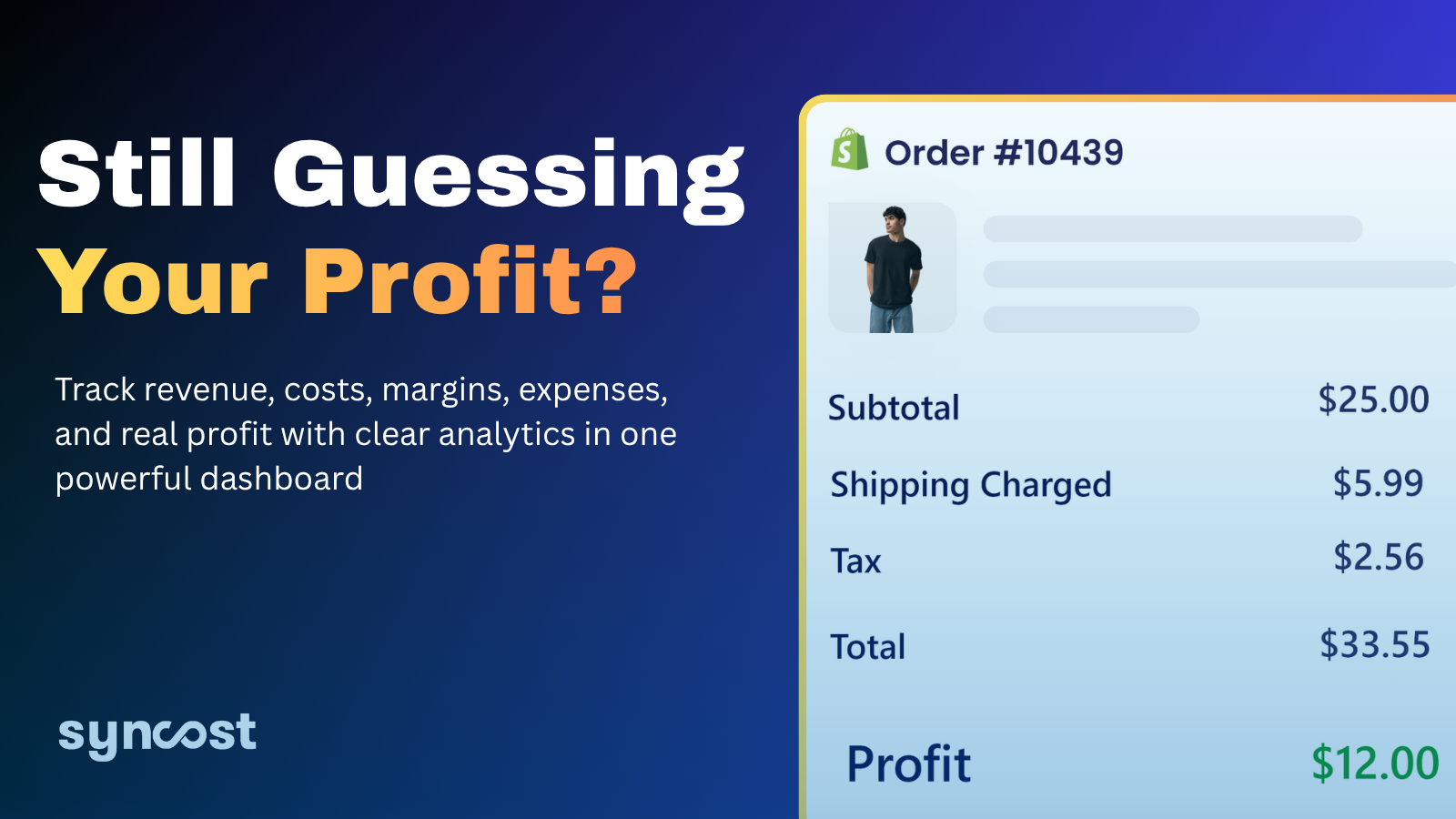
Syncost brings absolute, unvarnished transparency to your unit economics. Standard dashboards bundle discounts into vague line items. Syncost integrates your fully burdened custom cost structures, fulfillment expenses, and exact discount data into one real-time profit engine. It tracks the true, fully diluted reality of your daily operations, ensuring that you always know your exact Net Profit on every single order, right down to the cent.
Stop letting hidden coupon extensions and leaked promo codes quietly asphyxiate your working capital. Install Syncost today, lock in your true unit economics, and scale your brand with the ruthless financial clarity of an elite CFO.
Related articles