The Dropshipping Margin Squeeze: Why Low-Ticket Arbitrage Is a Race to Bankruptcy
Dropshipping is marketed as a low-risk, high-margin business model, but soaring ad acquisition costs and hidden logistics drag destroy bottom-line profits. Learn how to calculate your true arbitrage yield and stop low-ticket arbitrage from bleeding your store dry.

The Hook & The Silent Problem
Let’s not sugar-coat the reality of traditional e-commerce dropshipping: selling generic, low-ticket items sourced from overseas marketplaces via unbranded ad campaigns is no longer a business strategy—it is a slow-motion financial execution.
For years, the internet has romanticized the dropshipping model. Gurus preach that because you don't hold physical inventory upfront, you operate with zero risk and infinite upside. You spin up a Shopify store in a weekend, import a trending gadget for $5, list it for $30, run Meta or TikTok ads, and watch the front-end revenue tick upward. Your Shopify dashboard flashes green, and you feel like a master merchant. But then reality hits when your payment gateway slaps a rolling reserve on your account, your ad CPA spikes by 40%, disgruntled customers file chargebacks over 21-day shipping times, and refund requests swallow your entire operating capital.
The fundamental flaw of amateur dropshipping is the Arbitrage Illusion. When you sell a low-ticket item without product differentiation, brand equity, or supply chain control, you are entirely at the mercy of platform algorithms and volatile shipping costs. Every single time a competitor mimics your winning ad, your Customer Acquisition Cost (CAC) skyrockets. Meanwhile, your supplier raises shipping fees, international carriers lose packages, and your payment processor freezes funds due to high dispute rates. If you are operating a low-ticket dropshipping store without tracking your true variable costs down to the penny, you aren't building a sustainable enterprise—you are running an expensive charity for ad networks and payment gateways.
Core Concept Explained (The Quick Answer)
Dropshipping Margin Squeeze is the destructive financial phenomenon where rising ad acquisition costs compress against fixed supplier and shipping expenses, driving net profit margins into negative territory. To survive, operators must calculate their True Arbitrage Net Yield, which factors in payment gateway reserves, chargeback penalties, and hidden international transit fees before determining whether a product is viable to scale.
The Deep-Dive Reference Guide
To transition from a fragile dropshipping arbitrageur to an elite e-commerce operator, you must examine how amateur assumptions contrast with CFO-level financial reality.
| Operational Variable | The Amateur Dropshipper Assumption | The CFO Reality (True Financial Impact) |
|---|---|---|
| Product Cost (COGS) | "My supplier charges $4, so I pocket $25 profit on a $29.99 sale." | $4 base cost + cross-border currency conversion fees + supplier handling surcharges + damaged item write-offs. |
| Shipping & Logistics | "ePacket / Standard shipping is free or only $2." | 18 to 30-day delivery times, high carrier loss rates, and customer service ticket overhead from delayed packages. |
| Payment Processing | "Stripe and Shopify Payments automatically clear my funds." | High-risk industry tags, 10% to 20% rolling reserves held for 180 days, and costly chargeback dispute fees ($15 per occurrence). |
| Customer Acquisition | "My Facebook ad CPA is $12, so I am safely profitable." | In-platform ad dashboards ignore gateway fees, returns, chargebacks, and hidden fulfillment overhead. |
Technical Breakdown & Formulas
You cannot fix a leaking dropshipping model with guesswork. You must use uncompromising formulas to map your true unit economics.
[Formula 1: True Dropshipping Variable Cost (TDVC)]
TDVC = Supplier_Base_Cost
     + International_Shipping_Fee
     + Gateway_Percentage_Fee(Retail_Price)
     + Gateway_Fixed_Fee
     + Chargeback_Allocation_Cost
     + Reserve_Liquidity_Impact

[Formula 2: First-Order Arbitrage Contribution Margin]
Arbitrage_Margin_$ = Retail_Price - TDVC

[Formula 3: True Break-Even CPA for Dropshipping]
True_Break_Even_CPA = Arbitrage_Margin_$

[Formula 4: Adjusted Net Profit After Reserves]
Net_Profit_$ = Arbitrage_Margin_$ - Blended_CAC - Operating_Overhead
Gateway Percentage Fee: Standard processors charge around 2.9% + $0.30, but dropshipping accounts frequently get flagged as high-risk, pushing blended processing fees to 3.5% or higher, plus non-refundable cross-border fees. Chargeback Allocation Cost: If 3% of your customers file chargebacks due to late shipping, and each chargeback costs you a $15 processor fee plus the lost product value, you must amortize this penalty across every single order. Reserve Liquidity Impact: When payment processors hold 15% of your revenue in a rolling reserve for 6 months, your cash flow is artificially restricted, forcing you to fund ad spend out of pocket.
The Scaled Financial Impact (What It Actually Costs You)
Let’s analyze a classic low-ticket dropshipping scenario to reveal how scaling a flawed model destroys cash flow.
Assume you sell a trending kitchen gadget for $30.00. Your overseas supplier's base cost plus shipping is $9.00. Your target in-platform Meta ad CPA is $12.00.
An amateur calculates a $9.00 profit per unit ($30 - $9 - $12 = $9) and assumes they are ready to scale to thousands of orders a day. Now, let’s apply the True Dropshipping Variable Cost (TDVC) model.
- Supplier base cost + shipping: $9.00
- High-risk payment gateway fee (3.5% + $0.30): $1.35
- Amortized chargeback and dispute cost: $1.20
- Damaged/lost package refund allocation: $1.50
Your actual True Dropshipping Variable Cost is $13.05. Subtracting your $12.00 ad CPA, your real net profit before operating expenses is $4.95 per unit, not $9.00. You are operating on a razor-thin 16.5% gross margin.
At 100 Units a Month: You make $495 in net profit. The operational friction is low, and you feel encouraged by the performance.
At 5,000 Units a Month: You scale your ad spend aggressively and hit 5,000 orders. You generate $150,000 in top-line gross revenue! But here is what happens at scale:
- Ad fatigue hits, driving your average CPA from $12.00 to $15.50.
- Due to shipping congestions, your chargeback rate doubles, pushing your dispute allocation to $2.50 per unit.
- Your payment processor slaps a 15% rolling reserve on your payouts due to sudden volume spikes.
- Your TDVC climbs to $15.80. Combined with your $15.50 CPA, your total cost per order is $31.30.
You are now losing $1.30 on every single sale. Your $150,000 gross revenue month has resulted in a massive cash deficit, frozen reserves, and mounting supplier debts. You scaled yourself right into insolvency.
Strategic Execution (How to Apply This to Your Business)
To pivot away from fragile arbitrage and protect your business from margin compression, execute these operational steps immediately:
-
Calculate Your True Dropshipping Variable Cost: Audit your true transaction costs. Export your last 90 days of sales, refunds, and chargebacks. Factor in your exact high-risk processing fees, currency conversion spreads, and dispute penalties. If your true variable cost leaves you with less than 25% margin before ad spend, the product is mathematically unscalable.
-
Negotiate Direct Supplier SLAs: Eliminate shipping drag. If you are relying on 3-week unverified shipping lanes, your chargebacks will eventually kill your merchant accounts. Partner with private sourcing agents or fulfillment networks that offer guaranteed 7-to-12 day express lines, reducing customer disputes and stabilizing your cash flow.
-
Diversify Payment Gateways and Reserves: Protect your liquid cash. Never rely on a single payment processor for a dropshipping store. Set up backup merchant accounts to prevent catastrophic cash flow halts when rolling reserves are enforced. Factor reserve holds directly into your working capital forecasts so you never get caught without cash to pay your ad bills.
-
Bundle and Differentiate Your Offers: Transition from arbitrage to branding. Stop selling single, commoditized items that anyone can import from a search bar. Create proprietary bundles, custom packaging, or localized value-adds that justify a higher Average Order Value (AOV), expanding your margin buffer against rising ad costs.
Frequently Asked Questions (FAQ)
Is dropshipping still a viable business model?
Traditional low-ticket dropshipping arbitrage has become extremely difficult due to saturated ad markets, rising CPAs, and long shipping times. However, high-ticket dropshipping and private-agent dropshipping focused on branded products, fast shipping lines, and strict unit economic control remain viable when managed with rigorous financial discipline.
How do I handle high-risk merchant account reserves in dropshipping?
Payment processors impose rolling reserves (holding 10% to 20% of your daily revenue for 90 to 180 days) to protect against chargebacks. To manage this, maintain a cash reserve buffer equal to at least 30 days of projected ad spend, provide rapid tracking information to customers, and keep your dispute rate well below 1%.
How do I calculate my true break-even ROAS for a dropshipping store?
To find your break-even Return on Ad Spend, divide your retail selling price by your Contribution Margin (Retail Price minus True Dropshipping Variable Costs). If your product sells for $50 and your true variable cost is $20, your contribution margin is $30, making your break-even ROAS 1.66x. Any ad spend pushing you below that threshold means you are losing money.
From Financial Chaos to Verified Profit
Relying on default e-commerce dashboards while running a dropshipping store is a recipe for disaster. Native reporting tools celebrate top-line revenue while ignoring payment processor reserves, hidden currency conversion fees, and retroactive chargeback penalties. When you scale a low-ticket arbitrage model without bottom-up visibility, a single bad shipping week can wipe out months of hard-earned cash.
This is why successful scaling requires absolute financial clarity. Syncost is engineered specifically for modern merchants who refuse to fly blind.
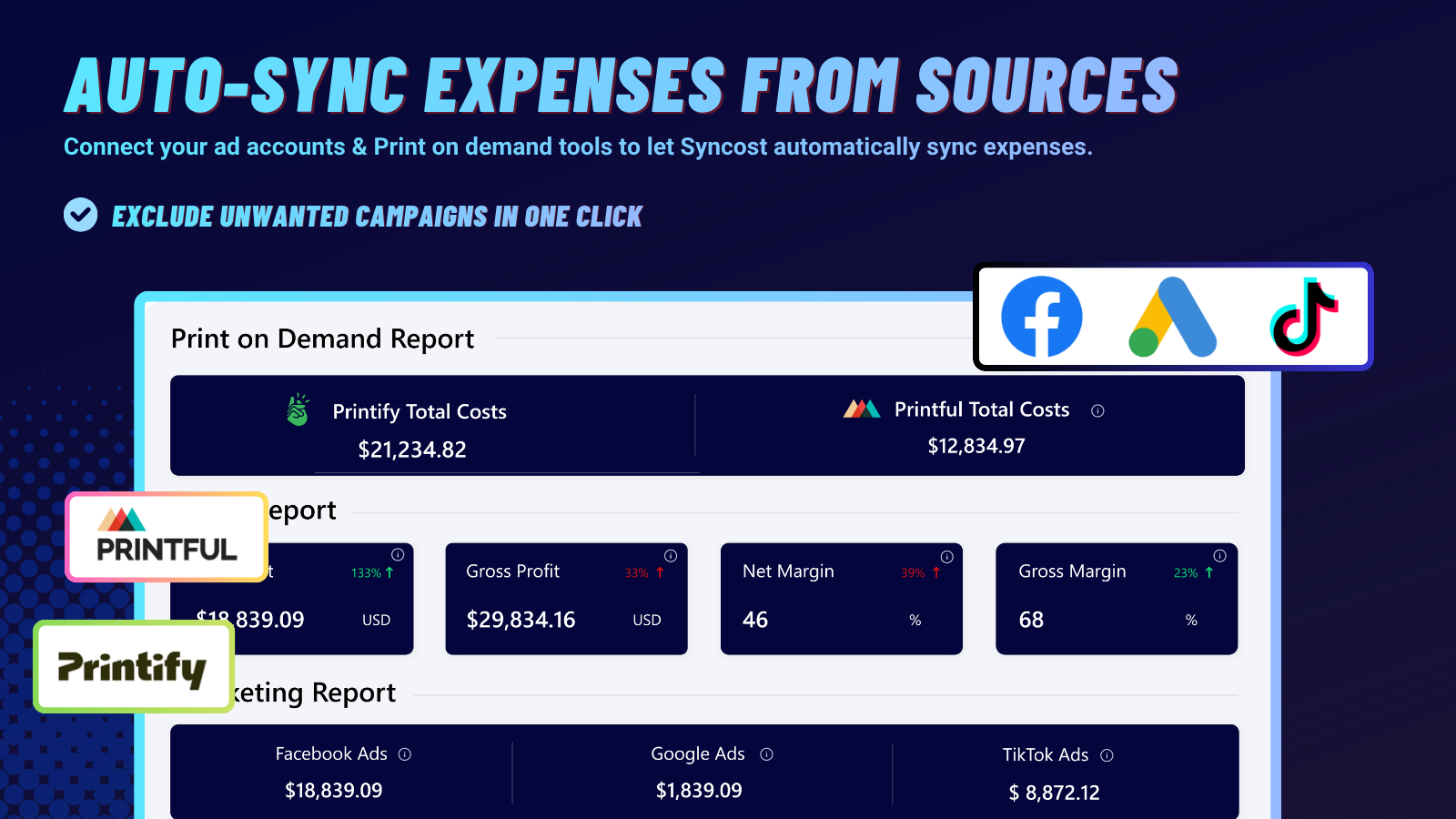
Syncost integrates seamlessly with your Shopify store, your ad platforms, and your exact product sourcing workflows to track your True Net Profit in real-time. Instead of guessing your margins behind a veil of gross revenue, Syncost automatically factors in your exact fulfillment costs, gateway fees, and ad spend to deliver uncompromising financial truth directly to your dashboard. Stop letting hidden dropshipping friction bleed your business dry. Install Syncost today, lock down your unit economics, and scale your store with absolute confidence.
Related articles