Chargeback vs Refund: Which One Actually Costs You More?
A refund costs you the sale. A chargeback on the same transaction costs you the sale, a $15–$40 dispute fee, a non-refunded processing fee, your chargeback rate, and an hour of your time. Here's the full cost comparison across every scenario — and the decision rule for when to refund proactively versus when to fight.
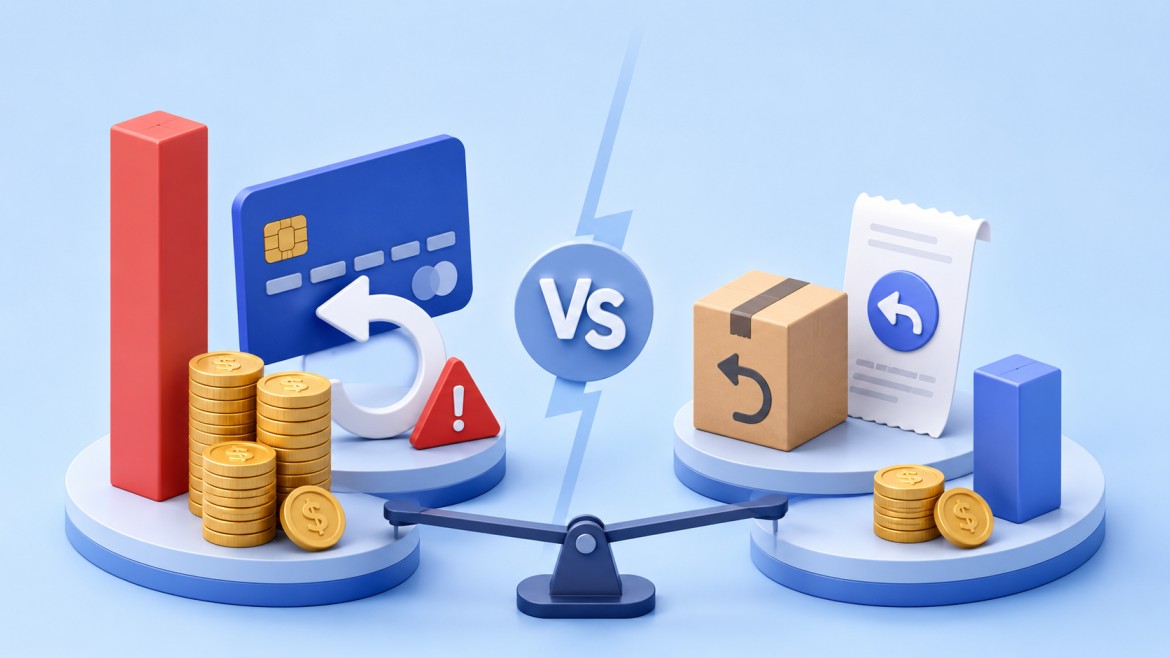
Every merchant knows refunds cost money. Fewer understand how much more a chargeback costs than a refund on the same transaction — or why the gap between the two is so large. The common assumption is that both outcomes lose you the sale. That's true. What's not true is that they cost the same.
A refund costs you the revenue. A chargeback costs you the revenue, a platform fee, a non-refunded processing fee, your merchant account reputation, and in repeated cases, your ability to process card payments at all. On a $50 order, the difference between processing a refund yourself and losing a chargeback can be $25–$45 in additional cost. Across a year of disputes, that gap compounds into thousands of dollars that never appear on a single report.
This guide clarifies the difference between the two, quantifies every cost on both sides, and explains why the choice between issuing a refund proactively versus waiting for a chargeback is rarely as close as it seems.
What Is a Refund?
A refund is a voluntary transaction initiated by you, the merchant. A customer contacts you, requests their money back, and you process the return through your payment gateway. The funds move from your account back to the customer's card, typically within 5–10 business days.
You control the process, the timing, and the conditions. Your return policy governs whether the refund is full or partial, whether the customer needs to return the product first, and how long they have to request one.
What a Refund Costs You
A refund is the cheaper outcome — but it's not free. Here's what you actually lose when you process one:
| Cost component | Amount (on $50 order) | Notes |
|---|---|---|
| Revenue refunded | $50.00 | Full sale amount returned |
| Processing fee (non-refunded) | $1.75 | 2.9% + 30¢ — kept by processor |
| Product cost (if not returned) | $0–$14.00 | Depends on return policy |
| Outbound shipping | $4.50 | Non-recoverable if already shipped |
| Total refund cost (no return) | $56.25 | |
| Total refund cost (product returned) | $42.25 | Revenue lost, fees kept, product back |
The key insight: payment processing fees are almost universally non-refundable when you issue a refund. Shopify, Stripe, PayPal — most processors keep the original transaction fee regardless of whether the sale is later reversed. On a $50 order at 2.9% + 30¢, that's $1.75 gone whether you refund or not.
If the customer keeps the product (a goodwill refund, a "just keep it" resolution), add the product cost and shipping to your loss. If they return it in resaleable condition, your net loss shrinks to just the processing fee and any shipping costs — which is the best-case refund scenario.
What Is a Chargeback?
A chargeback is an involuntary transaction initiated by the cardholder's bank, not by you. The customer contacts their bank, disputes the charge, and the bank reverses the payment from your account while the dispute is investigated. You have no say in the initiation — only in whether you fight it afterward.
Unlike a refund, chargebacks bypass your customer service process entirely. By the time you know about one, the money has already left your account and a fee has already been charged.
What a Chargeback Costs You
Here's the same $50 order run through a lost chargeback:
| Cost component | Amount (on $50 order) | Notes |
|---|---|---|
| Revenue lost (reversed) | $50.00 | Taken from your account at initiation |
| Chargeback dispute fee | $15.00 | Shopify Payments US — charged immediately |
| Processing fee (non-refunded) | $1.75 | Kept by processor regardless of outcome |
| Product cost | $14.00 | Already shipped, customer keeps it |
| Outbound shipping | $4.50 | Non-recoverable |
| Dispute response time | $15.00 | ~30 min at $30/hr to compile evidence |
| Total chargeback cost (lost) | $100.25 | |
| Total chargeback cost (won) | $31.75 | Revenue returned, but fee and time lost |
Even when you win a chargeback dispute, you're not made whole. The chargeback fee ($15 on Shopify Payments in the US) is typically refunded only on specific platforms with fraud protection programs — on most standard disputes you keep the fee loss even on a successful defence. Add the hour of documentation time and the operational drag, and a "won" chargeback still costs you $31.75 on a $50 order.
A lost chargeback on the same order costs $100.25 — exactly $94 more than processing a proactive refund where the customer returns the product.
The Direct Cost Comparison
Here's the full comparison in one table, using a $50 order as the reference:
| Scenario | What you lose | Total cost |
|---|---|---|
| Proactive refund (product returned) | Processing fee + shipping | $6.25 |
| Proactive refund (product kept) | Revenue + fees + product + shipping | $70.25 |
| Chargeback — you win | Dispute fee + processing fee + time | $31.75 |
| Chargeback — you lose | Everything | $100.25 |
| Chargeback — double refund | Already refunded + chargeback loss | $150.25 |
The hierarchy is clear. A proactive refund where you get the product back is the cheapest outcome by a factor of ten. A lost chargeback on a "keep the item" dispute is the most expensive. The double-refund scenario — where you already issued a refund but the customer files a chargeback anyway — is the most damaging single outcome available, and more common than most merchants realise.
The $15 Fee Is the Floor, Not the Ceiling
The $15 Shopify Payments chargeback fee applies to US merchants on standard disputes. Depending on your payment processor and card network, dispute fees range from $15 to $40 per incident. Some processors charge higher rates for international cards or specific reason codes. American Express disputes historically carry higher fees than Visa and Mastercard. If you process through a third-party gateway rather than Shopify Payments, verify your specific dispute fee — the cost gap between a refund and a chargeback may be even larger than the table above shows.
The Costs That Don't Show in Any Dashboard
The direct cost comparison above captures the financial loss. But chargebacks carry two additional cost categories that don't appear in any payout report.
Merchant Account Reputation
Card networks monitor your chargeback rate — the percentage of monthly transactions that result in disputes. Visa's threshold is 0.65% before you enter a monitoring program; Mastercard's is 1.0%. Breach these thresholds and you face:
- Monitoring program enrollment — additional monthly fees of $50–$100 and mandatory remediation reporting
- Higher processing rates — some processors raise your per-transaction rate if you're flagged as high-risk
- Account termination — sustained high chargeback rates lead to your merchant account being closed
- Industry blacklisting — placement on Visa MATCH or Mastercard MATCH means most processors won't work with you for up to five years
A refund has zero impact on your chargeback rate. A chargeback — even one you win — counts against your rate in most card network calculations. The chargeback rate damage from a dispute you won is one of the most counterintuitive costs in payments, and one most merchants don't learn until they're already in a monitoring program.
Time and Operational Cost
A chargeback response requires collecting delivery confirmation, order records, communication history, your return policy, and a written response letter — typically 30 minutes to an hour per dispute. At any reasonable valuation of your time or your team's time, that's $15–$60 per dispute. A refund takes two minutes to process.
At 10 chargebacks a month, dispute response time alone costs you 5–10 hours — hours that could be spent on marketing, product development, or customer acquisition instead.
When to Issue a Proactive Refund Instead of Waiting
The cost comparison above makes one decision remarkably clear: if a customer is going to dispute a charge regardless of what you do, issuing the refund yourself first is almost always cheaper.
A proactive refund on a product the customer returns costs you $6.25 on a $50 order. The same situation becoming a chargeback costs you $100.25 if you lose — a $94 difference. Even if you'd win the chargeback 60% of the time, the expected cost of letting it become a dispute ($59.15 on average) exceeds the cost of a proactive refund.
The Proactive Refund Rule of Thumb
Issue a proactive refund when any of these are true:
- The customer is clearly frustrated and has threatened to "dispute with their bank"
- You made a fulfilment error (wrong item, damaged goods, significant delay)
- The order value is under $30 — below this threshold, dispute response time costs more than any possible recovery
- Your documentation is weak — no tracking, no signed terms, no communication record
Fight the chargeback when:
- You have strong evidence (delivery confirmation, return tracking, communication showing the customer agreed to your terms)
- The order value is high enough that the recovery justifies the response time
- The dispute is clearly fraudulent (the customer has a history of disputes, or the claim contradicts trackable facts)
Chargeback vs Refund: The Definitions That Matter
Since the primary search intent behind this topic is definitional, here's a clean reference:
Refund — A voluntary, merchant-initiated reversal of a payment. You control when, how much, and under what conditions. Costs: processing fee (always), revenue (unless product returned in resaleable condition), shipping (if already sent).
Chargeback — An involuntary, bank-initiated reversal of a payment. The customer's card issuer takes the money and imposes a dispute fee. Costs: all of the above plus a $15–$40 dispute fee, chargeback rate damage, and time. Even a won dispute costs you the fee and operational time.
Chargeback rate — Your monthly chargebacks divided by your monthly transactions. Visa flags at 0.65%; Mastercard at 1.0%. Refunds don't affect this rate; chargebacks always do.
Double refund — When you issue a refund and the customer also wins a chargeback on the same transaction. You pay twice. Prevent this by refunding through a trackable process and documenting that a refund was already issued if a chargeback arrives on a transaction you've already settled.
Know What Every Dispute Is Really Costing You
The comparison in this article is built on clean, controlled numbers — a fixed order value, one card type, one processor. Your real store has a mix of order values, processors, international cards, and dispute types, and every one of those variables changes the cost calculation slightly. More importantly, the costs land in different places: revenue in your Shopify payout, the dispute fee in the next deduction, the product cost in your inventory records, and the time in your calendar — so no single screen ever shows you the true cost of a chargeback versus a refund on the same transaction.
That's precisely what Syncost does for Shopify merchants. It pulls together your product costs, Shopify fees, shipping, and transaction data into one clear view, so every order — including disputed and refunded ones — shows its real impact on your net margin. When you can see that a chargeback costs you $100.25 and a proactive refund costs you $6.25 on the same $50 order, the decision of when to refund and when to fight becomes a numbers question rather than a gut-feel one. That's the difference between managing disputes reactively and running the part of your business that determines whether you're actually profitable.
Fee figures and cost estimates reflect 2026 US merchant rates on Shopify Payments. Processing fees, dispute fees, and chargeback thresholds vary by processor, card network, and merchant agreement. Verify current terms with your payment provider.