The LTV Churn Cliff: How Aggressive Discounting Destroys Customer Retention Metrics
Slashing prices with perpetual 25% off popups and sitewide flash sales might spike your front-end conversion rate, but it fundamentally corrupts your customer base. High-discount buyers demonstrate abysmal repeat purchase rates, tanking your true Customer Lifetime Value (LTV) while conditioning high-intent shoppers never to pay full price. Discover the brutal mathematics behind discount cannibalization and how to protect your net contribution margins.

The Hook & The Silent Problem
Let’s not sugar-coat the reality of e-commerce promotional strategy: relying on aggressive price cuts to hit weekly revenue targets is the financial equivalent of burning your furniture to heat your house.
You are running a performance marketing program where customer acquisition costs (CAC) on Meta and Google continue to creep upward. To maintain your conversion rate and keep your top-of-funnel ad spend viable, you introduce a "Spin-to-Win" wheel or a mandatory 25% off welcome popup. Instantly, your store-wide conversion rate jumps from 1.8% to 3.2%. Your Shopify app sends constant notifications, and your revenue charts shoot upward.
You feel like you’ve unlocked a growth cheat code.
But twelve months later, you run a cohort retention report and are hit with a horrifying realization: almost none of those customers ever came back.
You built an audience of opportunistic deal-seekers who have zero brand affinity and a 100% price sensitivity threshold. Worse, your loyal core customers—who would have happily paid full price—accidentally triggered those exact same discount codes through browser extensions or abandoned cart emails, needlessly wiping out millions of dollars in gross margin.
You are trapped on The LTV Churn Cliff.
When you train your market that your products are perpetually discounted, you create a psychological floor for your pricing. The moment you attempt to sell a product at full retail price, your conversion rates collapse because your audience knows that another "Flash Sale" or "25% Off VIP Code" is coming in two weeks. You are stuck on a high-volume, zero-margin hamster wheel, trading real liquid profit for vanity top-line numbers.
Core Concept Explained (The Quick Answer)
Discount Cannibalization occurs when high-intent or existing buyers who intended to purchase at full retail price utilize a promotional code, transferring gross margin directly to the consumer without generating incremental sales volume. The LTV Churn Cliff represents the precipitous drop in 60-day, 90-day, and 360-day repurchase rates observed in customer cohorts acquired via deep price concessions compared to those acquired at full price.
The Deep-Dive Reference Guide
To eliminate margin erosion, you must audit every promotional mechanism in your store and classify its exact risk profile against your customer lifetime value.
| Discount Vector | Operational Mechanism | The Margin Impact (The Hidden Reality) |
|---|---|---|
| First-Order Welcome Popups | Offering 20%-30% off site-wide in exchange for an email address or SMS opt-in on the first session. | Severe Margin & LTV Erosion. Captures low-intent buyers who immediately churn while eroding the margin of buyers who were already going to purchase. |
| Perpetual Affiliate/Influencer Codes | Custom 15% discount codes distributed continuously by influencers or coupon aggregator websites. | High Cannibalization Risk. Coupon-hunting software automatically inserts these codes at checkout for full-price organic shoppers. |
| Cart Abandonment Discount Blasts | Automatically emailing a 20% discount code within 2 hours of a customer dropping off at the cart page. | Conditioning Bad Behavior. Teaches high-intent customers to intentionally abandon their cart to wait for the inevitable discount email. |
| Tiered Gift With Purchase (GWP) | Unlocking a free physical product or accessory once the cart reaches a specific dollar threshold (e.g., "Free Bag over $120"). | Margin-Protective Growth. Preserves cash margin while artificially driving higher Average Order Value (AOV) and exposing customers to new SKUs. |
Technical Breakdown & Formulas
You cannot manage a promotional calendar using hope and intuition. To evaluate whether a discount campaign actually generated incremental cash flow or merely destroyed unit profitability, you must model the Required Volume Lift required to break even on gross profit dollars.
The Discount-Adjusted Contribution Margin:
Net_Contribution_Margin = (Retail_Price * (1 - Discount_%)) - (Landed_COGS + CAC + Outbound_Fulfillment + Gateway_Fees)

The Required Volume Lift Formula (To Match Full-Price Gross Margin):
Required_Volume_Increase_% = Discount_% / (Original_Gross_Margin_% - Discount_%)

The True Cohort LTV Calculation:
True_Cohort_Net_LTV = First_Order_Net_Profit + SUM(Repeat_Order_Net_Profit_i * Retention_Rate_i)
The Math in Action: Let's analyze a brand selling a premium product at an $80 Retail Price with a 50% Original Gross Margin ($40 Landed COGS + Fulfillment).
- Full-Price Gross Margin Dollars:
$80 - $40 =$40 Gross Profit per unit.
Now, the brand runs a "Flash Sale" offering a 20% Sitewide Discount.
- Discounted Retail Price:
$80 * (1 - 0.20) =$64 - New Gross Margin Dollars:
$64 - $40 =$24 Gross Profit per unit.
To calculate the extra order volume required just to make the same total gross profit dollars as before:
Required Volume Increase % = 0.20 / (0.50 - 0.20) = 0.20 / 0.30 =66.7% Volume Lift
The Financial Truth: By offering a seemingly modest 20% discount, this brand must sell 66.7% more physical units just to make the exact same gross margin dollars they would have made at full price. If their ad campaign or email blast does not generate a 67%+ increase in unit sales, the promotional campaign was a net-negative cash event that compressed company profit.
The Scaled Financial Impact (What It Actually Costs You)
Let's model the 12-month financial trajectory of two competing e-commerce brands, both acquiring 10,000 new customers in Year 1. Both brands sell a product with a $100 list price, $35 Landed COGS + Fulfillment, and a $30 baseline CAC.
Store A: The Full-Price First Strategy
- Acquisition Terms: Full price ($100 AOV). Minimal 5% average promotional slippage.
- First Order Net Revenue: $95 per customer.
- First Order Variable Costs: $35 (COGS/Fulfillment) + $30 (CAC) = $65.
- First Order Contribution Margin:
$95 - $65 =$30 Net Profit per customer. - Initial Acquisition Net Profit (10,000 customers): $300,000
- 12-Month Retention Profile: High product quality perception. 25% of customers place a second order within 12 months at full price ($100 AOV, $0 CAC, $35 COGS = $60 Net Profit per repeat order).
- Repeat Profit Generated: 2,500 repeat orders * $60 = $150,000
- Total 12-Month Net Profit:
$300,000 + $150,000 =$450,000
Store B: The Aggressive Discount Addict
- Acquisition Terms: Heavy 25% OFF welcome discount ($75 AOV).
- First Order Net Revenue: $75 per customer.
- First Order Variable Costs: $35 (COGS/Fulfillment) + $25 (Slightly lower CAC due to discount callout in ads).
- First Order Contribution Margin:
$75 - $60 =$15 Net Profit per customer. - Initial Acquisition Net Profit (10,000 customers): $150,000
- 12-Month Retention Profile: Low brand loyalty. Customers only buy when a sale is active. Only 8% place a second order within 12 months, and only when offered another 20% discount code ($80 AOV, $0 CAC, $35 COGS = $40 Net Profit per repeat order).
- Repeat Profit Generated: 800 repeat orders * $40 = $32,000
- Total 12-Month Net Profit:
$150,000 + $32,000 =$182,000
The Catastrophic Reality: Despite acquiring the exact same number of customers and moving massive inventory volumes, Store B generated $268,000 LESS in liquid 12-month net profit than Store A. By leaning into aggressive discounting, Store B destroyed their front-end margins, corrupted their repeat purchase rates, and suffocated their long-term enterprise value.
Strategic Execution (How to Apply This to Your Business)
To break free from the discounting treadmill and protect your customer lifetime value, you must implement a disciplined promotional governance model.
-
Replace Percentage Discounts with Tiered GWPs: Shift from cash price cuts to value-add incentives. Eliminate sitewide percentage discounts (e.g., "20% off everything") and replace them with Gift With Purchase (GWP) thresholds (e.g., "Spend $100, receive a free $25 full-sized accessory"). GWPs cost you only the wholesale landed COGS of the gift item, preserving your top-line retail price point while driving up Average Order Value (AOV).
-
Neutralize Coupon Aggregator Extensions: Block automated coupon scrapers at checkout. Install script-blocking tools or checkout protection software that prevents browser extensions (like Honey or Capital One Shopping) from injecting discount codes into your checkout field. This ensures that organic, full-price shoppers cannot automatically scrape promotional codes meant exclusively for specific retention campaigns.
-
Restructure Your Abandoned Cart Flows: Stop giving away margin on the first abandoned email. Audit your automated Klaviyo or SMS abandoned cart sequences. Remove discount codes from Email 1 and Email 2 entirely. Focus those initial messages on social proof, unboxing videos, customer reviews, and clear return policies. Reserve small promotional incentives strictly for Email 3 or 4, sending them only to users who have never purchased before.
-
Audit Net Cohort LTV in Real-Time: Evaluate customer cohorts by acquisition promo code. Tag every customer in your database based on the specific discount code used on their initial transaction. Track the 30-day, 90-day, and 180-day repeat purchase velocity of each cohort separately. If a specific acquisition code generates buyers with an abysmal repurchase rate, immediately kill that promotion and reallocate ad budget to full-price acquisition funnels.
Frequently Asked Questions (FAQ)
Is offering discounts ever acceptable for a high-growth e-commerce brand?
Yes, but discounts must be used surgically, not globally. Promotional price cuts are acceptable in two specific scenarios: clearance of dead or end-of-season inventory to release tied-up working capital, and targeted win-back campaigns for dormant customers who haven't purchased in over 180 days. Using discounting as your primary tool to acquire first-time buyers is where fatal margin decay occurs.
How do I transition my existing customer base away from heavy discounting without killing my conversion rate?
You must transition gradually through value stack substitution. Replace 20% off popups with free shipping thresholds, exclusive product bundle access, or double loyalty rewards points. Improve your product page assets by adding unedited user-generated video, clear sizing guides, and explicit guarantee badges to build purchase confidence without cutting your price.
What is the difference between Gross LTV and Net LTV, and why does standard reporting obscure this?
Standard e-commerce dashboards calculate Gross LTV by summing total top-line revenue generated by a customer cohort over time. This metric is dangerously misleading because it ignores Landed COGS, fulfillment costs, merchant processing fees, and the cost of discount codes used on repeat orders. Net LTV calculates the actual net profit dollars remaining in your bank account after subtracting all variable costs, giving you the true measure of customer profitability.
From Financial Chaos to Verified Profit
Relying on aggressive discounting to drive top-line revenue growth is an optical illusion that hides deep structural flaws in your unit economics. If your growth strategy relies on vanity conversion metrics while ignoring the long-term destruction of your net customer lifetime value, a cash flow crunch is inevitable.
You cannot build a durable, high-valuation e-commerce enterprise if your financial tools fail to isolate the true net profitability of discounted customer cohorts versus full-price buyers.
This is exactly why performance-driven, financially elite Shopify merchants command their operations using Syncost.
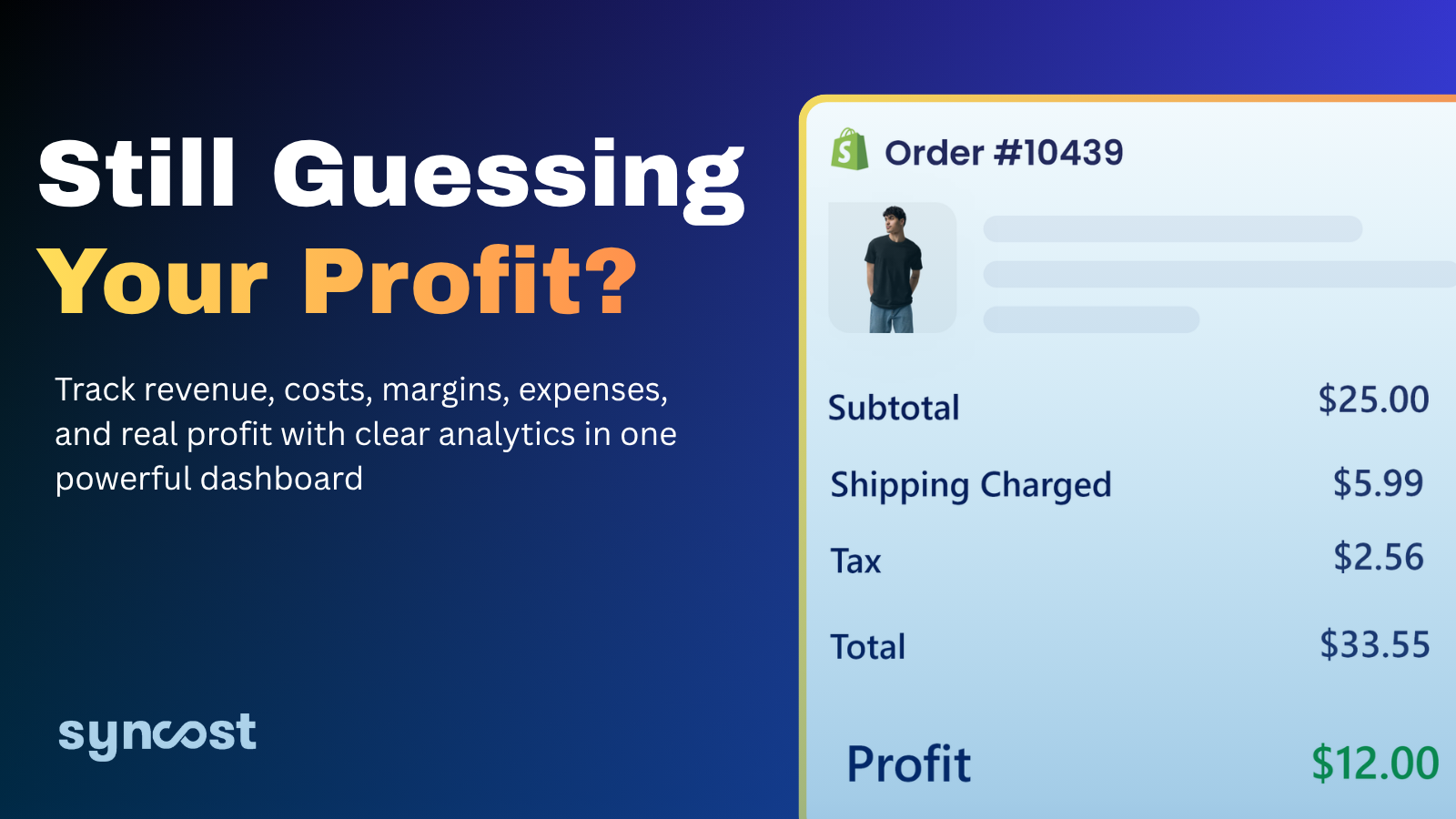
Syncost brings absolute clarity to your promotional performance. Standard Shopify analytics lump discounted sales into surface-level revenue reports, hiding the true cost of margin erosion. Syncost seamlessly integrates your real-time ad spend, exact Landed COGS, payment gateway fees, custom fulfillment charges, and promotional slippage into a single dashboard. It reveals your exact True Net Profit and Net LTV by cohort, empowering you to eliminate margin-killing discounts and scale with complete financial certainty.
Stop letting heavy promotional discounts and coupon scrapers quietly drain your bank account. Install Syncost today, lock down your true unit economics, and manage your brand with the precision of an elite CFO.