The True Cost of Shipping on Shopify (and How to Track It)
Most Shopify founders treat shipping as a simple postal fee paid at checkout. In reality, fluctuating zone rates, volumetric weight penalties, and unabsorbed packaging costs are quietly eroding up to 20% of your net margins. Learn how to accurately track and master your true shipping economics.

The Hook & The Silent Problem
Let’s talk about a familiar ritual in the e-commerce world. You log into your Shopify analytics dashboard on a Monday morning. The gross revenue graph is pointing sharply upward, your TikTok ad campaigns are spitting out an impressive 3.2x ROAS, and your conversion rate is sitting pretty at 2.8%. You feel like an operational genius. But when you pull your actual net profit statement at the end of the month, the math doesn't make sense. The revenue is massive, yet the liquid cash in your bank account is suspiciously low.
Where did the money go?
More often than not, the silent executioner is your shipping structure. Founders love to market "Free Shipping" as a conversion booster, absorbing the cost under the assumption that it's a minor line item. Others rely on flat-rate shipping tables without auditing how destination zones, carrier surcharges, and volumetric weight classes fluctuate behind the scenes. When a customer in New York buys a bulky, lightweight item, and your carrier bills you for dimensional weight to a rural delivery zone across the country, that "flat $5.99 shipping fee" you charged turns into a $14.20 out-of-pocket expense.
When you scale that discrepancy across thousands of orders a month, your shipping strategy stops being a customer perk and turns into an invisible capital hemorrhage. If you aren't tracking your real, order-level shipping variance, you are scaling blind.
Core Concept Explained (The Quick Answer)
True Shipping Cost (TSC) is the aggregate, all-in expense required to get a product from your 3PL or warehouse into the hands of the end consumer. It is not just the postage label price. It encompasses the base carrier rate, zone-based surcharges, dimensional (volumetric) weight penalties, custom packaging materials, pick-and-pack labor fees, and the unrecovered portion of the shipping fee when you offer free delivery.
The Deep-Dive Reference Guide
To master your e-commerce shipping economics, you must look past the basic carrier quote and break down every single component that contributes to your delivery overhead.
| Shipping Cost Component | What Merchants Think It Costs | The Financial Reality | Profit Impact |
|---|---|---|---|
| Base Postage Rate | The flat rate quoted on the shipping label calculator. | Spikes dynamically based on seasonal carrier general rate increases (GRIs) and fuel surcharges. | Direct gross margin compression. |
| Volumetric Weight (DIM) | Charged strictly by actual scale weight (e.g., 500 grams). | If the box is large, couriers charge by dimensional space. Your 500g item can be billed at a 3kg rate. | Doubles or triples shipping costs on bulky, lightweight items. |
| Zone-Based Surcharges | A uniform domestic shipping fee across the country. | Carriers segment deliveries into zones (Zone 1 to Zone 8). Cross-country shipping incurs steep distance penalties. | Severely reduces profitability on long-distance domestic orders. |
| Fulfillment Labor & Packaging | Negligible cost of a cardboard box and tape. | Corrugated boxes, custom inserts, void fill, and 3PL pick-and-pack labor typically cost $3 to $6 per order. | Sinks unit economics if not baked into product pricing. |
Technical Breakdown & Formulas
To accurately assess the financial weight of your fulfillment operations, you must calculate your exact True Shipping Cost per order using precise mathematical parameters.
True Shipping Cost (TSC) = Carrier_Base_Rate + Zone_Surcharge + DIM_Penalty + Packaging_Materials + Fulfillment_Labor_Fee - Customer_Shipping_Collected

Where:
- Carrier_Base_Rate: The raw postal rate for the weight class.
- Zone_Surcharge: Additional fees for delivering to remote, rural, or distant postal zones.
- DIM_Penalty: The financial penalty applied when volumetric weight exceeds actual weight.
- Packaging_Materials: The cost of the box, tape, bubble wrap, and marketing inserts.
- Fulfillment_Labor_Fee: The 3PL or in-house labor cost to pick, pack, and label the item.
- Customer_Shipping_Collected: The amount the customer paid for shipping at checkout (set to 0 if offering free shipping).
Once you calculate your TSC, you must evaluate its impact on your Contribution Margin:
Contribution Margin = Retail_Revenue - (Landed_COGS + True_Shipping_Cost + Payment_Gateway_Fees + CAC)
If your TSC creeps upward due to unmonitored carrier surcharges, your Contribution Margin shrinks. If it drops below zero, every single sale actively subtracts money from your operating capital.
The Scaled Financial Impact (What It Actually Costs You)
Let’s examine how a seemingly small shipping cost miscalculation wrecks a brand's P&L when scaling.
The Unit Economics Baseline:
- Retail Price: $60.00
- Landed COGS: $15.00
- Customer Acquisition Cost (CAC): $20.00
- Payment Gateway Fee (3%): $1.80
- Assumed Shipping Cost (What the founder thinks they pay): $5.00
- Assumed Net Profit per Order: $18.20 (30.3% Margin)
Now, let's look at the True Shipping Cost on an average order when factoring in real-world variables: a Zone 5 distance penalty ($2.50), a dimensional weight box penalty ($1.50), and 3PL pick-and-pack labor plus custom packaging ($4.50).
- True Shipping Cost: $5.00 (Base) + $2.50 + $1.50 + $4.50 = $13.50
Let's plug the actual shipping cost into the unit economics:
- Retail Price: $60.00
- Landed COGS: $15.00
- CAC: $20.00
- Gateway Fee: $1.80
- True Shipping Cost: $13.50
- Actual Net Profit per Order: $9.70 (16.1% Margin)
That is an invisible margin erosion of $8.50 per single order due to uncalculated shipping variables.
The Scaled Financial Devastation
- At 100 Units Sold: The founder expects $1,820 in profit, but actually makes $970. (An 83% overstatement of profit).
- At 5,000 Units Sold: The founder expects $91,000 in profit based on their back-of-the-napkin math. In reality, their actual net profit is $48,500.
By failing to track true shipping costs, this brand quietly surrendered $42,500 of hard-earned cash to carriers and fulfillment centers in a single scaling cycle.
Strategic Execution (How to Apply This to Your Business)
You cannot control carrier pricing, but you can ruthlessly optimize your operational workflows to protect your margins.
-
Perform a 90-Day Shipping Audit: Audit your actual carrier invoices. Stop looking at your Shopify shipping labels as the final word. Pull your actual billing statements from your shipping provider or 3PL. Compare what you were billed against what you collected from customers. Identify every instance of dimensional weight penalties and remote zone surcharges.
-
Right-Size Your Packaging Inventory: Optimize box dimensions. If you are shipping small, lightweight items in oversized boxes, you are paying for empty air. Audit your top 5 SKUs and transition to custom mailer bags or tightly fitted corrugated boxes to completely eliminate volumetric weight penalties.
-
Implement Dynamic Free Shipping Rules: Rethink your free shipping threshold. Offering free shipping on low-ticket items is a financial trap. Set your free shipping threshold intelligently above your Average Order Value (AOV) so that the product's gross margin comfortably absorbs the true delivery cost.
-
Integrate Real-Time Margin Tracking: Automate fulfillment analytics. Manual spreadsheets cannot keep up with fluctuating carrier zones and daily shipping rate adjustments. You must deploy an automated tracking system that syncs your live Shopify store data directly with your actual fulfillment and shipping expenses down to the penny.
Frequently Asked Questions (FAQ)
Why are my Shopify shipping labels more expensive than expected?
Shopify offers discounted carrier rates, but those rates are calculated based on standard base weights and optimal dimensions. If the carrier's automated sorting hubs scan your package and determine it takes up more dimensional space than declared, or if the delivery address falls into a remote zip code, surcharges are automatically billed to your account after the fact, causing unexpected discrepancies.
Should I charge customers actual shipping rates or stick to a flat rate?
While live calculated rates at checkout protect your profit margins entirely, they can hurt conversion rates because customers dislike unpredictable shipping fees. The ideal middle ground is to calculate your average true shipping cost across all zones, bake that baseline into your product pricing or a slightly higher flat-rate fee, and reserve true free shipping exclusively for high-threshold cart sizes.
How do I account for packaging materials in my Shopify COGS?
Packaging materials (boxes, custom tape, tissue paper, bubble mailers) are variable costs of fulfillment, not overhead. They should be calculated and added directly to your Landed COGS or tracked alongside your shipping expenses. Ignoring material costs on thousands of monthly orders creates a massive blind spot in your true net profit calculations.
From Financial Chaos to Verified Profit
Operating an e-commerce business while guessing your shipping and fulfillment expenses is like navigating a ship through a storm with a broken compass. Gross revenue numbers will make you feel wealthy, but hidden carrier surcharges, volumetric penalties, and unoptimized packaging will quietly drain your bank account dry. You cannot scale a brand sustainably when your foundational cost data is built on assumptions.
This is where Syncost steps in to eliminate the guesswork.
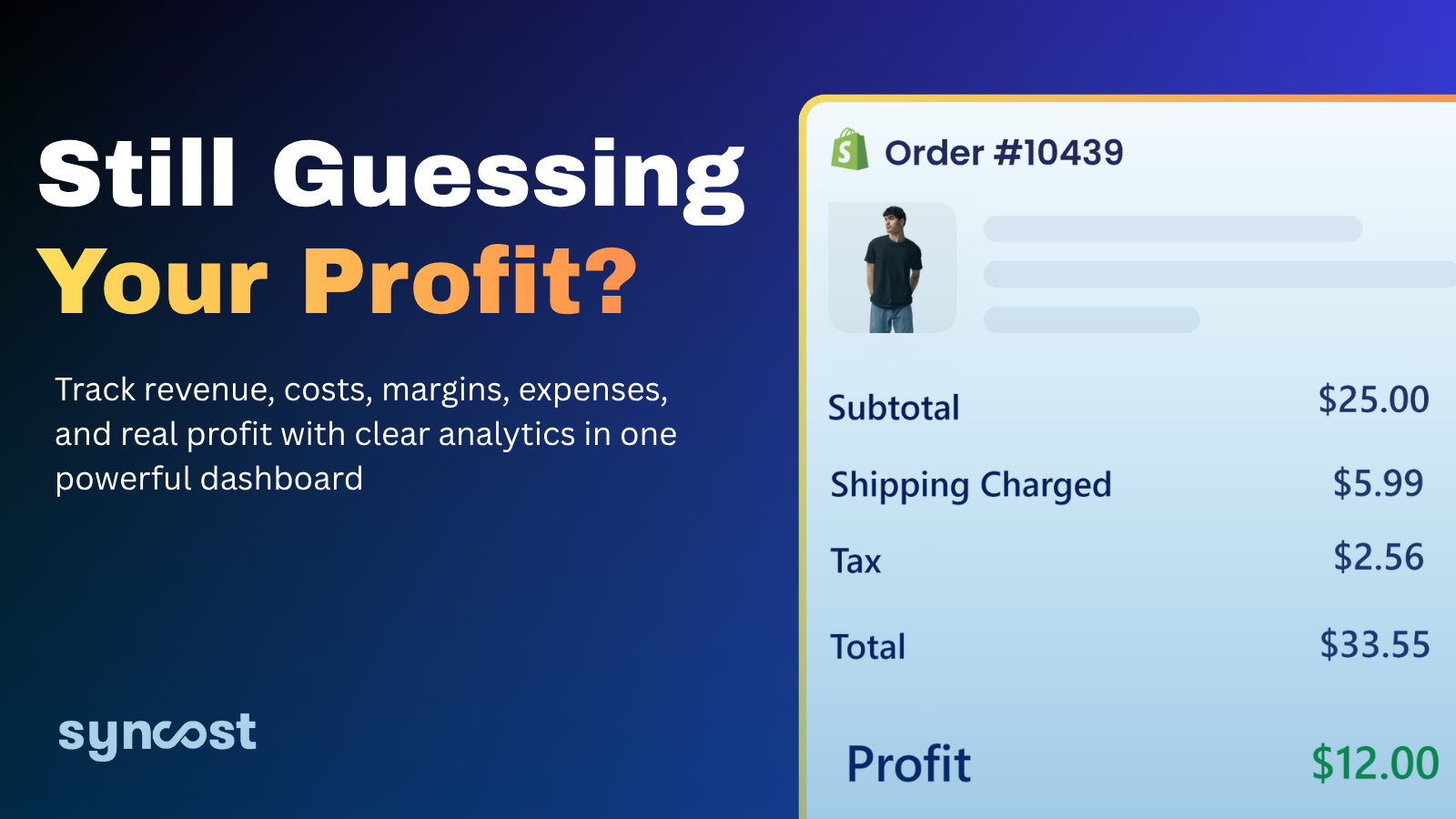
Instead of relying on fragmented spreadsheets or blind Shopify estimates, Syncost integrates directly into your e-commerce ecosystem to track your true, bottom-up net profit in real time. It ingests your live ad spend, exact payment gateway fees, and dynamic fulfillment and shipping costs, stripping away the illusion of gross revenue. With Syncost, you instantly see the exact net margin on every single order, campaign, and product. Stop letting hidden shipping fees eat your profits and start scaling with the confidence of verified, automated financial data.