Printful Print-on-Demand: True Costs and Realistic Profit Margins
Printful is the most polished POD platform — and the most expensive. Here's the complete 2026 cost teardown: base costs by plan (Free vs Growth), US shipping rates, add-on fees, and the per-order margin at three retail price points, plus the CAC impact table that shows exactly when Printful's economics work and when they don't.

Printful is the most polished print-on-demand platform available. In-house production across 15+ facilities, consistent quality, native Shopify integration, and branding options that make your unboxing experience look genuinely professional. It's also, by almost every comparison, the most expensive POD platform in the market.
That premium is real — and so is the question every merchant should answer before committing to it: what does Printful actually cost per order, what margin does it realistically leave, and under what conditions does that margin hold up?
This is the complete cost teardown. Every fee, every tier, and the honest per-order math that Printful's own pricing page doesn't show you assembled in one place.
How Printful Charges You
Printful has no per-order commission, no transaction fee on sales, and no hidden royalty structure. You pay for three things: the product itself (base cost), shipping to your customer, and any optional add-ons. Everything else — the Shopify integration, the design tools, the mockup generator — is free.
The Free Plan
Printful's free plan gives you full access to the platform: 450+ products, all 20+ ecommerce integrations, every design tool, automated order processing, and white-label fulfilment. There's no monthly subscription to use the platform, and you won't pay anything until a customer buys — then Printful charges you for the product, printing, and shipping on every order.
On the free plan, you pay the full base cost on every product with no discounts.
The Growth Plan
The Growth plan costs $24.99/month and becomes free once you reach $12,000/year in sales. It gives you up to 33% off product pricing, plus discounted branding and exclusive deals.
The free-at-$12K threshold is one of the most underappreciated features in Printful's model: once your store generates $12,000/year in Printful sales (roughly $1,000/month), the Growth plan waiver kicks in automatically — the subscription cost disappears while the discount stays. The math on Growth is simpler than it looks. The $24.99 fee pays for itself the moment your product discount exceeds $25 in a month. For most sellers, that's roughly 3–4 t-shirt orders.
Base Costs: What Printful Charges Per Product
Base cost includes the blank garment and the DTG printing. These are the 2026 figures for the most commonly sold Printful products on a US domestic order.
Apparel Base Costs (Free Plan)
| Product | Base cost range | Notes |
|---|---|---|
| Bella + Canvas 3001 Unisex Tee | $11.50–$13.50 | Most popular, size/colour varies |
| Gildan 64000 Softstyle Tee | $9.99–$11.99 | Budget option |
| Bella + Canvas 3001 (Growth) | ~$8.00–$9.50 | Up to 33% off |
| Gildan Hoodie (Free) | ~$27.00–$30.00 | Affected by Feb 2026 price update |
| Premium Hoodie (Growth) | ~$18.00–$22.00 | Significant Growth discount |
| All-over-print tee (Free) | ~$26.00–$30.00 | Full sublimation |
As of February 26, 2026, Printful rolled out a targeted price increase affecting Cotton Heritage products (hoodies, heavyweight tees, sweatshirts) and shipping rates on select accessories. Product base prices went up 0.4%–1.7% on affected items. Importantly, the most popular products — Bella + Canvas, Gildan, mugs, and posters — and standard apparel shipping rates were not affected.
Other Popular Products
| Product | Base cost (Free plan) | Approx. Growth price |
|---|---|---|
| Coffee mug (11oz) | ~$8.95 | ~$6.50 |
| Poster (A3) | ~$8.50 | ~$6.00 |
| Phone case | ~$10.95–$13.95 | ~$8.00–$10.00 |
| Tote bag | ~$11.99 | ~$8.50 |
| Canvas wall art (12×16) | ~$25.00 | ~$18.00 |
All figures are representative 2026 US-market base costs. Verify current prices in your Printful dashboard before setting retail prices.
Shipping Costs
Printful uses flat-rate shipping by product category and destination zone, not weight-based DIM pricing. Standard US shipping on a t-shirt runs $3.99 for the first item and $2.00 for each additional item.
US Domestic Shipping by Product Type
| Product | First item | Each additional |
|---|---|---|
| T-shirt | $3.99 | $2.00 |
| Hoodie | ~$7.49 | $2.00 |
| Mug | ~$5.99 | $3.00 |
| Poster | ~$4.99 | $1.50 |
| Phone case | $4.99 | $2.00 |
| All-over-print tee | ~$5.99 | $2.00 |
International shipping to the UK or EU typically runs $6–$15 depending on product type, which is significantly more expensive than the US rate. Printful ships internationally from its US and European facilities — EU customers served by the Barcelona facility pay lower shipping costs than those served from the US.
Seasonal Shipping Surcharges
Printful applies temporary shipping increases during peak periods. A $0.40 holiday surcharge applied October 15, 2025 through January 17, 2026. Factor this into your Q4 pricing if you're in a seasonal product category — an unplanned $0.40 surcharge on high-volume months erodes margin quietly.
Add-On Costs to Watch
Several optional features carry per-order or per-design fees that can meaningfully change your economics if you use them.
| Add-on | Cost | When it applies |
|---|---|---|
| Inside label | $0.99 | Per labelled item (branded label replacing Printful's) |
| Outside label | $2.49 | Per labelled item |
| Packing slip insert | ~$1.25–$2.25 | Per insert included in package |
| Extra print placement (back, sleeve) | $2.20–$5.25 | Per placement, per item |
| Embroidery digitization | $2.95–$6.50 | One-time per design |
Watch out for extra costs: additional print placements (~$2.49–$5.25), inside labels ($0.99), and embroidery digitization ($2.95–$6.50).
Inside labels are the most commonly overlooked add-on cost. At $0.99 per item, adding branded labels to every order at 300 orders/month adds $297/month to your cost base — nearly the cost of the Growth plan plus a large chunk of profit. Labels build brand equity; evaluate whether that equity justifies the per-order cost at your current volume.
The Full Cost Teardown: What You Actually Keep
Here's the per-order economics on a Bella + Canvas 3001 t-shirt sold through Shopify at three common retail price points, on both the Free and Growth plans. US domestic order, standard print, no add-ons.
Shopify Store (Basic plan, Shopify Payments)
Reference product: Bella + Canvas 3001 Unisex Tee Base cost (Free): $12.50 | Base cost (Growth, ~30% off): $8.75 US shipping: $3.99 Shopify payment fee: 2.9% + 30¢
| Sell price | Plan | Base cost | Shipping | Payment fee | Net profit | Net margin |
|---|---|---|---|---|---|---|
| $24.99 | Free | $12.50 | $3.99 | $1.03 | $7.47 | 29.9% |
| $24.99 | Growth | $8.75 | $3.99 | $1.03 | $11.22 | 44.9% |
| $29.99 | Free | $12.50 | $3.99 | $1.17 | $12.33 | 41.1% |
| $29.99 | Growth | $8.75 | $3.99 | $1.17 | $16.08 | 53.6% |
| $34.99 | Free | $12.50 | $3.99 | $1.32 | $17.18 | 49.1% |
| $34.99 | Growth | $8.75 | $3.99 | $1.32 | $20.93 | 59.8% |
Net profit = sell price − base cost − shipping − payment fee. Growth plan subscription ($24.99/month) not deducted per order — see break-even section below.
The Growth Plan Break-Even
At $24.99/month, the Growth subscription pays for itself when the discount savings exceed the subscription cost. If Growth saves $3.75 per shirt (the difference between $12.50 and $8.75), break-even is:
$24.99 ÷ $3.75 = 6.7 shirts per month
Seven shirts a month. If you're selling fewer than seven shirts through Printful monthly, the Growth plan costs you money. Above seven, every additional shirt makes the subscription more profitable. After the break-even point, every Growth-discounted unit is straight margin gain. Growth becomes free automatically once your store does $12,000/year (about $1,000/month) in sales through Printful.
Adding the Paid Advertising Reality
The table above assumes no customer acquisition cost. Once you factor in Meta or Google ads, the margin picture changes significantly:
| Sell price | Plan | Net profit (no ads) | After $10 CAC | After $15 CAC |
|---|---|---|---|---|
| $24.99 | Free | $7.47 | −$2.53 | −$7.53 |
| $24.99 | Growth | $11.22 | $1.22 | −$3.78 |
| $29.99 | Free | $12.33 | $2.33 | −$2.67 |
| $29.99 | Growth | $16.08 | $6.08 | $1.08 |
| $34.99 | Free | $17.18 | $7.18 | $2.18 |
| $34.99 | Growth | $20.93 | $10.93 | $5.93 |
The pattern is stark: at $24.99 on the Free plan, a $10 CAC puts you $2.53 in the red on every ad-driven order. You need Printful Growth and a retail price of at least $29.99 before paid traffic at a $10 CAC becomes profitable. At $34.99 with Growth, even a $15 CAC leaves $5.93/shirt — a sustainable margin for a brand with design differentiation that justifies the price point.
This is why Printful's higher base cost is only sustainable at higher retail prices. The platform's quality supports premium positioning — but premium pricing must actually be in place for the economics to work.
Selling on Etsy vs Shopify
Many Printful sellers start on Etsy for the built-in traffic, then consider moving to Shopify as they grow. The fee structures create meaningfully different margins.
Etsy fees on a $29.99 shirt:
- Transaction fee: 6.5% = $1.95
- Payment processing: ~3% + 25¢ = $1.15
- Listing fee: $0.20
- Total Etsy fees: ~$3.30
Shopify Basic fees on the same $29.99 shirt:
- Payment processing (Shopify Payments): 2.9% + 30¢ = $1.17
- Total Shopify fees: ~$1.17
At the same product and retail price, Etsy adds $2.13 more in fees per order than Shopify — reducing your net profit accordingly. Etsy's organic traffic is the offsetting benefit: on Etsy you don't pay to acquire customers; on Shopify you almost always do.
| Channel | Fees per $29.99 order | Traffic cost | Best when |
|---|---|---|---|
| Etsy | ~$3.30 | Near-zero (organic) | Building audience, early stage |
| Shopify | ~$1.17 | Must be paid for (ads/SEO) | At scale with own audience |
The break-even between Etsy and Shopify depends entirely on your CAC. If you can acquire Shopify customers for under $2.13 (the fee savings), Shopify is cheaper per order. Most merchants need significantly more than that — making Etsy genuinely competitive on total cost once traffic is factored in.
Printful vs Printify: The Honest Margin Comparison
Printify is the most-cited Printful alternative. The Bella + Canvas t-shirt costs $9.04 with Printify's Premium subscription versus Printful's $11.69 — a 22.7% base cost difference. Trade-off: Quality varies by print provider. You're managing multiple supplier relationships, and consistency across orders isn't guaranteed.
At a $29.99 sell price on Shopify:
| Platform | Base cost | Shipping | Payment fee | Net profit | Net margin |
|---|---|---|---|---|---|
| Printify Free | ~$12.50 | $4.50 | $1.17 | $11.82 | 39.4% |
| Printify Premium | ~$9.04 | $4.50 | $1.17 | $15.28 | 51.0% |
| Printful Free | $12.50 | $3.99 | $1.17 | $12.33 | 41.1% |
| Printful Growth | $8.75 | $3.99 | $1.17 | $16.08 | 53.6% |
On paid plans, Printful Growth ($16.08/shirt) and Printify Premium ($15.28/shirt) are within $0.80 of each other at this price point — much closer than the headline base cost comparison suggests. Both subscriptions run ~$25/month.
The real difference isn't base cost on a paid plan. It's what you get for the extra $0.80/shirt: Printful's consistent in-house quality versus Printify's provider flexibility and variability.
Who Should Use Printful
Printful is the right fit if:
-
Brand consistency matters. Printful's in-house production across its own facilities delivers more uniform quality than a marketplace of independent providers. If your repeat customers, your reviews, and your brand reputation depend on every order looking the same, Printful's infrastructure is worth the base cost premium.
-
You're pricing at $30 or above. The economics work cleanly at $30+ retail. Below $25, even the Growth plan struggles to produce meaningful margin once any paid acquisition cost is applied.
-
You need custom branding at low volume. Inside labels, custom packing slips, and branded packaging are available on Printful without the minimum-order quantities other platforms require. For a brand-led store, this enables premium packaging from order one.
-
International fulfilment matters. Printful's European facilities (Barcelona, Riga) make EU delivery times and costs competitive — unlike some competitors who ship all international orders from a single US warehouse.
Printful is harder to justify if:
-
You're selling at $20–$25 retail. The margin at that price point on the Free plan is thin and doesn't absorb any meaningful advertising cost. You'd need to be on Growth with organic-only traffic to make the numbers work at these price points.
-
You're running high-volume paid traffic. Printify's lower base cost (especially on Premium) gives you more CAC headroom on paid channels. The $3–$4 per-shirt cost difference can be the margin that makes your ad campaigns profitable or not.
-
Product variety is more important than brand consistency. Printify's 800+ product catalog via its provider network significantly outpaces Printful's 450+ products.
Know What You're Actually Keeping Per Printful Order
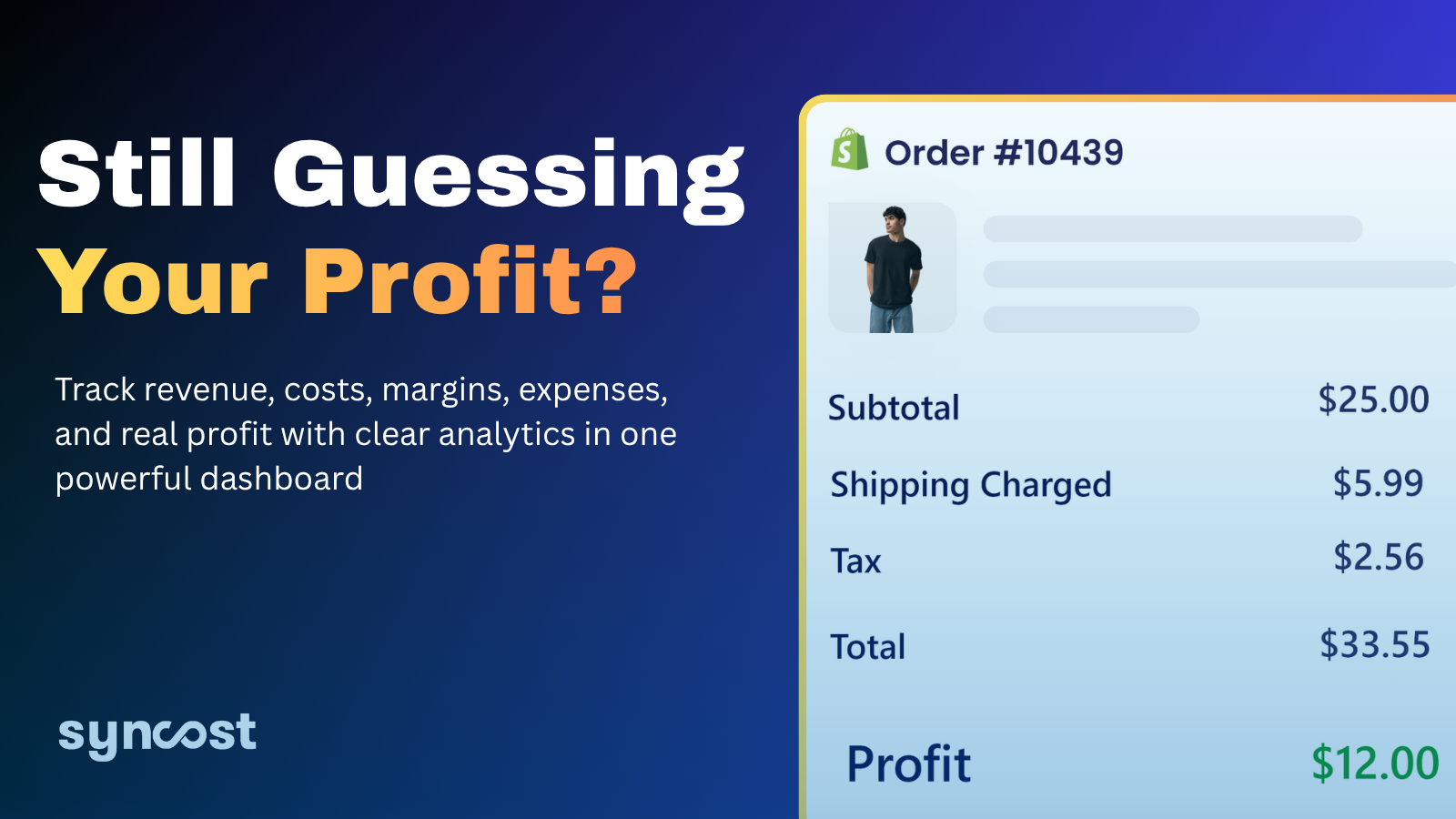
The teardown above gives you the framework. Running it accurately on your actual order mix — across the products you sell, the destinations you ship to, and the channels you use to acquire customers — requires per-order data that Printful's dashboard and Shopify's analytics don't assemble in one place.
Syncost does exactly this for Shopify merchants. It automatically pulls your Printful product costs, Shopify fees, and ad spend together on every order — so you see the real net profit on each sale, not just the revenue. When Printful's base cost changes in a February update, it appears in your per-order margin immediately. When Growth discounts change the economics of a product, the impact shows in the order data rather than in a quarterly spreadsheet reconciliation. Use the numbers in this guide to evaluate whether Printful fits your business model. Use Syncost to confirm those numbers are holding on every order you ship.
All Printful base costs, shipping rates, and plan details reflect verified 2026 information from Printful's pricing page and multiple independent sources. Prices are subject to change; verify current rates in your Printful dashboard before making pricing decisions. All margin calculations are illustrative and assume US domestic orders with standard DTG printing and no add-ons.