Shopify Fees in 2026: The Complete Breakdown of What You Really Pay Per Sale
The monthly plan price is the smallest part of what Shopify costs you. This complete 2026 breakdown maps every fee layer — subscription, payment processing, third-party charges, apps, and chargebacks — with a worked per-order example that shows exactly what lands in your bank account after every deduction.
Ask ten Shopify merchants what Shopify costs and most will quote you a monthly plan price. That number is the smallest part of the story. The subscription fee is a fixed line item you notice once a month — the fees that actually shape your margin are the ones deducted quietly from every single order.
This is the complete, up-to-date breakdown of Shopify fees in 2026: every layer, every rate, and a worked per-order example that shows exactly what lands in your bank account after Shopify takes its cut. All figures are pulled from Shopify's official 2026 pricing and payments documentation. Bookmark it — it's built to be the one page you actually check before you price a product.
The 5 Layers of Shopify Fees
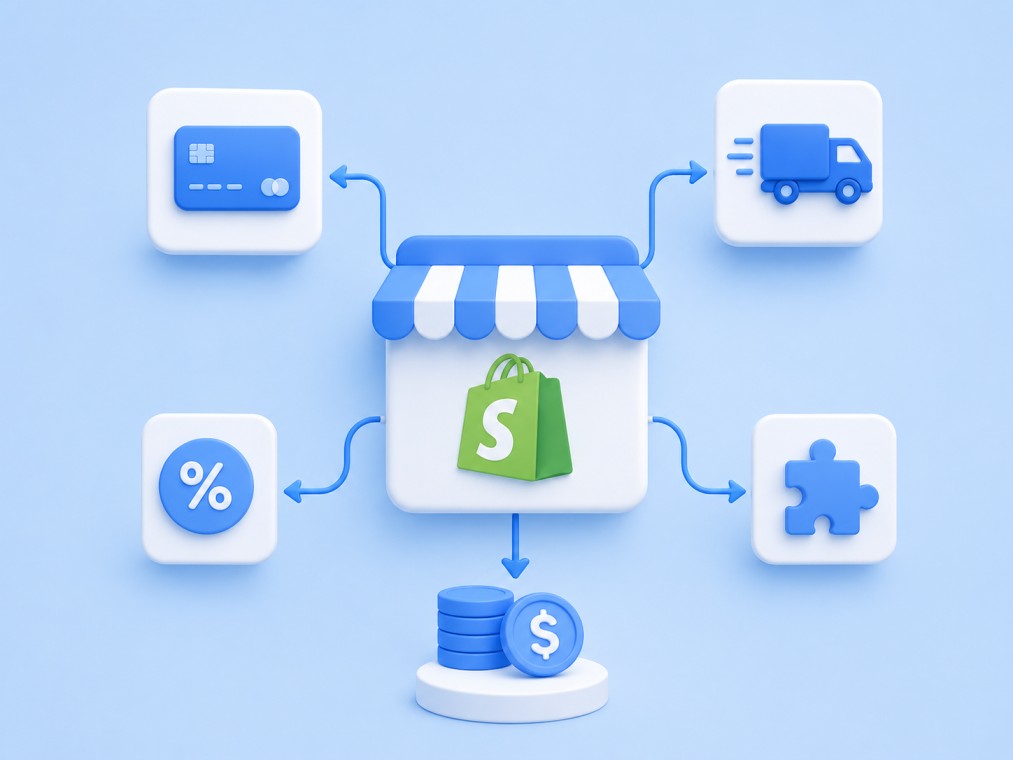
Before the tables, it helps to see the full stack. Shopify fees fall into five layers, and a healthy margin depends on understanding all of them together, not one at a time:
- Plan subscription — your fixed monthly platform fee.
- Payment processing — the percentage plus flat fee taken on every card transaction.
- Third-party transaction fees — an extra penalty Shopify charges if you don't use Shopify Payments.
- App subscriptions — recurring costs for the tools that run your store.
- Chargebacks and other per-event fees — disputes, currency conversion, marketplace sync, and more.
Layers one and four are predictable monthly costs. Layers two, three, and five hit per order — and that's where merchants lose money without realizing it.
Shopify Plan Fees in 2026
Your subscription buys the platform, checkout, hosting, and a processing rate that improves as you move up tiers. Here are the current US plan prices.
| Plan | Monthly billing | Annual billing (per month) | Best for |
|---|---|---|---|
| Basic | $39 | $29 | Solo entrepreneurs |
| Grow | $105 | $79 | Small teams |
| Advanced | $399 | $299 | Growing, global stores |
| Plus | from $2,300 (3-yr term) / $2,500 (1-yr) | Billed annually | High-volume & complex businesses |
Two smaller options sit outside the core lineup: Shopify Starter at $5/month gives you checkout links and social selling but no full storefront, and POS Pro is an $89/month-per-location add-on for physical retail. There's also a $0/month Agentic plan for selling through AI channels, where you only pay card rates when a sale happens.
Annual billing saves 25%
Paying yearly instead of monthly cuts roughly 25% off the subscription across Basic, Grow, and Advanced. That's about $120/year saved on Basic, $312 on Grow, and $1,200 on Advanced — the single easiest fee reduction available, with no downside beyond committing upfront.
Shopify Payment Processing Fees
This is the layer that matters most, because it scales directly with your revenue. When you use Shopify Payments (the built-in processor), you pay only the card rate below — no separate transaction fee.
| Plan | Online standard cards | Online premium cards | In-person cards |
|---|---|---|---|
| Basic | 2.9% + 30¢ | 3.5% + 30¢ | 2.6% + 10¢ |
| Grow | 2.7% + 30¢ | 3.3% + 30¢ | 2.5% + 10¢ |
| Advanced | 2.5% + 30¢ | 3.1% + 30¢ | 2.4% + 10¢ |
| Plus | from 2.25% + 30¢ | Negotiated | Negotiated |
Premium and international card surcharges
Two surcharges catch merchants off guard. Premium cards — American Express, corporate, and rewards cards — carry the higher "premium" rate above. And international cards add +1% on top of your standard rate on every plan. If a meaningful share of your customers pay from abroad, your effective processing rate is higher than the headline number suggests.
Alternative payment methods
Not every checkout runs on a standard card. PayPal Wallet starts at 3.49% + 49¢. In-person manual entry (typing a card number) is 3.5% + 10¢ on all plans. USDC stablecoin payments match the standard online card rate. Each method carries its own economics, so your true blended processing cost depends on your actual payment mix.
Third-Party Transaction Fees
Here's the fee that surprises people most. If you choose to process payments through an external gateway instead of Shopify Payments, Shopify charges an additional transaction fee on top of whatever your gateway already charges.
| Plan | Third-party transaction fee |
|---|---|
| Basic | 2.0% |
| Grow | 1.0% |
| Advanced | 0.6% |
| Plus | 0.2% |
On the Basic plan, that means a third-party gateway charging 2.9% + 30¢ effectively costs you 4.9% + 30¢ once Shopify's 2% is added. For most merchants, the math strongly favors Shopify Payments. One nuance worth knowing: gift cards and store credit are treated as outside payment instruments, so on some plans they can trigger this fee even when Shopify Payments is your main processor.
App Subscription Fees
Apps aren't a Shopify fee in the strict sense, but they're an unavoidable part of your real cost. The average store runs several paid apps for email, reviews, upsells, subscriptions, and analytics. Realistic monthly spend:
- Small stores: $50–$200/month
- Growing DTC brands: $200–$800/month
- Enterprise / Plus stores: $1,000–$3,000+/month
Because app fees are fixed monthly costs, their per-order impact shrinks as your volume grows — which is exactly why they belong in any honest "cost per sale" calculation rather than being ignored.
Chargeback and Dispute Fees
When a customer disputes a charge, Shopify Payments charges a $15 chargeback fee for US merchants, deducted from your next payout along with the disputed amount. The fee is refunded if you win the dispute. Eligible fraud-related chargebacks may be covered by Shopify Protect, which reimburses both the disputed amount and the fee for qualifying US orders. Chargebacks are among the most damaging fees because you lose the product, the shipping, and the revenue on top of the $15 — so prevention pays for itself quickly.
Other Fees to Watch
A few smaller charges round out the picture:
- Marketplace order sync: the first 50 synced marketplace orders per month are free; beyond that it's 1%, capped at $99/month.
- Currency conversion: cross-border payouts are subject to exchange-rate adjustments.
- POS Pro: $89/month per physical location.
- Shopify Tax: automated sales-tax filing carries usage-based fees once you cross certain thresholds.
The Complete Shopify Fees Table (2026)
Here is the full fee stack in one place — the reference table to link back to.
| Fee type | Basic | Grow | Advanced | Plus |
|---|---|---|---|---|
| Monthly subscription | $39 ($29 annual) | $105 ($79 annual) | $399 ($299 annual) | from $2,300 |
| Online standard card | 2.9% + 30¢ | 2.7% + 30¢ | 2.5% + 30¢ | from 2.25% + 30¢ |
| Online premium card | 3.5% + 30¢ | 3.3% + 30¢ | 3.1% + 30¢ | Negotiated |
| International card surcharge | +1% | +1% | +1% | Negotiated |
| In-person card | 2.6% + 10¢ | 2.5% + 10¢ | 2.4% + 10¢ | Negotiated |
| Third-party transaction fee | 2.0% | 1.0% | 0.6% | 0.2% |
| Chargeback fee (US) | $15 | $15 | $15 | $15 |
| POS Pro (per location) | $89 | $89 | $89 | Included (20 locations) |
| 1% back on sales (credit cap) | up to $5,000 | up to $7,500 | up to $10,000 | up to $15,000 |
What You Really Take Home on a $100 Order
Rates in a table are abstract. Here's what they mean for a single $100 order paid by a standard domestic card through Shopify Payments.
| Plan | Processing fee | You keep |
|---|---|---|
| Basic | 2.9% + 30¢ = $3.20 | $96.80 |
| Grow | 2.7% + 30¢ = $3.00 | $97.00 |
| Advanced | 2.5% + 30¢ = $2.80 | $97.20 |
| Plus | 2.25% + 30¢ = $2.55 | $97.45 |
The same order through a third-party gateway
Now run that $100 order on Basic using an external gateway that charges 2.9% + 30¢, and add Shopify's 2% third-party fee:
$3.20 (gateway) + $2.00 (Shopify's 2%) = $5.20, leaving you $94.80.
That's $2.40 less per order than using Shopify Payments — pure margin lost to avoidable fees.
When a chargeback hits
A single disputed $100 order costs far more than the sale. You lose the $100 (deducted from your payout), pay the $15 chargeback fee, and forfeit the product and shipping you already sent. Even at a low dispute rate, chargebacks quietly reshape your annual margin.
The number the tables don't show
Everything above is just processing. Your true cost per order also includes the subscription and apps, spread across your volume. Take a Grow store doing 500 orders a month at a $100 average:
- Processing: 500 × $3.00 = $1,500
- Subscription (annual Grow): ~$79
- Apps: ~$200
- Total: ~$1,779 on $50,000 revenue = ~3.56%, or about $3.56 per order
So the "$3.00" processing fee is really closer to $3.56 per order once fixed costs are amortized. That gap — between the sticker rate and your actual take-home — is where profitable-looking stores turn out to be barely breaking even.
How to Reduce Your Shopify Fees
The commercial payoff of understanding fees is knowing which levers actually move the needle:
- Use Shopify Payments. Avoiding the third-party transaction fee is the single biggest saving for most stores.
- Switch to annual billing. An instant ~25% cut on your subscription.
- Right-size your plan. Upgrading is worth it when your processing savings exceed the higher subscription — for many stores that tipping point arrives around $25,000–$30,000 in monthly sales.
- Audit your apps quarterly. Most stores carry two to five paid apps they no longer use.
- Prevent chargebacks. Clear product descriptions, tracking numbers, recognizable billing descriptors, and fast customer service keep the $15 fees — and lost product — off your books.
Know Your True Take-Home on Every Order
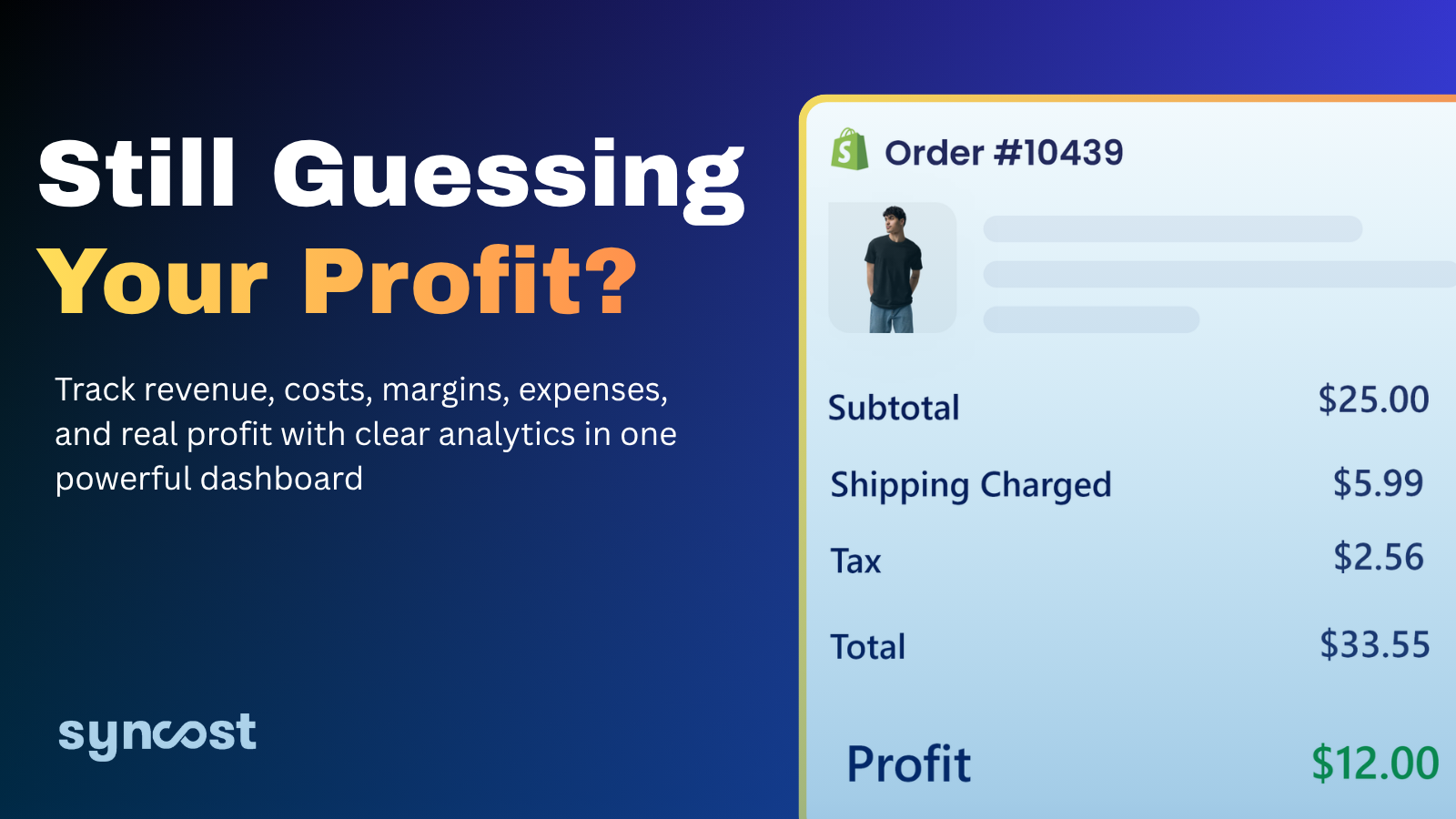
The hardest part of Shopify fees isn't the rates — it's that they're scattered across processing statements, app invoices, ad platforms, and payout deductions, so no single screen shows what any given order actually earned you. That's precisely the blind spot Syncost closes for Shopify merchants. It automatically pulls together your hidden costs — payment fees, product costs, shipping, and ad spend — into one clear view, so every order tells the full story and you can see your real net profit per sale instead of estimating it. Once you can see which products and campaigns are actually profitable after every fee in this guide, you stop scaling revenue that quietly loses money and start scaling true profit.
Shopify pricing is subject to change. Figures reflect Shopify's published US rates as of 2026 — always confirm current pricing on Shopify's official pricing page before making decisions.