The Payment Gateway Reserve Trap: How Rolling Holds and Hidden Processing Fees Stifle Shopify Cash Flow
Your Shopify payout report shows record-breaking monthly sales, but your corporate bank account is constantly running dry because payment processors are quietly withholding 20% in rolling reserves. Discover how gateway holds and interchange fees drain your operating liquidity, and learn how to master your true cash velocity.

The Hook & The Silent Problem
You log into your Shopify dashboard on a Friday afternoon and smile at the metrics. Your new creative campaign clicked, your daily order volume has tripled, and your top-line gross revenue for the month just crossed $300,000. You feel like an unstoppable e-commerce founder ready to scale aggressively into the next quarter.
Then, you check your business bank account to wire a critical $50,000 deposit for your next manufacturing production run. The transfer fails due to insufficient funds.
You frantically open your payment processor dashboard (whether Shopify Payments, Stripe, or a custom merchant account). That is when you discover the devastating reality: out of your $300,000 in gross sales, the processor has slapped an emergency 20% rolling reserve on your account. Sixty thousand dollars of your hard-earned cash is completely frozen for 180 days, held back to cover potential future chargebacks and returns.
Furthermore, when you analyze your monthly settlement statements, you realize that between interchange fees, cross-border conversion markups, and PCI compliance non-compliance penalties, your actual payment processing costs aren't the standard 2.9% + $0.30 you assumed—they are devouring nearly 4.5% of your gross revenue.
How can a business generating massive top-line revenue be pushed to the brink of insolvency by its own payment gateway?
You have fallen straight into the Payment Gateway Reserve Trap.
Founders frequently treat payment processing as a passive utility—a silent pipe that channels money from the customer's credit card into the company bank account. But in the ruthless mechanics of direct-to-consumer e-commerce, payment processors act as risk-averse financial institutions. The moment your sales velocity spikes, your refund rate ticks up by 1%, or your average order value shifts, risk algorithms trigger automated holds that instantly lock up your working capital. If you do not monitor your effective processing rates and cash reserve exposures, your growth will be choked off by liquidity freezes long before your products ever reach your customers.
Core Concept Explained (The Quick Answer)
Payment Gateway Reserves (Rolling Holds) are mandatory funds withheld by payment processors from daily sales payouts—typically ranging from 10% to 25% for 90 to 180 days—to protect against potential customer chargebacks, refunds, and fraudulent disputes. Effective Processing Cost measures the true total percentage of revenue consumed by payment gateways once interchange fees, assessment fees, cross-border surcharges, and gateway markups are fully aggregated.
The Deep-Dive Reference Guide
To eliminate hidden cash leaks at checkout, you must deconstruct every fee category and risk restriction imposed by your merchant processors.
| Gateway Fee or Hold Type | Operational Trigger | The Margin Impact (The Hidden Drain) | Risk Level to Cash Flow |
|---|---|---|---|
| Rolling Reserve Hold | Triggered by sudden sales scaling, high-risk categories, or spikes in customer refund rates. | Severe Liquidity Freeze. Traps 10% to 25% of daily revenue for 6 months, starving your working capital. | Critical. Can instantly paralyze inventory purchasing and ad funding. |
| Interchange & Assessment Fees | Non-negotiable base rates set by Visa, Mastercard, and American Express per transaction. | Fixed Variable Drain. Higher-tier rewards cards and business credit cards incur higher interchange costs. | Moderate. Predictable baseline expense if monitored closely. |
| Cross-Border / FX Surcharges | Applied when international customers purchase using foreign currency cards. | Margin Erosion. Adds an extra 1% to 2% penalty per transaction plus unfavorable conversion spreads. | High for brands expanding into global markets without localized billing. |
| Chargeback Dispute Penalties | Assessed when a customer initiates a forced bank reversal instead of contacting support. | Direct Cash Loss. Processors charge a $15 to $25 fee per dispute plus the loss of the product and sale. | Moderate to High depending on product quality and customer service response times. |
Technical Breakdown & Formulas
Evaluating your true payment processing efficiency requires looking beyond headline gateway rates and calculating your fully burdened effective processing cost and reserve exposure.
The Effective Processing Rate Formula:
Effective_Processing_Rate = (Total_Processor_Fees_Paid / Total_Gross_Sales_Volume) * 100

The Rolling Reserve Cash Lockup Formula:
Locked_Working_Capital = Monthly_Gross_Revenue * (Reserve_Percentage_%)

True Net Cash Payout Formula:
True_Net_Payout = Gross_Revenue - Effective_Processing_Fees - Rolling_Reserve_Withheld - Refunds_And_Chargebacks
The Math in Action: Consider a month where your Shopify store generates $200,000 in gross revenue.
- Your headline processor rate is 2.9% + $0.30 per transaction across 2,000 orders ($100 AOV).
- Headline processing fees: $(200,000 * 0.029) + (2,000 * $0.30) = $5,800 + $600 = $6,400$.
- However, due to international orders, cross-border FX fees, and premium rewards card interchange bumps, your actual processor fees total $8,200.
- Your Effective Processing Rate is actually
($8,200 / $200,000) * 100 = 4.1%, significantly higher than the advertised baseline. - To compound the issue, if your processor slaps a 15% rolling reserve on your account for 90 days due to a sudden scaling spike, $30,000 in liquid cash is instantly locked away, leaving you scrambling to cover operational expenses.
The Scaled Financial Impact (What It Actually Costs You)
Let’s examine how unmonitored gateway reserves and processing fees destroy your operating cash flow during scaling phases, comparing a store operating with clean payout velocity against one crippled by gateway holds while scaling from $50,000 to $500,000 in monthly gross revenue.
Store A: Optimized Payment Routing (Low Friction Payouts)
- Effective Processing Rate: 2.6% (Optimized interchange-plus pricing).
- Rolling Reserve Exposure: 0% (Clean risk profile, immediate next-day payouts).
- Monthly Gross Revenue: $300,000.
- Total Processing Costs: $7,800.
- Trapped Working Capital: $0.
- Operational Reality: Cash hits the bank account instantly, recycling seamlessly into Meta ad spend and inventory replenishment.
Store B: The "Gateway Hold" Trap (High Friction Payouts)
- Effective Processing Rate: 4.2% (Blended markup pricing with cross-border penalties).
- Rolling Reserve Exposure: 20% held for 120 days.
- Monthly Gross Revenue: $300,000.
- Total Processing Costs: $12,600.
- Trapped Working Capital (Rolling Reserve): $60,000 locked every single month.
- The Catastrophic Reality: Store B is paying $4,800 more in pure processing fees every month and has $60,000 of its monthly revenue frozen in reserve. By Month 4, Store B has $240,000 trapped in gateway purgatory. The founder is forced to take on high-interest merchant cash advances just to pay for inventory that is already sitting sold in customers' hands.
Strategic Execution (How to Apply This to Your Business)
To break free from payment gateway traps and protect your operating liquidity, execute this four-step payment infrastructure optimization workflow.
-
Calculate Your True Effective Processing Rate: Audit processor billing structures. Stop relying on advertised flat rates. Export your last 90 days of merchant processing statements. Divide total fees paid by total gross sales to find your true Effective Processing Rate. If your blended rate exceeds 3.3%, audit your gateway setup for hidden cross-border surcharges and non-compliance fees.
-
Proactively Prevent Rolling Reserve Triggers: Mitigate risk triggers. Payment processors freeze funds when risk algorithms panic. Prevent reserve holds by maintaining a strict customer refund rate below 5%, keeping chargeback rates under 0.8%, and providing automated shipping tracking numbers within 24 hours of checkout so processors can verify fulfillment velocity.
-
Implement Multi-Gateway Load Balancing: Diversify merchant accounts. Never rely 100% on a single payment gateway. If you scale rapidly, establish backup merchant accounts (such as alternative merchant processors integrated via Shopify) to split your transaction volume. Diversifying your payment routing prevents a single platform hold from locking up 100% of your company's cash flow.
-
Transition to Interchange-Plus Pricing: Negotiate enterprise terms. If your monthly processing volume exceeds $100,000, abandon flat-rate blended pricing models immediately. Negotiate an Interchange-Plus pricing structure with your processor, ensuring you pay the exact wholesale network fee set by credit card issuers plus a flat, transparent processor markup.
Frequently Asked Questions (FAQ)
Why do payment gateways suddenly impose rolling reserves on Shopify stores?
Payment gateways impose rolling reserves when they detect abnormal risk profiles—such as a sudden, massive spike in daily sales volume, an increase in customer chargebacks, a high rate of delayed fulfillment, or operating in a high-risk product category. Because processors are legally liable for refunds and chargebacks if a merchant goes bankrupt, they withhold a percentage of your cash as a safety buffer.
How can I lower my effective credit card processing fees?
To lower your effective processing rate, transition away from flat-rate blended pricing (like standard Shopify Payments or basic Stripe tiers) once your monthly volume exceeds six figures. Negotiate custom Interchange-Plus pricing contracts, optimize your checkout flow to encourage lower-cost debit cards over high-reward credit cards, and implement robust fraud-prevention tools to eliminate costly chargeback fees.
What is the difference between a rolling reserve and a fixed reserve?
A fixed reserve requires a lump-sum cash deposit upfront (or withheld from your first payouts) that sits untouched until your merchant account contract is closed. A rolling reserve continuously withholds a percentage (e.g., 10%) of every daily payout for a set period (e.g., 180 days), after which the oldest withheld funds are systematically released back to your bank account on a rolling schedule.
How does Syncost account for processing fees and gateway holds?
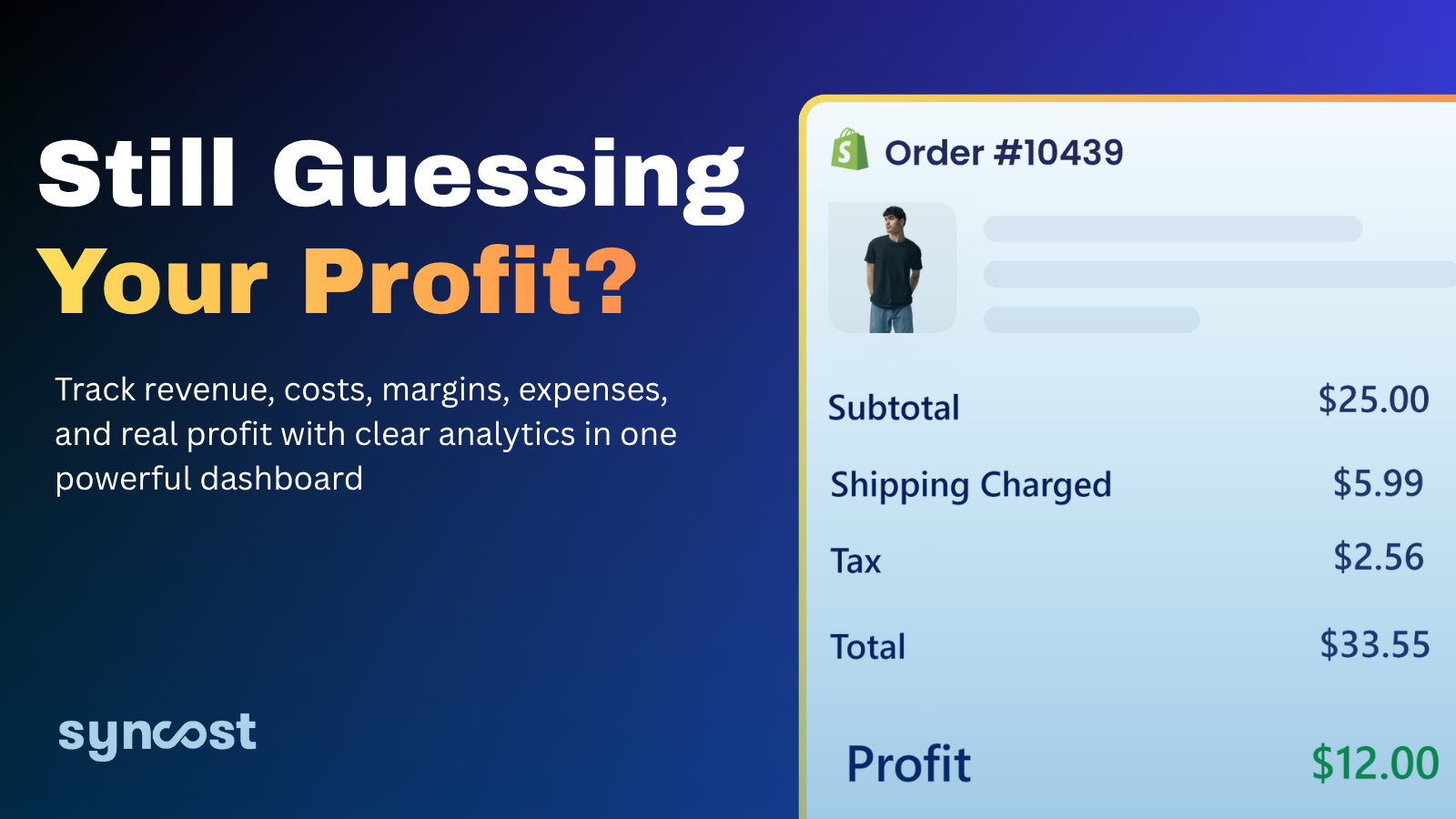
Syncost tracks your true bottom-line profitability by capturing all variable costs associated with every transaction, including exact payment gateway fees, processing markups, and payment gateway percentages. By integrating directly with your store and financial data, Syncost ensures your profit reporting reflects the actual cash clearing your bank accounts, stripping away the illusion of unadjusted gross revenue figures.
From Financial Chaos to Verified Profit
Scaling an e-commerce brand while ignoring the hidden mechanics of payment gateway fees and rolling reserves is a dangerous gamble. When your Shopify dashboard celebrates record-breaking gross sales while unexpected gateway holds freeze your operating capital, your business is building its growth on unstable financial ground.
You cannot protect your bottom line if your analytics tools treat unadjusted gross revenue as spendable cash while ignoring processing fees and reserve lockups.
This is precisely why elite Shopify founders run their operations on Syncost.
Syncost brings absolute mathematical clarity to your e-commerce unit economics. By integrating seamlessly with Shopify, your paid marketing channels, and your custom cost structures, Syncost automatically tracks your true Net Profit and cash velocity in real time. It strips away the illusion of top-line vanity metrics and delivers a bottom-up view of your true financial health on every single order.
Stop letting hidden gateway fees and surprise rolling reserves quietly drain your operating capital. Install Syncost today, master your true unit economics, and scale your brand with absolute financial confidence.