How to Increase Average Order Value (10 Tactics That Protect Margin)
A 22% AOV increase can mean real profit growth — or just more revenue at thinner margin. Here are 10 tactics to increase average order value ranked by their margin impact, not just cart size: version upsells, post-purchase add-ons, bundle pricing, free shipping thresholds, and more, with the math that shows which ones actually improve your bottom line.

Average order value is one of the most-cited ecommerce metrics and one of the most misused. Stores chase AOV as if a bigger cart is automatically a better one — then discover they've increased revenue while compressing margin, because every tactic that adds to cart value doesn't add to cart profit at the same rate.
A bundle that adds $15 to the order value but costs $12 in extra product cost adds $3 to profit. A free-shipping threshold that increases AOV by $18 by adding a $4 product to qualify costs you the $4 product and the shipping you just gave away — often a net-negative margin event despite the headline cart-size increase.
This guide ranks 10 AOV tactics by their margin impact, not just their ability to inflate the number in your Shopify dashboard. The distinction matters because one drives profitability, and the other drives the illusion of it.
Why AOV and Margin Must Be Tracked Together
Average order value tells you how much customers spend per transaction. Contribution margin per order tells you how much of that spend you actually keep. When these two numbers move together, AOV improvements are real profit wins. When they diverge — AOV up, margin flat or down — something in the tactic structure is giving back what the cart size gained.
The clearest example: a 20% discount that raises AOV from $35 to $55 because customers buy two units instead of one. Revenue per order went up $20. But the discount applied to both units — and at 20% off, the margin on the additional unit is lower than on the original. AOV is up. Margin per dollar is down. Gross profit per order may or may not have improved, depending on the product economics. Tracking both tells you which way it went. Tracking only AOV tells you nothing useful.
The 10 Tactics, Ranked by Margin Impact
1. Upsell to a Higher-Margin Version of the Same Product
Margin impact: High — often the highest per-dollar added to cart
If a customer is buying a $30 product and there's a $45 version with meaningfully better features, an in-context upsell at the product page or checkout converts a portion of them to the higher-value option. Critically, if the $45 version has the same base cost as the $30 version (a software tier, a premium material, a larger size with similar unit cost), the incremental $15 goes almost entirely to margin.
This is the highest-margin AOV tactic available because it converts existing intent rather than adding new products. No extra shipping cost. No additional fulfilment complexity. The customer was already buying — you're simply moving them to the version with better unit economics for both parties.
How to implement: Product page upsells showing a comparison of standard vs. premium, or post-add-to-cart interstitials offering a version upgrade. Keep the upgrade price differential below 60% of the original price — above that, conversion drops sharply.
2. Post-Purchase Upsell (One-Click Add-on After Checkout)
Margin impact: High — full-margin addition with no CAC
A post-purchase upsell presents an offer after the customer has completed payment — Shopify's checkout extensibility supports these natively, and apps like ReConvert or Zipify OCU add them to most stores. Because the customer has already committed to buying and the fulfilment is merged with the original order, the economics are excellent: no customer acquisition cost, and the add-on product is added to an already-confirmed order at whatever margin it carries.
Conversion rates on post-purchase upsells typically run 10–25% depending on relevance. A store doing 400 orders a month, with a $12 average upsell value and 15% uptake, adds $720/month in revenue with near-zero acquisition overhead.
What to offer: Complementary products, consumables (batteries, filters, cleaning kits), or a subscription upgrade. The product should feel like a logical next purchase, not a random cross-sell.
3. Product Bundling With a Real Discount
Margin impact: Medium-to-high — depends on bundle structure
Bundles increase AOV by selling multiple products together at a combined price, usually with a modest discount versus buying items separately. The margin outcome depends entirely on how the bundle is priced.
A bundle offering three products at 10% off the combined retail price needs to be analysed as: (total bundle revenue) minus (COGS on all three units) minus (fulfilment cost) — not just "AOV went up by $X." If the three-unit COGS is $28 and the bundle sells for $54 (10% off $60), gross profit is $26 on a $54 order. Versus the standalone first-unit sale of $20 profit on $20 revenue, the bundle adds $34 in revenue and $6 in gross profit. That's a 17.6% gross margin on the incremental revenue — lower than the standalone margin but still additive.
The high-margin bundle structure: Bundle a high-margin product with a lower-margin one, pricing the bundle at a discount on the low-margin item. The customer perceives value; you protect margin on the hero product.
The margin-destroying bundle structure: Bundle your three highest-margin products at 20% off to increase AOV. You've increased cart size while compressing margin on your best products.
4. Free Shipping Threshold
Margin impact: Medium — only when set correctly
A free shipping threshold ("free shipping on orders over $50") incentivises customers to add items to reach the threshold. The mechanic works — most studies show 60–70% of customers will add items specifically to qualify for free shipping.
The margin math is tricky. If your average order is $38 and you set the threshold at $55, customers adding $17 of product to qualify cost you the COGS on that product plus the shipping you're now absorbing. If shipping costs $5.50 and the added item costs $4.50, you've added $17 in AOV for $10 in cost — a $7 gross profit improvement. If the added item costs $12, you've improved AOV by $17 for $17.50 in cost — a margin-negative transaction.
Set the threshold correctly: Calculate your average shipping cost, then set the threshold at (current AOV × 1.3) + shipping cost. This creates a threshold customers can reach without spending so much more that they abandon, while ensuring the incremental product margin covers the shipping cost you're absorbing.
5. Volume Discounts (Buy More, Save More)
Margin impact: Medium — requires precise tier design
"Buy 2, save 10% / Buy 3, save 15%" is a classic AOV driver for consumables, fashion basics, and products customers naturally use multiples of. It works because it combines the incentive to save with the excuse to buy more of something they already wanted.
The margin impact depends on where the discount tiers fall. A 10% discount on unit 2 reduces margin on that unit by roughly 10 margin points at constant cost. If your gross margin is 50%, a 10% price reduction on incremental units drops their margin to approximately 44%. That's still profitable and meaningful for a low-CAC sale — but it's not the same margin as unit 1.
Margin-protecting volume discount structure: Offer the first-unit price with no discount. Offer unit 2 at 10% off. Stop there unless your product has a very high gross margin (60%+) that can absorb a third tier. The goal is to convert single-unit buyers into two-unit buyers — not to cascade discounts through an entire order.
6. Complementary Product Cross-Sells at Cart
Margin impact: Medium — depends entirely on what you cross-sell
Cross-selling ("customers also bought," "pair this with," "complete the look") at the cart or product page adds relevant adjacent products to the consideration set. It increases AOV when it converts — which depends on relevance and friction.
The margin impact is determined by which products you cross-sell. Cross-selling a high-margin accessory to a lower-margin hero product improves your blended order margin. Cross-selling a low-margin consumable as the add-on depresses it. Before setting up cross-sell logic, rank your products by gross margin and prioritise surfacing high-margin items as cross-sells — not just items with high affinity in your order data.
7. Minimum Order for a Free Gift
Margin impact: Medium — only if the gift is a low-cost, high-perceived-value item
"Spend $65, get a [branded item] free" works as an AOV driver when the gift has meaningful perceived value but low COGS. A branded tote bag that costs you $2.50 to produce but carries perceived value of $15–$20 works well. A skin-care sample that costs you $1.50 and introduces a product the customer might repurchase works even better.
The margin math: the customer adds $25 to reach the $65 threshold. The gross profit on that $25 in incremental product covers the $2.50 gift cost many times over. Net margin on the transaction improves despite the "free" gift, because the threshold addition and the gift economics both work in your favour.
What undermines this tactic: Using a product with significant COGS as the gift, or setting the threshold too high so customers don't reach it.
8. Subscription or Replenishment Offer at Checkout
Margin impact: Medium-to-high over time, modest per-order
Offering "subscribe and save" at checkout — typically 10–15% off in exchange for a recurring order — converts a one-time buyer into a predictable repeat customer. For consumable products (supplements, coffee, skincare, cleaning products), this is the highest-LTV tactic available.
The margin impact on the first order is modest or slightly negative (the 10–15% discount reduces first-order margin). The long-term margin impact is significant: subscription customers have near-zero CAC on all subsequent orders, which dramatically improves contribution margin over their lifetime. A subscription at 50% gross margin with no acquisition cost beats a 60% gross margin one-time sale that cost $15 to acquire, calculated across 12 months of orders.
9. Time-Limited Upsell Offers
Margin impact: Low-to-medium — depends on discount depth
Countdown timers and "this offer expires at checkout" mechanics reduce the psychological cost of the upsell decision. Used well, they lift post-purchase upsell conversion without requiring a deeper discount. The margin risk: time-limited offers often use a discount as the urgency mechanism. Scarcity without a discount — "this product is only available at checkout" — is the higher-margin version when the product justifies it.
10. Loyalty Points Earned on Current Order
Margin impact: Low per order — positive LTV effect
Showing customers the loyalty points they'd earn doesn't increase AOV on this transaction. It increases the probability of the next one — at near-zero CAC. Loyalty members tend to spend more per order over time, which becomes an AOV lift across the customer relationship. This tactic protects margin most when point redemption is structured at 1–5% of order value, so future-order margin isn't meaningfully eroded.
The AOV Tactics Ranked
| Tactic | AOV impact | Margin impact | Best for |
|---|---|---|---|
| Version upsell (same product) | Medium | High | Any store with good/better/best product tiers |
| Post-purchase upsell | Medium | High | All stores — set up first |
| Product bundling | High | Medium-High | Consumables, multi-use product lines |
| Free shipping threshold | High | Medium | Stores where shipping is the barrier |
| Volume discounts | Medium | Medium | Consumables, fashion basics |
| Cross-sells at cart | Medium | Medium | Stores with complementary catalogs |
| Gift-with-purchase | Medium | Medium | Brand-led stores with low-cost samples |
| Subscription offer | Low (first order) | Medium-High (LTV) | Consumables and recurring-need products |
| Time-limited upsell | Low-Medium | Low-Medium | Use without aggressive discounts |
| Loyalty points | Low | Low-Medium | Mature stores focused on retention |
A Bigger Order Is Only Better If the Margin Is There
Tracking AOV alongside contribution margin per order is the difference between knowing you're growing and knowing the growth is profitable. An AOV that increased because customers are buying high-margin bundles is a win. An AOV that increased because you're offering deeper discounts to move more volume is not — even if the dashboard shows a 22% AOV improvement.
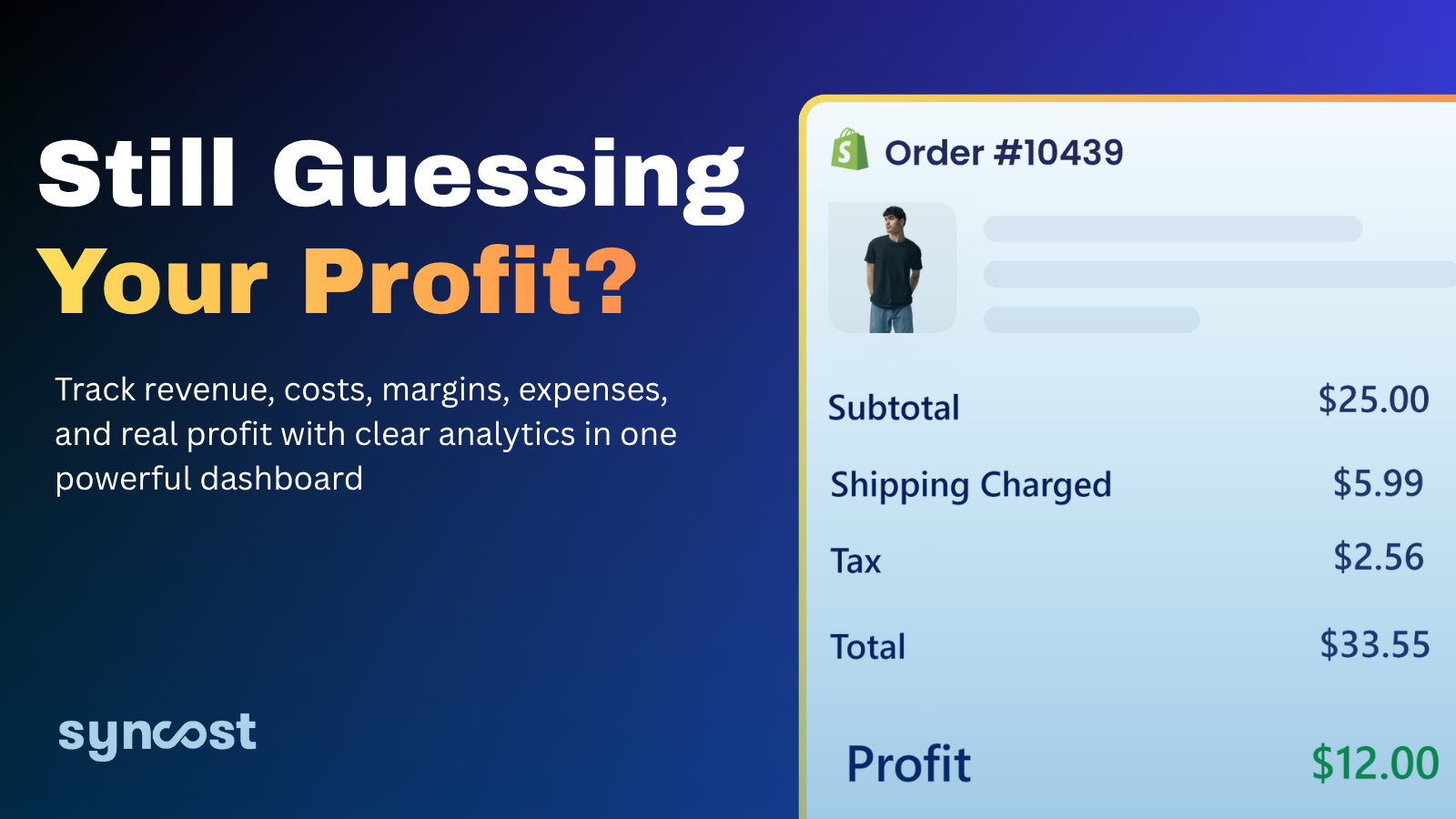
Syncost shows Shopify merchants the real margin on every order — so when you implement any of the tactics above, you can see whether the AOV gain translated into a profit gain or just a revenue one. Because a bigger cart that costs you as much as it adds isn't growth. It's activity — and in ecommerce, activity without margin is the most expensive kind of busy there is.
AOV benchmarks and conversion rates referenced are illustrative based on published 2026 ecommerce industry data. Results vary by product category, pricing structure, and implementation quality.