The Return Rate Death Spiral: How Reverse Logistics Silently Bankrupt E-Commerce Stores
Processing a return doesn't just cost you the sale—it actively drains your cash flow through dead shipping, unsellable inventory, and wasted acquisition costs. Learn how to calculate the true mathematical penalty of reverse logistics and stop returns from vaporizing your Shopify net profit.

The Hook & The Silent Problem
Listen, let's not sugar-coat the reality of e-commerce returns: accepting a return is not a "neutral" financial event. It is a violently negative cash flow transaction that can completely obliterate the profit margins of your most successful marketing campaigns.
You just finished a massive weekend push. Your Shopify dashboard is flashing $50,000 in gross revenue, and you are feeling invincible. But two weeks later, the return requests start trickling in. Most operators simply look at a return as a refunded sale—revenue that temporarily hits the books and is then subtracted. This is a fatal miscalculation.
When a customer returns a product, you do not simply go back to zero. You suffer the "Triple Penalty." You permanently lose the ad spend (CAC) used to acquire that customer. You lose the outbound pick, pack, and shipping fees. And you incur new, hidden costs in the form of return shipping labels, 3PL receiving fees, un-refunded payment gateway percentages, and damaged, unsellable inventory. If you are operating on standard e-commerce margins, a single return doesn't just cost you one sale—it mathematically wipes out the net profit of two to three successful sales. This is the Return Rate Death Spiral. If you aren't tracking reverse logistics as a strict line-item expense, your business is bleeding cash right in front of you.
Core Concept Explained (The Quick Answer)
Reverse Logistics Margin Bleed is the aggregated, unrecoverable cash loss incurred during the lifecycle of a returned order, encompassing sunk marketing costs, bi-directional fulfillment fees, and inventory depreciation. To maintain profitability, operators must calculate the Amortized Return Penalty, which takes the total cost of all returns and divides it across every successfully delivered order, permanently baking the cost of returns into the baseline unit economics of the business.
The Deep-Dive Reference Guide
To stop the bleeding, you must fundamentally change how you categorize returns on your Profit and Loss (P&L) statement. Here is how amateur operators view returns compared to how an elite CFO handles them.
| Return Variable | The Amateur Assumption (The Trap) | The CFO Reality (True Cash Impact) |
|---|---|---|
| Customer Acquisition Cost (CAC) | "I lost the sale, but I can re-target them later." | 100% sunk cost. You paid Facebook $40 to acquire a customer who generated $0 in retained revenue. |
| Payment Gateway Fees | "Shopify Payments refunds the customer, so it washes out." | Gateways keep the original 2.9% + $0.30 processing fee. You pay for the privilege of losing money. |
| Fulfillment & Shipping | "I'll just deduct the return shipping label from their refund." | You still paid the outbound shipping, the initial 3PL pick/pack fee, and the 3PL return-to-stock processing fee. |
| Inventory Value | "The item goes right back on the shelf." | Average salvage rate is rarely 100%. Factor in damaged packaging, missing parts, and "used" discounting. |
Technical Breakdown & Formulas
You cannot fix a financial leak until you quantify it down to the exact cent. Use these uncompromising formulas to map the exact cash destruction of your return policy.
Absolute Cost of a Return = Sunk CAC + Outbound Shipping + Outbound 3PL Fees + Un-refunded Gateway Fees + Return Shipping Label + 3PL Restocking Fee + (Landed COGS * Damage Probability %)

Amortized Return Penalty = (Total Number of Returns * Absolute Cost of a Return) / Total Successful Kept Orders

Adjusted True Net Margin ($) = Target Net Profit per Order - Amortized Return Penalty
Sunk CAC: The blended marketing dollars spent to acquire the specific order that was returned. Un-refunded Gateway Fees: Processors like Stripe and Shopify Payments no longer return the transaction fee when you process a refund. On a $150 order, that is a permanently lost $4.65. Damage Probability %: Not all returns are pristine. If historically 20% of returned items must be liquidated or thrown away due to damaged packaging or wear, you must multiply your Landed COGS by 0.20 and add it to the cost of every return. Amortized Return Penalty: This is the most critical metric. You must take the total cash lost to returns and spread that loss across the orders you actually kept. This reduces the margin of your "successful" sales.
The Scaled Financial Impact (What It Actually Costs You)
Let’s apply this math to a rapidly scaling apparel brand selling a $120 premium jacket, operating with a seemingly healthy 10% return rate.
The Baseline Unit Economics (Per Order):
- Retail Price: $120.00
- Landed COGS: $30.00
- Outbound Shipping & 3PL: $12.00
- Blended CAC: $35.00
- Gateway Fee (3%): $3.60
- Target Net Profit (If kept): $120 - ($30 + $12 + $35 + $3.60) = $39.40 true net profit.
The Absolute Cost of One Return: When a customer returns that jacket, you refund their $120 (minus maybe a $7 return label, if you charge for it). But look at your actual cash flow:
- You lost the $35 CAC.
- You lost the $12 outbound fulfillment.
- You lost the $3.60 gateway fee.
- You pay a $4 return 3PL processing fee.
- Assume the item is perfectly restocked (no COGS loss).
- Total Cash Evaporated on One Return: $54.60.
Because you make $39.40 in profit on a successful sale, but lose $54.60 on a return, every single return requires 1.4 successful sales just to break even.
The Impact at Scale (2,000 Orders / Month): If you push 2,000 orders a month with a 10% return rate:
- 1,800 kept orders * $39.40 target profit = $70,920.
- 200 returns * $54.60 cash loss = -$10,920.
- Actual Net Profit: $60,000.
Your return rate just cannibalized over 15% of your total net profit. If your return rate slips to 15% (300 returns), your cash loss balloons to -$16,380, and your business rapidly approaches an unscalable, cash-poor reality.
Strategic Execution (How to Apply This to Your Business)
To stop the hemorrhage, you must build operational friction and financial tracking into your reverse logistics immediately.
-
Implement Strategic Return Friction: Stop subsidizing buyer's remorse. Never offer unconditional free returns. Deduct a standard $7 to $10 flat-rate handling and shipping fee directly from the customer's cash refund. Alternatively, offer a bonus (e.g., 10% extra value) if they choose store credit instead of cash, which protects your retained revenue and preserves the sunk CAC.
-
Audit Your 3PL Receiving Workflows: Contact your fulfillment center and demand their exact Service Level Agreement (SLA) and pricing for returns. Many 3PLs charge 2x the standard pick-and-pack fee just to inspect and re-bin an item. If their restocking fees are exorbitant, negotiate a bulk "quarantine and process weekly" rate rather than daily processing.
-
Calculate Your Amortized Penalty: Pull last month's exact return volume. Calculate your 'Absolute Cost of a Return' using the formula above. Divide that total dollar loss by your total successful orders. Take that final number (e.g., $4.50) and subtract it from your target net profit on every single spreadsheet or forecasting model you use.
-
Isolate Serial Returners via Segmentation: Use your customer data platform to identify users with a return rate higher than 40%. Tag these profiles in Shopify. Exclude these specific users from all Facebook and Google retargeting audiences immediately. Do not pay marketing dollars to re-acquire customers who mathematically guarantee a loss.
Frequently Asked Questions (FAQ)
What is the average e-commerce return rate?
Across the broader e-commerce landscape, average return rates hover between 15% and 20%. However, this is highly vertically dependent. Apparel and footwear routinely see catastrophic return rates of 25% to 35% due to sizing issues, while health, beauty, and print-on-demand (POD) hard goods usually operate safely in the 2% to 6% range.
How do I reduce my return rate on Shopify?
The highest-leverage actions happen pre-purchase. Implement ultra-detailed sizing charts, high-definition video showing the product on different body types, and uncompromisingly clear product descriptions. Post-purchase, force customers through a structured return portal (like Loop or Returnly) that incentivizes exchanges or store credit over straight cash refunds.
Can I legally refuse returns in my e-commerce store?
In the United States, you can generally enforce a "No Returns" or "All Sales Final" policy as long as it is explicitly stated before the purchase is finalized. However, doing so will drastically lower your front-end conversion rate. For EU customers, consumer protection laws legally require a 14-day minimum return window for most goods, regardless of your store's stated policy.
Do Print-on-Demand (POD) suppliers accept returns?
If you are using platforms like Printify or Printful, they generally do not accept returns for buyer's remorse or sizing issues because the product is custom-made. They will only reprint or refund if the item is defective or misprinted. Therefore, if a customer returns a POD item to you, you absorb the 100% loss of the Landed COGS.
From Financial Chaos to Verified Profit
Standard e-commerce dashboards are designed to make you feel good. When a return happens, they quietly deduct the gross revenue and adjust your taxes—but they entirely ignore the sunk marketing costs, the outbound shipping fees, and the non-refundable gateway charges. Managing this across dozens of SKUs in a manual spreadsheet is how scaling brands accidentally run out of cash.
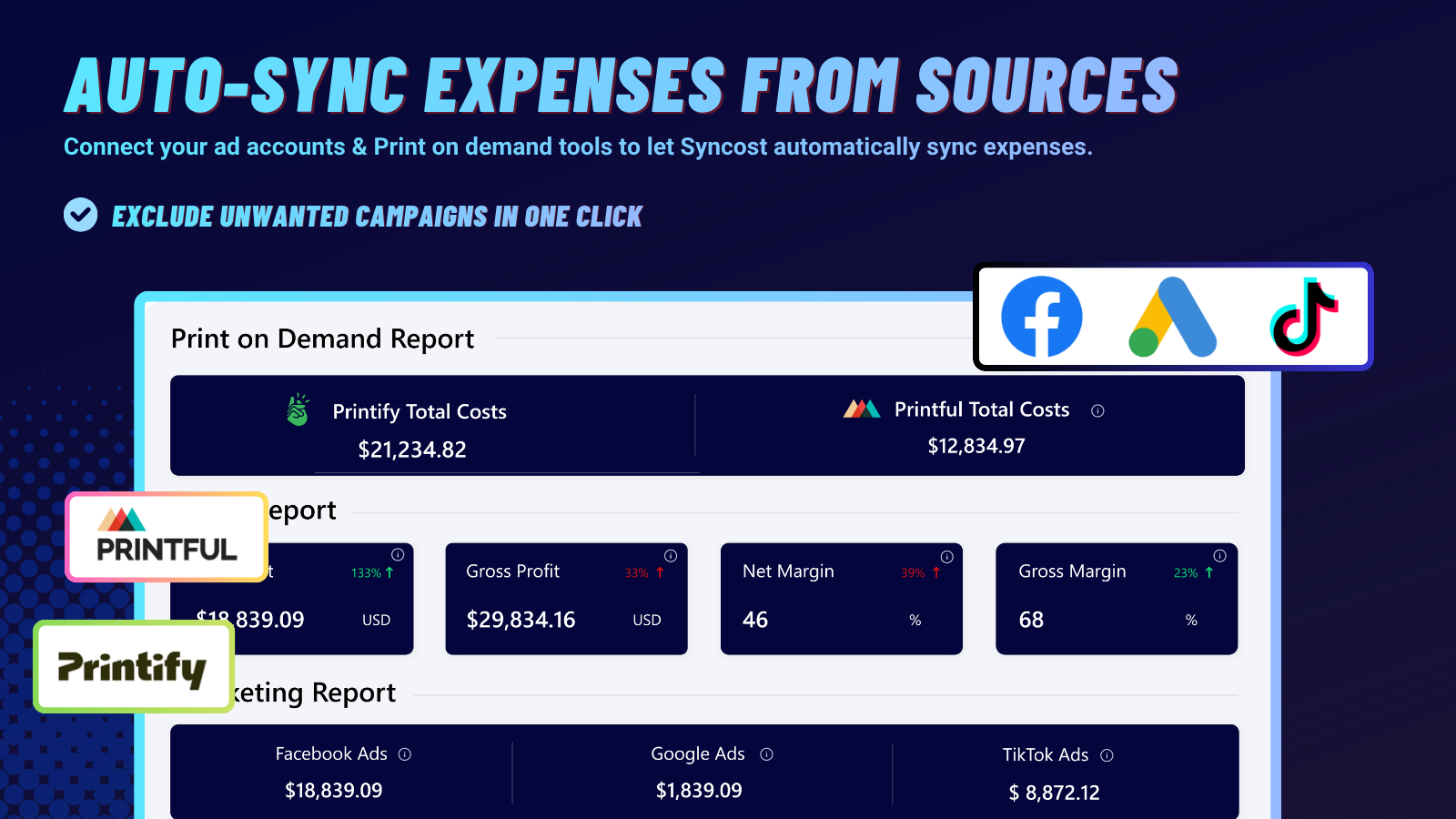
To survive, you need financial infrastructure that calculates the ugly truth. Syncost is built for operators who demand absolute clarity. Instead of guessing at your margin bleed, Syncost actively syncs your storefront, ad platforms, and exact product sourcing costs (including integrations with platforms like Printify) to calculate your true, bottom-up net profit in real-time. It automatically factors in the exact operational drag of your returns, giving you an uncompromising view of your true unit economics. Stop letting reverse logistics silently bankrupt your store. Let Syncost track every cent, so you can scale with absolute confidence.