Discounting to Death: How a 20% Off Sale Destroys 80% of Your Shopify Profit
Running a "20% Off" site-wide sale feels like a guaranteed way to spike revenue, but most founders fail to realize that discounts are deducted directly from net profit, not just top-line revenue. Discover the brutal mathematics of margin erosion and how to drive volume without destroying your cash flow.

The Hook & The Silent Problem
It is Friday morning of a holiday weekend. Growth has been sluggish, so you decide to pull the ultimate e-commerce growth lever: you blast your email list and launch Meta ads announcing a "20% OFF SITEWIDE" flash sale.
The strategy appears to work flawlessly. Your Shopify dashboard lights up. You process 300 orders over the weekend instead of your usual 100. Your top-line revenue graph spikes up and to the right. You high-five your team, confident that the aggressive promotion was exactly what the brand needed to capture market share.
Then, at the end of the month, you run your P&L. You shipped 3x the physical volume. Your customer service team was swamped with inquiries. Your 3PL billed you for triple the pick-and-pack labor. Yet, the actual net cash deposited into your operating account is less than it was during a slow, full-price weekend.
How did you sell three times as much product but make less money?
You fell victim to the absolute mathematics of margin erosion. Most founders view a 20% discount as a minor 20% haircut on their overall business. This is a fatal misunderstanding of unit economics. A discount does not scale down your costs; it comes 100% out of your net profit margin. Because your factory, your 3PL, and your payment gateway still charge you full price for the transaction, offering a 20% discount on your storefront can easily wipe out 60% to 80% of your actual bottom-line cash.
If you do not understand the volume multiplier required to offset a discount, you are not running a promotion—you are subsidizing your customers' purchases with your own operating capital.
Core Concept Explained (The Quick Answer)
Top-Line Discounting is the percentage taken off the retail price of an item. Margin Erosion is the disproportionate destruction of gross and net profit caused by that discount, because variable costs (COGS, fulfillment, CPA) remain static. To maintain the same net dollar profit during a sale, an e-commerce brand must achieve a Breakeven Volume Increase—which often requires selling 200% to 300% more units just to make the exact same amount of money.
The Deep-Dive Reference Guide
To understand why discounts are so devastating, you must look at how a transaction is capitalized. Costs do not care about your coupon codes.
| Financial Layer | Does a 20% Discount Reduce This Cost? | The Margin Impact |
|---|---|---|
| Retail Price (Revenue) | YES. Revenue drops by 20%. | The perceived impact to the customer and the founder. |
| Landed COGS | NO. The factory still charged you the same amount to manufacture the goods. | COGS instantly consumes a significantly higher percentage of the remaining revenue. |
| Pick, Pack & Shipping | NO. The 3PL and UPS do not give you a discount because you ran a sale. | Fulfillment logistics become aggressively more expensive relative to the new, lower AOV. |
| Customer Acquisition Cost (CAC) | SOMETIMES. Conversion rates may rise, slightly lowering CAC, but often not enough to offset the margin loss. | If CAC remains static while AOV drops, net margin collapses entirely. |
| True Net Profit | YES (Disproportionately). Takes 100% of the financial impact. | The 20% top-line loss is absorbed entirely by the founder's take-home margin. |
Technical Breakdown & Formulas
Before you activate a discount code, you must calculate the exact increase in unit volume required to simply break even on the absolute dollars of profit you gave away.
The Profit Breakeven Volume Formula:
Required_Volume_Increase_% = (Discount_%) / (Original_Gross_Margin_% - Discount_%)

Where:
- Discount_%: The percentage off the retail price (e.g., 20% or 0.20).
- Original_Gross_Margin_%: Your gross margin before marketing and fixed OpEx (e.g., 50% or 0.50).

The Margin Erosion Formula:
New_Profit_Dollars = (Original_Retail_Price * (1 - Discount_%)) - Fixed_Variable_Costs
Profit_Destruction_% = (Original_Profit_Dollars - New_Profit_Dollars) / Original_Profit_Dollars
The Math in Action: If your Gross Margin is 40% and you offer a 20% discount: Required Volume Increase = 0.20 / (0.40 - 0.20) = 0.20 / 0.20 = 1.0 (or 100%). You must double (100% increase) your sales volume just to make the exact same amount of gross profit dollars as you would have without the sale.
The Scaled Financial Impact (What It Actually Costs You)
Let’s model the catastrophic impact of a 20% sale on a standard direct-to-consumer product, moving from Gross Margin down to True Net Profit.
Assume you sell a premium jacket for $100. Your static variable costs per unit are:
- Landed COGS: $30
- Fulfillment & Shipping: $15
- Ad Spend (CAC): $25
- Total Cost to Deliver One Unit: $70
Scenario A: Full Price Sale
- Revenue: $100
- Total Variable Costs: -$70
- True Net Profit per Unit: $30
- If you sell 100 jackets, you put $3,000 cash in the bank.
Scenario B: The 20% Off "Flash Sale"
You email a 20% off code. The customer pays $80.
- Revenue: $80
- Total Variable Costs: -$70 (Your factory, 3PL, and Meta still got paid in full).
- True Net Profit per Unit: $10
The Devastation: A 20% discount on the top-line price resulted in a 66% destruction of your net profit ($30 dropping to $10).
To make the same $3,000 cash you made in Scenario A, you cannot just sell 20% more jackets. You must sell 300 jackets (a 200% increase in volume) just to equal the profit of selling 100 jackets at full price. You forced your warehouse to do 3x the work, drained 3x the inventory from your stock, and incurred 3x the customer service risk—all to break even.
Strategic Execution (How to Apply This to Your Business)
You do not have to stop running promotions, but you must stop using margin-destroying percentage-off discounts. Transition your brand to value-additive promotions that protect your AOV (Average Order Value) and your cash flow.
), offer a free accessory that retails for $25 but only has a Landed COGS of $4. The customer perceives a higher value ($25 gift), but your actual cash margin erosion is only $4 instead of $20.
Never offer sitewide discounts with no minimums. If your AOV is $80, offer "$20 off orders over $150." This forces the customer to add a second or third item to their cart to unlock the deal. The massive spike in AOV dilutes the fulfillment and CAC costs, heavily offsetting the margin loss of the discount.
Take a high-margin hero product and bundle it with a slow-moving, low-margin SKU. Sell the bundle at a slight discount. You protect the standalone perceived value of your hero product while simultaneously clearing dead inventory that is racking up 3PL storage fees.
If you are going to sacrifice net margin, you must get an asset in return. Stop putting promo codes directly on your website header. Force users to surrender an SMS number or an email address to unlock the code. You are trading a portion of today's margin for the ability to market to them for free (zero CAC) in the future.
Frequently Asked Questions (FAQ)
What if the discount dramatically lowers my Customer Acquisition Cost (CAC)?
This is the only valid mathematical defense for a deep discount, but it rarely works as well as founders hope. If a 20% discount drops your Net Profit per unit from $30 to $10, your CAC must drop by a massive, proportional amount to make up the gap. Often, the ad platforms eat the efficiency gain, meaning you sell more units but still take the full margin hit.
Is it ever acceptable to run a heavy percentage-off discount?
Yes, strictly for inventory liquidation. If you have seasonal stock or dead SKUs tying up operating capital, discounting heavily to convert that dead physical asset back into liquid cash is a smart survival tactic. However, this is cash flow management, not a profitable growth strategy.
Will abandoning sitewide sales hurt my brand's growth?
In the short term, you may see a dip in immediate conversion rate from bargain hunters. In the long term, constantly discounting trains your customer base to never buy at full price, permanently destroying your brand equity and margin profile (often called the "Bed Bath & Beyond Death Spiral"). Premium brands protect their MSRP at all costs.
How do abandoned cart discounts affect unit economics?
An abandoned cart 10% discount is generally acceptable because the initial CAC is already a sunk cost. The customer clicked the ad and left. If an automated email triggers a 10% discount to save the sale, you are sacrificing a small amount of margin to recover an order that was otherwise going to yield zero revenue and leave you negative on the ad click.
From Financial Chaos to Verified Profit
If you cannot instantly calculate how a 15%, 20%, or 30% discount impacts your final net cash position after all variable costs are deducted, you are gambling with your company's lifeblood. Revenue is a vanity metric. If scaling your revenue via discounts requires you to work three times as hard for half the profit, your promotional strategy is functionally bankrupting you.
This is exactly why disciplined e-commerce operators rely on Syncost.
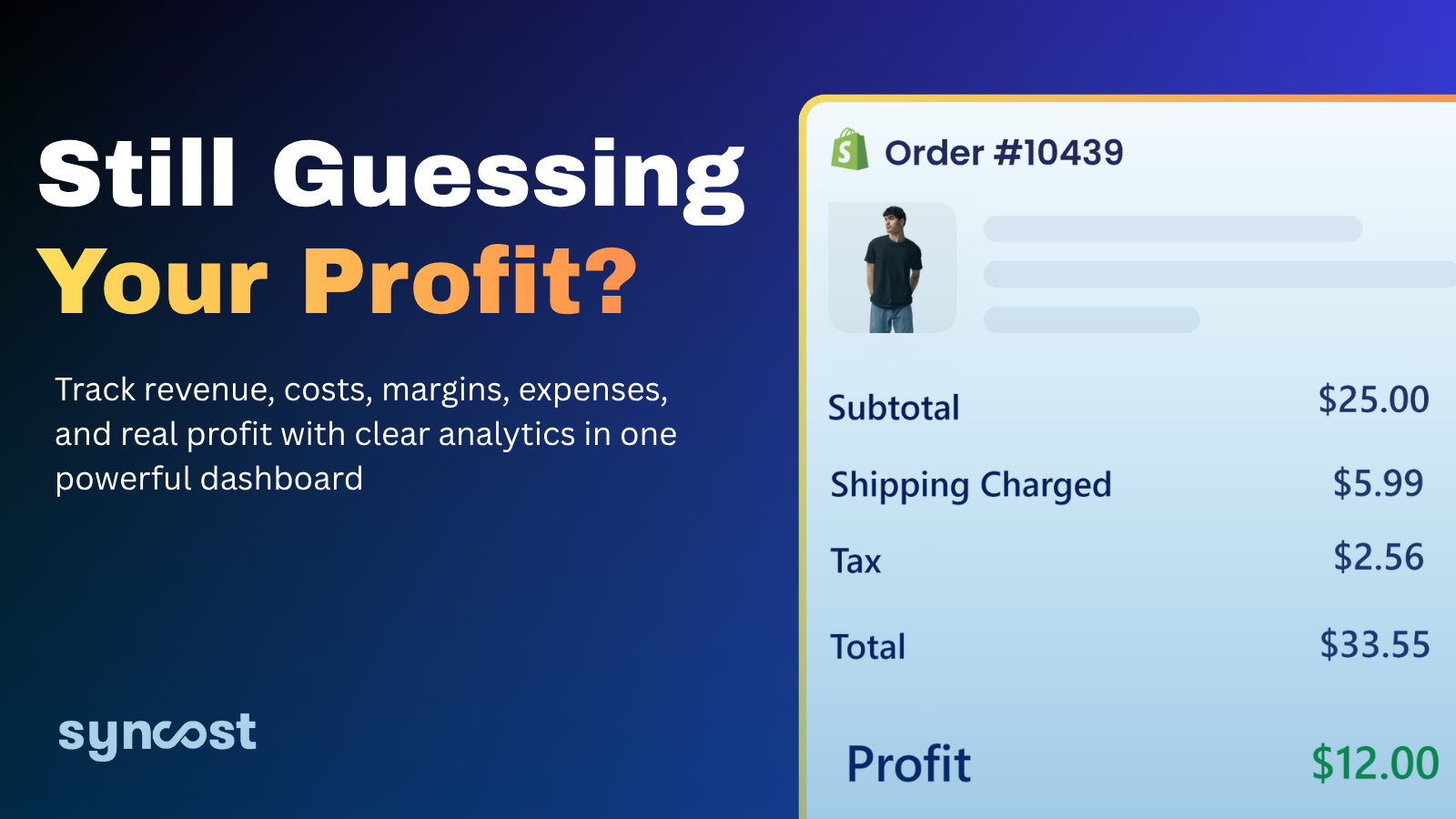
Syncost protects you from the discounting death spiral. By pulling live transaction data from Shopify, syncing real-time ad spend, and automatically deducting your fully burdened Landed COGS and 3PL fees, Syncost shows you your exact True Net Profit on every single order. When you run a sale, Syncost dynamically tracks the margin compression, alerting you instantly if your promotional volume is destroying your absolute cash flow.
Stop giving away your operating capital in the name of top-line growth. Install Syncost, master your unit economics, and ensure every promotion you run actually puts money in the bank.