The Discount Margin Erosion Trap: Why Sitewide Sales and Promo Codes Secretly Bleed Your Shopify Store Dry
Many e-commerce founders rely on heavy discounts and sitewide promo codes to drive top-line volume, mistaking high conversion rates for real profitability. Discover how margin compression silently guts your net operating income, and learn how to engineer a discount strategy that protects your bottom line.

The Hook & The Silent Problem
It is Black Friday weekend, and your Shopify analytics dashboard is a blur of dopamine-inducing activity. Your conversion rate spikes from 1.8% to 4.5%, checkout pings ring out every few seconds, and your gross revenue curve shoots vertically upward. To celebrate the traffic surge, you run a 25% sitewide promo code alongside an aggressive "Buy One, Get One 50% Off" banner across your homepage. You go to bed feeling like an e-commerce titan.
When the monthly financial reconciliation lands on your desk, however, the celebration turns to panic. Gross revenue is up 80%, but your net bank balance has barely budged—and in some accounts, it has actually declined.
How can a record-breaking sales month leave your business cash-starved?
You have fallen victim to the Discount Margin Erosion Trap.
Founders frequently treat discounts as a free marketing tool—a harmless lever to boost conversion rates and clear out slow-moving inventory. But mathematically, discounts do not come out of your top-line revenue pool; they come directly out of your bottom-line net profit. Because your Landed Cost of Goods Sold (COGS), 3PL pick-and-pack fees, payment gateway percentages, and customer acquisition costs remain completely fixed regardless of what price the customer pays, every percentage point of discount hits your profit margin with compounding severity.
Scaling a business on perpetual discounting is like running a treadmill on an incline: you are expending massive physical and financial energy, but you aren't actually moving forward. In fact, you are slowly exhausting your working capital until your operating margins hit zero.
Core Concept Explained (The Quick Answer)
Discount Margin Erosion is the destructive mathematical phenomenon where a percentage discount on retail price causes a disproportionately massive collapse in net profit margins because fixed variable costs remain unchanged. Contribution Margin After Discount (CM2) measures the exact liquid cash remaining per order after deducting landed COGS, fulfillment, payment fees, marketing acquisition costs, and promotional discounts.
The Deep-Dive Reference Guide
To eliminate unprofitable discounting habits, you must understand how different promotional strategies impact your unit economics and customer behavior.
| Promotion Strategy | Psychological Impact on Buyer | The Margin Impact (The Hidden Drain) | Long-Term Brand Risk |
|---|---|---|---|
| Sitewide Percentage Off (e.g., 20% Off) | Creates urgency, lowers hesitation for cold traffic. | Severe Profit Wipeout. Erases up to 50% or more of net profit on every single order across the entire catalog. | Trains your audience never to buy at full price, destroying perceived brand value. |
| Buy One, Get One (BOGO) | High perceived value; encourages higher unit volume per transaction. | Inventory Drain. Doubles your picking, packing, and shipping cost exposure while cutting revenue per shipment in half. | Accelerates inventory turnover but compresses cash velocity. |
| Free Shipping Threshold ($75+) | Effective AOV booster; reduces cart abandonment at checkout. | Shipping Subsidy Loss. Absorbs heavy carrier base rates and dimensional weight penalties if not calculated properly. | Expected baseline; fails to generate brand loyalty on its own. |
| VIP Exclusive Promo Codes | Makes repeat buyers feel valued and recognized. | Low Risk if Gated. Protects first-order margins while rewarding high-LTV cohorts for repeat retention. | Highly effective when tied to specific customer tags or loyalty tiers. |
Technical Breakdown & Formulas
Evaluating the true cost of a promotion requires moving beyond top-line conversion lifts and calculating the exact elasticity required to break even on a discount.
The Discounted Operating Margin Formula:
Discounted_Gross_Profit = Discounted_Selling_Price - Landed_COGS - Variable_Fulfillment_Fees - Payment_Fees

The Profit Destruction Ratio (PDR):
PDR = Reduction_in_Net_Profit / Original_Net_Profit

Required Volume Increase to Break Even on a 20% Discount (assuming 50% original gross margin):
Required_Volume_Multiplier = Original_Margin / (Original_Margin - Discount_Percentage)
The Math in Action: Consider a product that retails for $100.
- Landed COGS: $30
- Shipping, Fulfillment & Gateway Fees: $20
- Original Gross Profit: $50 (A healthy 50% margin).
If you institute a 20% sitewide discount, your new selling price is $80.
Your Landed COGS ($30) and Fulfillment Fees ($20) do not drop—they remain locked at $50 total.
Your new Gross Profit is: $80 - $50 = $30.
By discounting your price by 20% (dropping from $100 to $80), your gross profit collapsed from $50 to $30. Your net profit dropped by 40% from a single promotional adjustment. To make the exact same dollar profit at a 20% discount, you must sell 66% more units just to stand still.
The Scaled Financial Impact (What It Actually Costs You)
Let’s examine how uncontrolled discounting destroys your bottom line during peak scaling periods, contrasting a store selling at full margin against a store running constant 25% promotions while scaling from 100 orders to 5,000 orders per month.
Store A: Protected Full-Margin Pricing
- Retail Price: $100.00
- Fixed Variable Costs (COGS + 3PL + Fees): $45.00
- Net Margin per Unit: $55.00 (55%)
- Monthly Volume at Scale: 5,000 units.
- Total Monthly Gross Profit: $275,000.
Store B: The "Discount-Addicted" Store (25% Sitewide Off)
- Discounted Retail Price: $75.00
- Fixed Variable Costs (COGS + 3PL + Fees): $45.00
- Net Margin per Unit: $30.00 (40%)
- Monthly Volume at Scale: 5,000 units (assuming flat volume despite discounts).
- Total Monthly Gross Profit: $150,000.
The Cash Flow Reality at Scale
At 100 Orders / Month:
- Store A Generates: $5,500 in net unit margin.
- Store B Generates: $3,000 in net unit margin. (A manageable $2,500 variance for an early-stage store).
At 5,000 Orders / Month (Scaling Phase):
- Store A Generates: $275,000 in clean, spendable gross profit to reinvest into inventory and profitable ad scaling.
- Store B Generates: $150,000.
The Compounding Deficit: Store B is throwing away $125,000 every single month ($1.5 Million annually) in pure profit margin simply because they relied on lazy 25% discount codes to drive volume. To make matters worse, because their profit per unit was slashed nearly in half, they cannot afford their customer acquisition costs, forcing them to take on high-interest merchant cash advances to survive.
Strategic Execution (How to Apply This to Your Business)
To break your store's addiction to discounting and restore your operating margins, execute this four-step promotional restructuring workflow.
-
Eliminate Unrestricted Sitewide Promos: Ban sitewide blanket codes. Immediately stop running blanket sitewide discounts (e.g., "20% Off Everything"). Blanket discounts reward customers who were already willing to pay full price, transferring pure profit directly out of your bank account into their pockets. Restrict promotions to specific, high-margin slow-moving SKUs.
-
Implement Value-Add Bundles Instead of Price Cuts: Shift from price drops to value adds. Instead of slashing your product price by 20%, maintain your full retail price and offer a complementary accessory or digital guide as a free gift with purchase. The perceived value to the customer remains high, but your actual cost exposure is limited to the low marginal cost of the add-on item, protecting your core contribution margin.
-
Calculate Your Maximum Allowable Discount: Enforce minimum margin thresholds. Before creating any promo code in Shopify, calculate your absolute floor margin. If your break-even contribution margin requires a 40% gross return, hardcode your discount engine so that no promo code can ever exceed 15%. Protect your unit economics programmatically rather than relying on manual oversight.
-
Gated VIP and Post-Purchase Retention Offers: Reward loyalty, not hesitation. Reserve deep discounts exclusively for closed-loop retention channels (such as SMS-exclusive VIP tiers or 60-day post-purchase replenishment codes). This ensures that your promotional dollars are spent exclusively on verified repeat buyers whose lifetime value justifies the temporary margin compression.
Frequently Asked Questions (FAQ)
How much do I need to increase sales to break even on a 20% discount?
The volume increase required to break even on a discount depends entirely on your original gross margin. If your product retails for $100 with $50 in total variable costs (50% margin), offering a 20% discount drops your margin to $30. To maintain the exact same total dollar profit, you must increase your sales volume by 66.7%. If you cannot guarantee a 66.7% surge in order volume, the discount will result in a net financial loss.
Are sitewide sales ever acceptable for a growing Shopify brand?
Sitewide sales should be restricted to rare, strategic events—such as clearing out end-of-season inventory that would otherwise incur high long-term 3PL storage fees, or driving massive Q4 volume spikes where customer acquisition costs are temporarily offset by high average order values. Running constant weekend sales trains your customer base to wait for discounts, permanently eroding your brand equity.
How do free shipping thresholds compare to percentage discounts?
Free shipping thresholds (e.g., "Free Shipping on Orders Over $75") are generally superior to percentage discounts because they directly incentivize higher Average Order Value (AOV) without devaluing the core product price. When customers add an extra item to qualify for free shipping, the incremental margin from that extra item helps offset the shipping cost absorbed by your store.
How do discount codes distort marketing ROAS metrics?
Discount codes distort ROAS because ad platforms (like Meta and Google) track top-line gross revenue, not net contribution margin. If a discount code reduces an order value from $150 to $112.50, your ad platform still reports the conversion at the gross level, making your ad campaign look artificially more efficient than the actual cash landing in your bank account.
From Financial Chaos to Verified Profit
Scaling an e-commerce brand while relying on uncalculated discounts and sitewide promo codes is a silent margin killer. When your Shopify dashboard celebrates record-breaking top-line revenue while your bank account struggles to cover inventory deposits, your business is suffering from structural profit erosion.
You cannot protect your bottom line if your financial tracking tools treat discounted revenue the same as full-margin cash flow.
This is precisely why elite Shopify founders run their operations on Syncost.
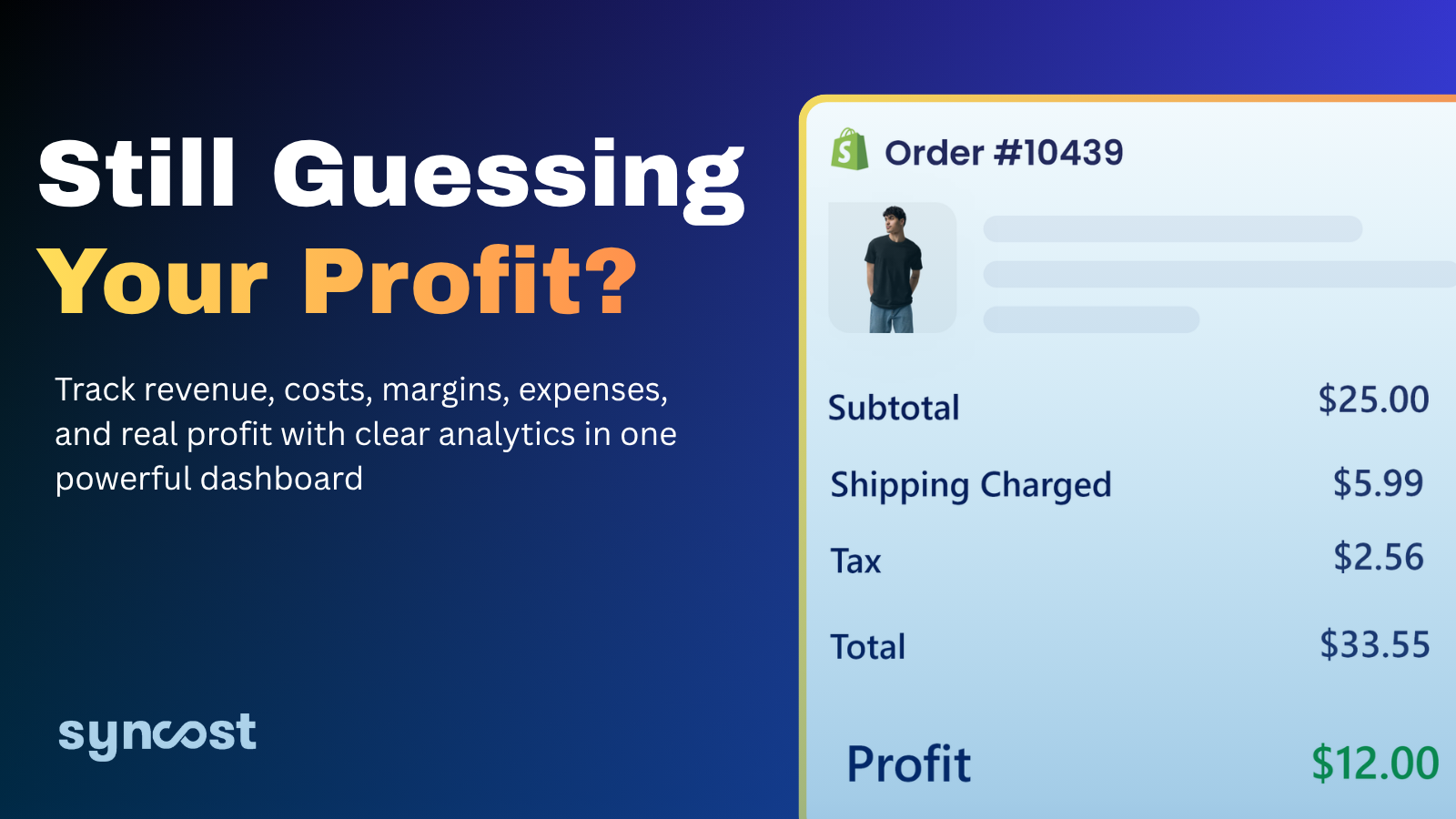
Syncost brings absolute mathematical clarity to your e-commerce unit economics. By integrating seamlessly with Shopify, your paid marketing channels, and your custom cost structures, Syncost automatically tracks your true Contribution Margin After Discount in real time. It strips away the illusion of top-line vanity metrics and delivers a bottom-up view of your True Net Profit on every single order, promotional or full-price.
Stop letting unmonitored discount codes quietly drain your operating capital. Install Syncost today, master your true item-level profitability, and scale your brand with absolute financial confidence.