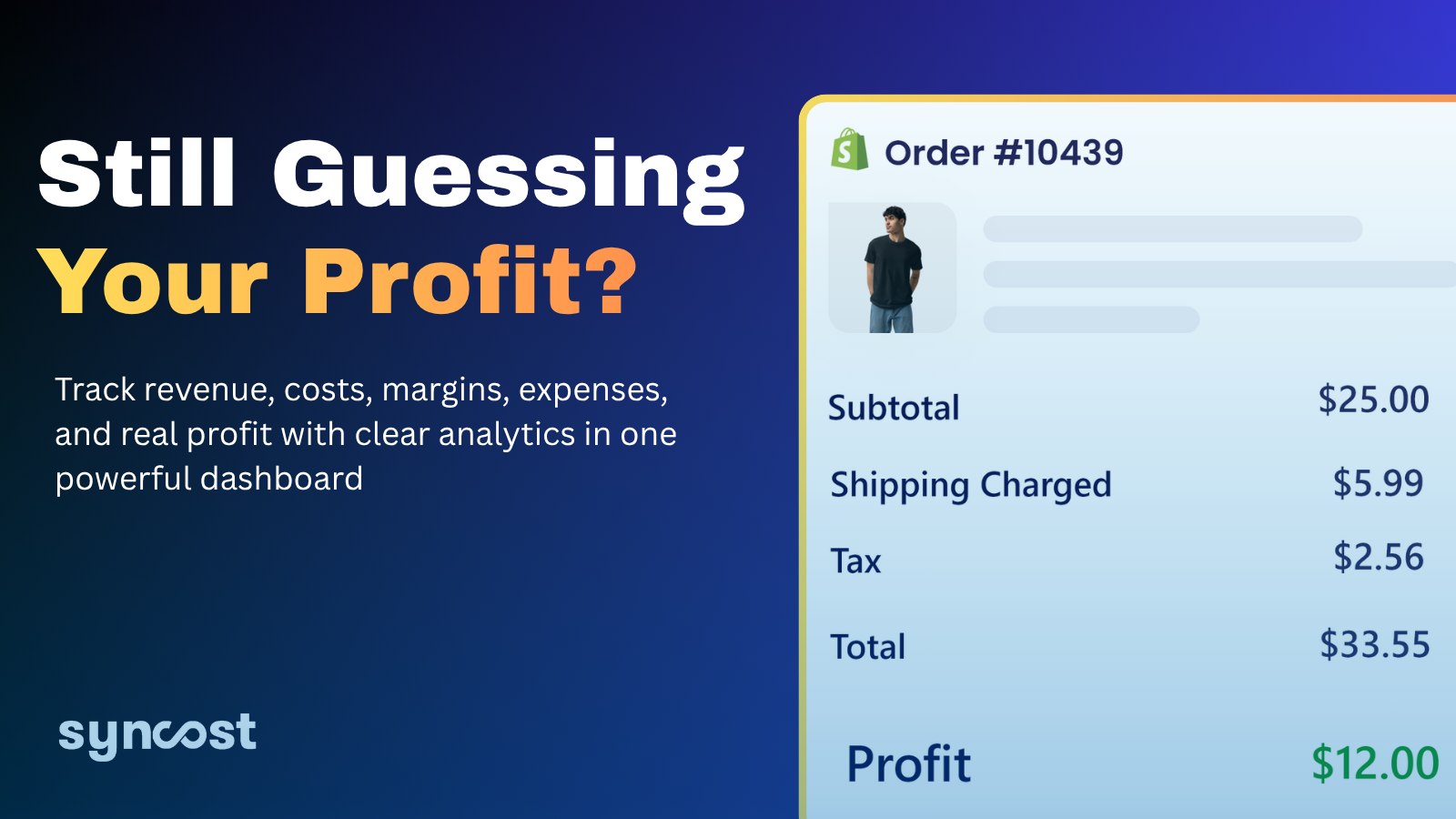
The Contribution Margin Illusion: Why Your E-commerce Dashboard is Hiding Your True Net Profit
You’re aggressively scaling ad spend based on a 40% gross margin, but your operating bank account is mysteriously shrinking. Discover the hidden variable costs—from gateway fees to fulfillment surcharges—that secretly erode your true net profit, and learn the financial frameworks required to calculate your actual bottom line.

The Hook & The Silent Problem
There is a fatal flaw in how 90% of e-commerce founders measure success, and it starts with a dangerous reliance on top-line revenue and baseline Cost of Goods Sold (COGS). You log into your storefront, see a spike in sales, calculate your product cost against your ad spend, and assume you are printing money.
But at the end of the month, the cash in your bank account doesn't align with the "profit" on your screen.
This discrepancy isn’t a math error; it’s a structural visibility problem. The silent killers of e-commerce are the micro-transactions—the invisible variable costs thatTitle* Landed Cost vs. COGS: The E-commerce Margin Mirage Costing You Thousands
Slug* landed-cost-vs-cogs-ecommerce-margins
Excerpt Most e-commerce merchants confuse their supplier invoice with their actual Cost of Goods Sold. Discover why ignoring True Landed Cost creates a "Margin Mirage" that drains your bank account, and learn the exact financial formulas to uncover your real net profit before you scale into bankruptcy.
Content*
The Hook & The Silent Problem
Here is the brutal reality of e-commerce: scaling a flawed financial model will bankrupt you faster than having no sales at all. Every Q4, we see the same tragic post-mortem. A merchant scales their ad spend, hits $100,000 in monthly revenue, pops the champagne, and then looks at their bank account 30 days later only to find it completely empty. Where did the money go?
The culprit is almost always the Margin Mirage.
Most operators look at their factory invoice, see a unit cost of $15, sell the item for $60, and delude themselves into believing they have a 75% gross margin. They base their entire Customer Acquisition Cost (CAC) and Return on Ad Spend (ROAS) targets on this fabricated number. But they are ignoring the silent margin killers: inbound freight weight distribution, fluctuating customs duties, variable payment gateway fees, and hidden 3PL pick-and-pack surcharges. When you optimize your marketing based on a lie, you are aggressively paying to lose money.
Core Concept Explained (The Quick Answer)
To survive in modern e-commerce, you must stop treating your factory price as your final cost. Cost of Goods Sold (COGS) is often narrowly (and dangerously) defined by merchants as just the raw manufacturing or wholesale purchase price of the product. True Landed Cost (TLC), however, is the absolute, fully burdened cost required to get that product from the factory floor directly into your customer's hands, accounting for every single logistical and transactional toll booth along the way.
The Deep-Dive Reference Guide
If you want to operate like a CFO, you need to categorize your expenses accurately. Below is the anatomy of a fully burdened Landed Cost breakdown:
| Cost Category | Financial Definition | Operational Example |
|---|---|---|
| Base Manufacturing (Factory COGS) | The raw unit price agreed upon with your supplier under specific incoterms (e.g., EXW or FOB). | $12.00 per unit on an invoice for 5,000 units of a premium jacket. |
| Inbound Freight & Logistics | The cost to move bulk inventory from the manufacturer to your domestic 3PL or warehouse. | Sea freight container costs, port handling charges, and drayage fees. |
| Customs, Duties & Tariffs | Government taxes imposed on imported goods based on their specific HTS (Harmonized Tariff Schedule) codes. | A 15% import tariff applied to the commercial value of apparel. |
| Fulfillment & Warehousing (3PL) | The per-order operational costs required to pick, pack, and package the product for the end consumer. | $2.50 per order pick fee, plus $0.75 for custom branded mailers. |
| Transactional & Gateway Fees | The percentage and fixed fees extracted by Shopify, Stripe, PayPal, or credit card processors per transaction. | 2.9% + $0.30 standard gateway fee applied to the final cart value. |
Technical Breakdown & Formulas
To calculate True Landed Cost accurately, you cannot just divide a massive logistics bill by your total units, because different SKUs have different volumetric weights. You must allocate costs proportionally.
Here is the exact CFO-level formula for calculating True Landed Cost on a per-SKU basis:
True Landed Cost (TLC) = Base Unit Cost + Allocated Inbound Freight + Allocated Duties + Fulfillment Cost + Gateway Fees

Where:
Allocated Inbound Freight = (Total Freight Bill / Total Shipment Volumetric Weight) * SKU Volumetric Weight
Allocated Duties = (Total Duties Paid / Total Commercial Value) * SKU Commercial Value
Gateway Fees = (Final Retail Price * Gateway Percentage) + Fixed Transaction Fee
Let's break down the variables: Allocated Inbound Freight: Shipping a feather pillow costs more in freight than shipping a heavy but tiny tungsten ring due to volumetric weight. You must distribute your sea or air freight bill based on the CBM (Cubic Meters) each SKU takes up, not just a flat per-unit division. Allocated Duties: Duties are a percentage of the declared value. If one shipment contains $5 t-shirts and $50 jackets, dividing the duty bill equally across all units artificially inflates the cost of your t-shirts and hides the true cost of your jackets.
The Scaled Financial Impact (What It Actually Costs You)
Let's look at the terrifying mathematics of getting this wrong.
Imagine you are selling a tech accessory for $75.00. Your factory invoice (Base COGS) says $18.00 per unit. You mistakenly believe your gross profit is $57.00 per unit, and you tell your media buyer they can spend up to $40 to acquire a customer (CPA), leaving you with a comfortable $17 net profit per order.
Here is the financial reality when we calculate True Landed Cost:
- Base Factory Cost: $18.00
- Allocated Freight (Air): $4.50
- Import Duties (10%): $1.80
- 3PL Pick, Pack, & Mailer: $3.25
- Outbound Shipping to Customer: $6.50
- Shopify/Stripe Fee (2.9% + $0.30 of $75): $2.48
True Landed Cost: $36.53 (More than double your assumed COGS!) True Gross Margin: $75.00 - $36.53 = $38.47
If your media buyer spends $40 to acquire a customer, you are losing $1.53 on every single order.
The Scaled Impact: At 100 units, you think you made $1,700 in profit, but you actually bled $153 in cash. At 5,000 units, you are expecting an $85,000 windfall, but you have actually incinerated $7,650 of your operating capital. This is exactly how stores go bankrupt while celebrating record top-line revenue.
Strategic Execution (How to Apply This to Your Business)
To fix this leakage immediately, execute the following operational workflows:
- Audit Your Incoterms: Check your supplier agreements. Are you paying EXW (Ex Works), meaning you cover transport from the factory door? Or FOB (Free on Board), where the supplier pays to get it on the ship? This drastically shifts your baseline logistics modeling.
- Standardize Volumetric Apportionment: Stop dividing your freight bills by total units. Build a spreadsheet matrix that assigns a CBM (Cubic Meter) value to every SKU. When a $10,000 freight bill arrives, multiply the bill by the SKU's CBM percentage to find the true freight-per-unit.
- Map Gateway Blends: Customers pay with Shop Pay, PayPal, Sezzle, and Amex. Each has a radically different fee structure (ranging from 2% to 6%). Calculate a blended average payment gateway fee over a 90-day period and lock that percentage into your fixed margin calculations.
- Demand 3PL Transparency: Force your 3PL to break down invoices by receiving fees, storage, pick/pack, and outbound postage. Do not accept bundled "fulfillment" charges. You cannot optimize a black box.
Frequently Asked Questions (FAQ)
What happens if my freight costs fluctuate wildly month-to-month?
Logistics costs are inherently volatile. You should utilize a moving average for your freight allocation. Calculate the average freight cost per CBM over the trailing 90 days. If you experience a massive spike (e.g., Q4 peak season surcharges), you must instantly recalculate your True Landed Cost and adjust your front-end pricing or ad bids accordingly.
Are marketing costs and CAC part of Landed Cost?
No. True Landed Cost encompasses the operational lifecycle of the physical product. Customer Acquisition Cost (CAC) and marketing spend sit below the gross margin line. Subtracting CAC from your Gross Profit (Revenue minus True Landed Cost) gives you your Contribution Margin.
Why can't I just use Shopify's default COGS field?
Shopify's native COGS field is static and singular. It only allows you to input one flat number per SKU. It does not account for variable freight, dynamic payment gateway fees, or fluctuating 3PL charges. Relying on a static field for dynamic costs guarantees your profit dashboards will be inaccurate.
From Financial Chaos to Verified Profit
Operating an e-commerce brand on spreadsheets and static COGS fields is a recipe for disaster. The math is too dynamic, the variables change too frequently, and the cost of human error is fatal to your cash flow. You cannot manage what you cannot accurately measure.
This is exactly why top-tier merchants rely on Syncost. Instead of fighting with disjointed logistics invoices, static Shopify fields, and messy Excel formulas, Syncost automates your exact financial truth. By pulling in real-time data across your ad platforms, store backend, and variable operational costs, Syncost calculates your True Landed Cost automatically. We eliminate the Margin Mirage by giving you bottom-up, net profit clarity on a per-order, per-product, and per-channel basis. Stop guessing your margins. Let Syncost give you the financial command center your business actually deserves.