Cash Flow Statement 101 for Ecommerce Founders
Your P&L can show a profitable month while your bank account runs dry. That gap is what the cash flow statement explains — and most ecommerce founders look at it last and understand it least. Here's what each section shows, the five ecommerce-specific timing problems that make it essential, and how to use it to make decisions rather than just file it for the accountant.
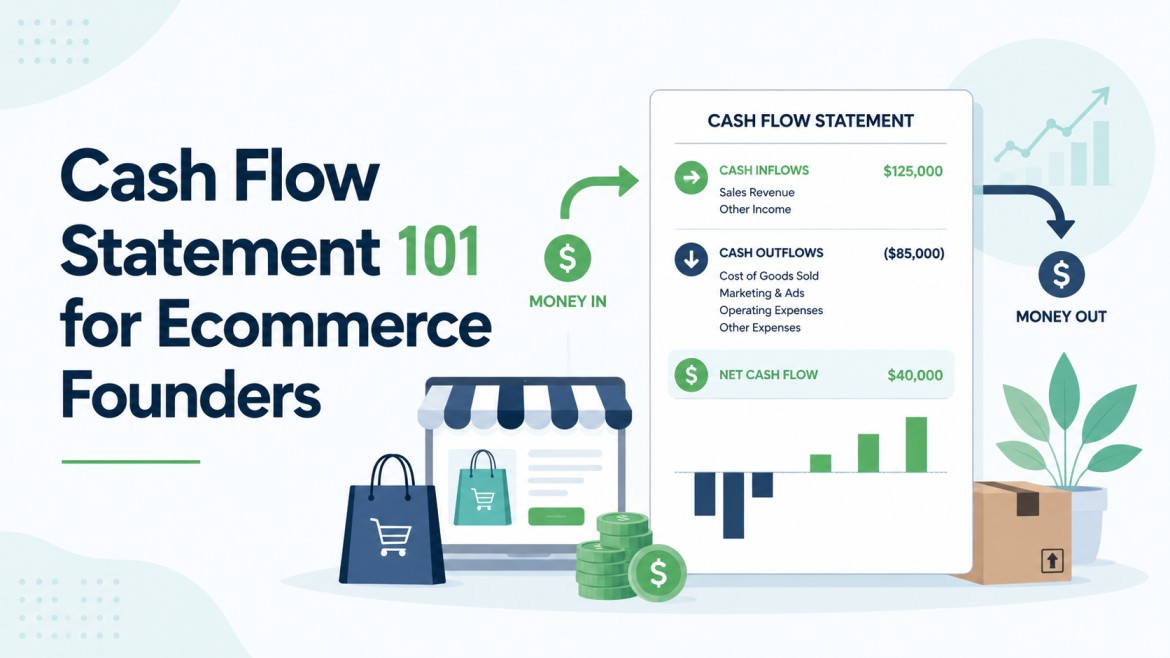
Your profit and loss statement can show a profitable month while your bank account runs dry. Your revenue dashboard can show record sales while you struggle to pay a supplier invoice. Both of these scenarios are common in ecommerce — and both are explained by the cash flow statement, the financial report most founders look at last and understand least.
Understanding your cash flow statement isn't an accounting exercise. It's the difference between a business that grows and one that quietly runs out of money in the middle of its most successful quarter. This guide explains what a cash flow statement is, how each section works, what the ecommerce-specific timing problems are that make it essential, and how to use it to make decisions — not just file it for the accountant.
What a Cash Flow Statement Is
A cash flow statement is a financial report that tracks the actual movement of cash into and out of your business over a period — usually a month, quarter, or year. It answers one question your P&L doesn't: not whether you made money, but whether you have money.
The distinction matters enormously in ecommerce. Profit is an accounting concept — it's calculated when revenue is recognised and expenses are matched against it, regardless of when cash actually moves. Cash flow is a reality concept — it's the difference between your opening and closing bank balance.
A business can be genuinely profitable and cash-poor simultaneously. This happens when:
- Revenue is recognised before cash is received (rare in ecommerce but relevant for net-terms B2B or wholesale orders)
- Inventory is purchased before the sales that will recover it are made
- Shopify payouts arrive one to three days after sales close
- Supplier invoices fall due before the products they funded have sold and generated payouts
The cash flow statement maps all of this — when cash actually arrived and when it actually left — so you can see the pattern that the P&L obscures.
The Three Sections of a Cash Flow Statement
Every cash flow statement is divided into three sections, each tracking a different type of cash movement.
Section 1 — Operating Activities
Operating cash flow captures all cash generated or consumed by running the core business. This is the section most ecommerce founders care about most — it shows whether the day-to-day business of selling products is actually generating cash.
Cash inflows in operating activities:
- Customer payments received (Shopify payouts, marketplace remittances, direct sales)
- Tax refunds received
Cash outflows in operating activities:
- Supplier payments made for inventory or fulfilment
- Advertising and marketing spend paid
- Employee and contractor wages paid
- Platform subscription payments (Shopify, apps)
- Shipping and fulfilment costs paid
- Sales tax remittances paid to states
- Returns processed and refunded
The key word throughout is paid and received — not invoiced, not earned, not recognised. Cash accounting for operating activities reflects the actual bank movements.
What healthy operating cash flow looks like: Positive and growing. An ecommerce business generating consistent positive operating cash flow is one whose daily operations are self-funding — it doesn't need external capital to keep running. A business with profitable P&L months but negative operating cash flow has a timing or working capital problem that will eventually create a crisis.
Section 2 — Investing Activities
Investing cash flow captures cash spent on or received from long-term assets — things that will generate value over multiple periods rather than being consumed in the current month.
For ecommerce founders, investing activities typically include:
- Purchase of equipment (warehouse shelving, packaging machinery, computers)
- Software or website development costs capitalised as assets
- Proceeds from selling any business assets
Most early-stage ecommerce stores have minimal investing activity. It becomes more relevant as you build physical infrastructure — warehousing, proprietary technology, or manufacturing equipment.
What to watch: Significant investing outflows during a period of thin operating cash flow is a warning signal — you're spending on long-term assets while short-term operations haven't yet proven they can fund themselves.
Section 3 — Financing Activities
Financing cash flow captures cash movements related to how the business is funded — borrowing, repaying debt, equity investments, and owner withdrawals.
Cash inflows in financing activities:
- Loan proceeds received (inventory financing, revenue-based financing, bank loans)
- Equity investment received from investors
- Owner capital contributions
Cash outflows in financing activities:
- Loan repayments (principal only — interest appears in operating activities)
- Owner distributions or dividends taken
- Repayment of lines of credit
What to watch: Consistent positive financing cash flow alongside negative operating cash flow means the business is borrowing to fund its operations — a pattern that's sometimes appropriate for a growth stage but unsustainable indefinitely. A business that requires constant external financing to cover operating deficits hasn't yet proven its model generates enough cash to sustain itself.
The Complete Cash Flow Statement Structure
Here's what a monthly cash flow statement looks like for a mid-stage Shopify store:
| Line item | Amount |
|---|---|
| Operating Activities | |
| Shopify payouts received | $38,400 |
| Returns and refunds paid | −$2,100 |
| Supplier payments (COGS) | −$13,200 |
| Ad spend paid (Meta/Google) | −$6,800 |
| Shipping costs paid | −$4,600 |
| Shopify + app subscriptions | −$420 |
| Contractor wages paid | −$2,400 |
| Sales tax remitted | −$1,890 |
| Net operating cash flow | $6,990 |
| Investing Activities | |
| Equipment purchased | −$800 |
| Net investing cash flow | −$800 |
| Financing Activities | |
| Loan repayment (principal) | −$1,200 |
| Net financing cash flow | −$1,200 |
| Net change in cash | $4,990 |
| Opening cash balance | $18,200 |
| Closing cash balance | $23,190 |
Net income for the same month (from the P&L) might be $8,750 — higher than the $6,990 in operating cash flow because of timing differences between when revenue was recognised and when payouts cleared, or when expenses were accrued versus when they were paid.
The Ecommerce-Specific Cash Flow Timing Problems
General cash flow guides explain the three sections. What they miss is the specific ways ecommerce creates cash timing problems that the statement is uniquely positioned to catch.
The Inventory Float
For inventory-holding stores, buying stock creates an immediate cash outflow. The revenue that will recover that cash outflow arrives weeks or months later, when units sell and payouts clear. During the gap — which can be 30 to 90 days for imported inventory — the business has spent the cash but hasn't received the revenue.
This is why a fast-growing ecommerce store can become cash-constrained while being genuinely profitable. Each month's growth requires buying more inventory than the previous month before the previous month's inventory revenue has fully cleared. Scale fast enough and the inventory float can consume your entire cash reserve even as your P&L shows widening margins.
The cash flow statement surfaces this. A month with high operating cash outflows on supplier payments and a lower cash inflow from payouts is a month where the inventory float is consuming cash. If this pattern persists, you're outgrowing your available working capital.
Shopify Payout Timing
Shopify Payments typically pays out within one to three business days after a sale is made. That gap isn't a problem in stable months. It becomes relevant around month-end when sales made on the 29th, 30th, and 31st clear in the following month's bank statement — creating a gap between when revenue is recognised on the P&L (the date of sale) and when cash arrives (the date of payout).
For accurate cash flow tracking, use actual payout dates rather than sale dates. Your January P&L might show $40,000 in January sales, but $3,200 of that payed out in February. Your January cash flow statement should show only the $36,800 that actually arrived in January.
Ad Spend Billing Cycles
Meta and Google both bill on cycle-based thresholds rather than a fixed monthly date. A Meta billing cycle might close on the 12th of one month, charging everything since the 12th of the previous month. This means your ad spend rarely maps cleanly to calendar months in your bank statement.
For cash flow purposes, record ad spend when your card is charged — not when the campaign ran. The mismatch is usually small month to month but matters for accurate cash balance forecasting.
Seasonal Inventory Builds
For stores with seasonal demand (holiday gifts, summer products, back-to-school), the months of largest inventory investment precede the months of largest revenue by weeks. The cash flow statement during the build-up period shows large investing outflows (in inventory, which appears in operating activities for inventory businesses) and lower inflows — creating temporary negative or near-zero operating cash flow that a P&L analysis wouldn't flag.
Understanding this seasonal cash pattern in advance is what makes inventory financing decisions rational rather than reactive. You can see when the cash trough will arrive and arrange financing before you're in it.
Chargebacks and Delayed Deductions
When a chargeback occurs, Shopify deducts the disputed amount and the $15 dispute fee from your next payout — not from the payout of the original sale, which may have cleared weeks ago. This creates a cash flow statement entry (payout reduction) that doesn't correspond to a P&L entry in the same period.
Over time, chargebacks that were recognised as revenue in previous months generate cash outflows in the current month that don't appear as expenses — only as reduced payout receipts. Tracking this carefully in your cash flow statement reveals the real cash cost of your dispute rate.
Operating Cash Flow vs Net Profit: The Reconciliation
One of the most useful things you can do with a cash flow statement is reconcile operating cash flow against net profit for the same period. The difference between the two reveals your cash conversion efficiency — how much of each dollar of profit is actually showing up as cash.
The Indirect Method Reconciliation
The most common approach starts with net profit and adjusts for non-cash items and working capital changes:
Operating cash flow = Net profit
  + Depreciation and amortisation (non-cash expense added back)
  − Increase in accounts receivable (cash not yet received)
  + Increase in accounts payable (cash not yet paid)
  − Increase in inventory (cash spent on stock not yet sold)
  + Increase in deferred revenue (cash received before recognition)
For most ecommerce sellers: depreciation is minimal, accounts receivable is near-zero (Shopify pays quickly), and accounts payable is modest. The main reconciling item is inventory change — and this is where the story lives.
A month where you built $15,000 of inventory that hasn't yet sold shows a $15,000 gap between operating cash flow and net profit. That's not a problem — it's a timing issue. But if that inventory doesn't turn in the expected window, the gap becomes a permanent impairment.
Using the Cash Flow Statement to Make Decisions
The cash flow statement isn't just for historical analysis. Used prospectively, it's the most powerful planning tool available to an ecommerce founder.
Cash Flow Forecasting
A 13-week rolling cash flow forecast projects expected inflows (based on current inventory turns, seasonal patterns, and marketing plans) against expected outflows (supplier payments due, ad spend planned, payroll dates, loan repayments) to show your projected cash balance week by week.
This forecast tells you in advance whether you'll have enough cash to fund a large inventory purchase, whether you need a short-term line of credit to bridge a seasonal trough, and when you can safely take an owner distribution without putting operations at risk.
Identifying the Cash Drain
If operating cash flow is consistently lower than net profit, something is consuming cash that the P&L isn't showing. The most common culprits in ecommerce: inventory build-up faster than sell-through, returns consuming cash before they generate offsetting revenue, or supplier terms requiring payment faster than your Shopify payout cycle recovers it.
The cash flow statement doesn't just show the gap — it shows where it's happening, by period and by category. That's the diagnostic information that makes solving the problem possible.
The Profit vs Cash Health Check
| P&L shows | Cash flow shows | Diagnosis |
|---|---|---|
| Profit | Positive cash flow | Healthy — business is generating cash as it earns |
| Profit | Negative cash flow | Timing problem — working capital or inventory float |
| Loss | Positive cash flow | Possible — revenue collected before expenses (rare in ecom) |
| Loss | Negative cash flow | Structural problem — core model consuming cash |
The most dangerous ecommerce scenario is the second row: a profitable P&L masking a negative operating cash flow driven by inventory float or slow turns. This is precisely the pattern that takes growing, apparently successful stores by surprise.
What the Cash Flow Statement Can't Show You
A cash flow statement reflects what moved through your bank account. It doesn't show you why — specifically, which orders, products, or channels are generating or consuming cash. A month with strong operating cash flow but thin margins on most products is a different problem from the same cash flow driven by strong margins on a few hero SKUs. The cash flow tells you the total; per-order profit data tells you the composition.
That per-order detail is what Syncost provides for Shopify merchants — automatically combining product costs, Shopify fees, shipping, and ad spend into a real-time profit view on every sale. The cash flow statement tells you whether your bank account is healthy. Syncost tells you which orders, products, and channels are making it so — and which are quietly consuming the cash your best products generate. Together, they give you the complete financial picture: the aggregate cash health from the statement, and the per-order profit clarity that explains it.
This guide is for general informational purposes and does not constitute accounting or tax advice. Cash flow statement preparation requirements vary by jurisdiction and business structure. Consult a qualified accountant for guidance specific to your business.