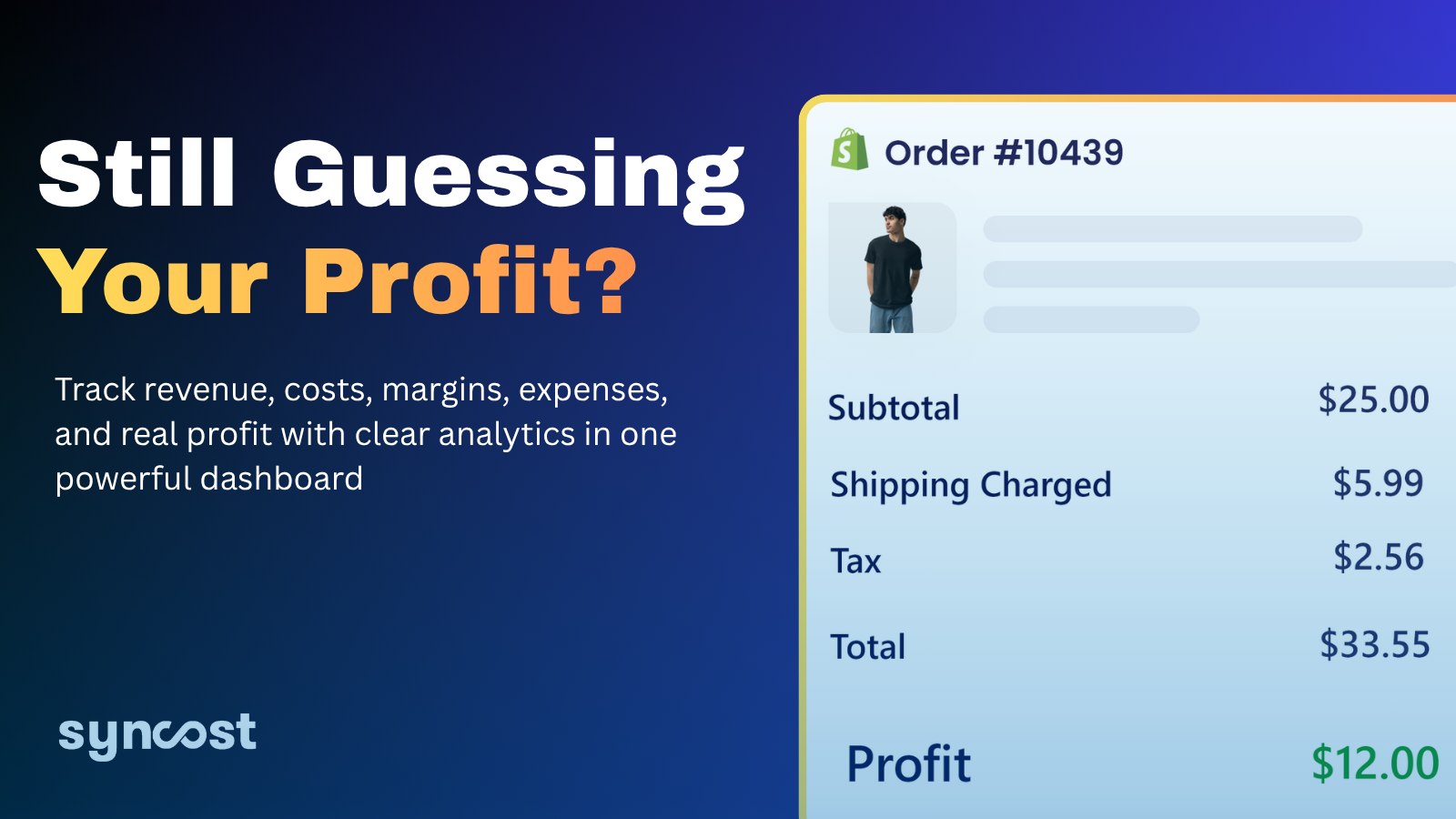
The Overhead Mirage: How Unallocated Fixed OpEx Turns High-Margin Stores Cash-Negative
Calculating profitability based solely on contribution margin creates a dangerous financial illusion. When software stack subscriptions, agency retainers, payroll overhead, and indirect operating expenses are excluded from daily unit economic calculations, high-volume stores unknowingly burn through their liquid reserves. Discover how unallocated fixed OpEx turns seemingly high-margin Shopify stores cash-negative.

The Hook & The Silent Problem
Let’s not sugar-coat the brutal reality of e-commerce accounting: celebrating a strong top-of-funnel Contribution Margin while ignoring your fixed operating expenses is the fastest way to drive a multi-million dollar store into bankruptcy.
You log into your store dashboards at the end of a high-volume scaling month. Your ad spend was $60,000, your gross revenue reached $200,000, and after subtracting Landed COGS, outbound shipping, and payment processing fees, your contribution margin sits at a solid $40,000 (a 20% contribution margin). On paper, your media team is high-fiving. Your marketing agency is asking for a performance bonus.
Yet, when you log into your business checking account to pay your inventory deposit for next season, the cash isn't there. In fact, your bank balance is $10,000 lower than it was at the beginning of the month.
How can a brand generate $40,000 in positive contribution margin from ad campaigns and still lose liquid cash?
You are suffering from The Overhead Mirage.
While your contribution margin covers the direct, variable costs of fulfilling an order, it completely ignores the massive structural footprint required to keep your business operational. Your $12,000 monthly agency retainers, your $8,000 specialized Shopify app and tech stack bill, your $18,000 payroll commitments, your $5,000 warehouse lease, and your $7,000 in legal, accounting, and sample development costs add up to $50,000 in monthly fixed operating expenses (OpEx).
Because your fixed overhead ($50,000) exceeded your total contribution profit ($40,000), your store actually operated at a $10,000 net operating loss. You didn't scale a profitable business—you scaled a top-heavy administrative structure that eats cash faster than your ad funnels can generate it.
Core Concept Explained (The Quick Answer)
Contribution Margin represents the remaining profit generated after deducting only direct variable costs (COGS, shipping, payment processing, and ad spend) from gross revenue. True Net Operating Profit deducts all indirect, fixed Operating Expenses (OpEx)—including software subscriptions, agency retainers, payroll, office overhead, and professional fees—allocating these fixed burdens to expose whether the enterprise is actually cash-positive.
The Deep-Dive Reference Guide
To eliminate the overhead mirage, you must categorize every single dollar that leaves your bank account into strict cost buckets. Conflating variable fulfillment costs with fixed structural overhead obscures your true daily break-even thresholds.
| Expense Category | Operational Definition | The Margin Impact (The Hidden Drain) |
|---|---|---|
| Direct Variable Costs (COGS & Media) | Costs that scale 1-to-1 with order volume (e.g., product manufacturing, pick/pack fees, ad spend, merchant fees). | Direct Margin Deduct. Determines your unit-level Contribution Margin 1 and 2. |
| Semi-Variable OpEx | Costs that remain baseline-fixed but step up at specific volume triggers (e.g., 3PL pallet storage, customer support software tier limits). | Step-Function Breakers. Can suddenly jump by thousands of dollars as order volumes breach contract thresholds. |
| Fixed Software & SaaS Overhead | Monthly or annual software licenses (e.g., Shopify Plus, Klaviyo, ERPs, attribution tools, design apps). | The SaaS Bloat. Frequently compounds unnoticed across dozens of recurring app fees, silently draining $3k–$15k monthly. |
| Fixed Administrative & Payroll OpEx | Retainers for marketing agencies, full-time staff salaries, contractor fees, legal, rent, and insurance. | The Structural Anchor. Fixed cash obligations that must be paid on the 1st of every month regardless of store sales volume. |
Technical Breakdown & Formulas
You cannot manage an e-commerce enterprise on gross profit assumptions. You must continuously calculate your Daily Fixed OpEx Run-Rate and map it against your real-time Contribution Margin to uncover your true break-even requirements.
Contribution Margin (CM) Formula:
Contribution_Margin = Gross_Revenue - (Landed_COGS + Paid_Ad_Spend + Outbound_Shipping + Gateway_Fees + Variable_3PL_Fees)

Daily Fixed OpEx Allocation Rate:
Daily_OpEx_Burden = (Monthly_SaaS_Costs + Monthly_Payroll + Monthly_Agency_Retainers + Monthly_Fixed_Overhead) / Days_In_Month

True Net Operating Profit (NOP):
Net_Operating_Profit = Contribution_Margin - Total_Fixed_OpEx

Daily Break-Even Contribution Target:
Required_Daily_CM = Daily_OpEx_Burden
The Math in Action: Let’s analyze a store doing $300,000 in monthly revenue with a 25% Contribution Margin ($75,000 in CM dollars).
- Gross Revenue: $300,000
- Variable Costs (COGS, Ads, Gateway, Shipping): $225,000
- Contribution Margin Dollars: $75,000
Now, let's detail their unallocated monthly Fixed Operating Expenses (OpEx):
- SaaS & Software Stack (Klaviyo, Shopify Plus, Apps): $8,000
- Agency Retainers (Creative, SEO, Paid Media): $18,000
- Payroll & Contractor Fees: $35,000
- Rent, Insurance, Legal, Accounting, Utilities: $9,000
- Total Fixed Monthly OpEx: $70,000 ($2,333.33 per day)
The Financial Truth: Subtracting the $70,000 Fixed OpEx from the $75,000 Contribution Margin leaves a True Net Operating Profit of just $5,000 (a paper-thin 1.6% net margin).
If ad performance dips slightly next month and Contribution Margin drops by just 10% (to $67,500), the business instantly flips into a $2,500 net monthly cash loss, despite still showing $300,000 in top-line Shopify revenue.
The Scaled Financial Impact (What It Actually Costs You)
Let's model two scaling e-commerce brands attempting to double their business over 90 days. Both stores start at $150,000 monthly revenue with a $45,000 Contribution Margin (30% CM).
Store A: The Bloated Scale Trap (Unchecked OpEx Expansion)
Store A decides to scale aggressive media buying while hiring two additional internal specialists and adding expensive enterprise software integrations to support the growth.
- New Monthly Revenue: $300,000
- New Contribution Margin (25% CM due to ad fatigue): $75,000
- Legacy Fixed OpEx: $35,000
- New Added OpEx (New hires + software + agency price increase): +$45,000
- Total New Fixed OpEx: $80,000
- True Net Operating Profit:
$75,000 CM - $80,000 OpEx =-$5,000 Net Loss - The Reality: Store A doubled its operational revenue, doubled its shipping volume, and doubled its inventory commitment—only to transform a previously profitable $10,000/mo net business into a $5,000/mo cash-draining liability.
Store B: The Lean Overhead Engine (Disciplined OpEx Control)
Store B scales using the exact same ad campaign performance, achieving the same $300,000 revenue at a 25% Contribution Margin ($75,000 CM). However, Store B maintains strict operational control over overhead, leveraging lean automated systems instead of adding unnecessary fixed headcount and software.
- New Monthly Revenue: $300,000
- New Contribution Margin (25% CM): $75,000
- Legacy Fixed OpEx: $35,000
- New Added OpEx (Slight usage-tier bumps for existing software): +$3,000
- Total New Fixed OpEx: $38,000
- True Net Operating Profit:
$75,000 CM - $38,000 OpEx =+$37,000 Net Profit
The Catastrophic Reality: Despite operating at the exact same $300,000 revenue line and the exact same 25% media contribution margin, Store B generated $42,000 MORE in liquid net profit every single month than Store A. Unmanaged fixed OpEx completely wiped out Store A's operating leverage.
Strategic Execution (How to Apply This to Your Business)
To permanently dismantle the overhead mirage and establish absolute cash flow clarity, you must implement a rigorous fixed-cost allocation protocol across your daily accounting setup.
-
Compile a Complete Fixed OpEx Inventory: Audit every recurring subscription and invoice. Export 90 days of corporate credit card and bank statements. Extract every non-variable expense—including software subscriptions, agency retainers, salaries, utility bills, insurance, and professional retainers. Calculate your exact monthly fixed overhead baseline and divide it by the number of days in the month to establish your Daily Fixed OpEx Burden.
-
Set Your Daily Net Operating Break-Even Target: Establish realistic daily contribution hurdles. Do not consider your store "profitable" for the day simply because your ad account shows a positive ROAS or your contribution margin covers your media spend. Add your Daily Fixed OpEx Burden directly to your daily variable break-even calculation. Your media and sales team must hit this combined dollar target before a single dollar of true net operating profit is locked in.
-
Execute a Quarterly OpEx Rationalization Audit: Prune redundant SaaS tools and agency retainers. Review your tech stack every 90 days. Eliminate unused Shopify apps, duplicate marketing software, and underperforming agency retainers. Categorize software tools by explicit ROI. If an app or service cannot be directly tied to conversion lift, cost reduction, or operational efficiency, cancel it immediately to protect your bottom line.
-
Integrate Dynamic OpEx Deductions Into Real-Time Dashboards: Automate fixed cost allocation in your daily profit tracking. Stop waiting for month-end accounting reconciliations to find out if your business made money. Implement an automated analytics engine that automatically deducts your prorated daily fixed OpEx alongside live ad spend, Landed COGS, and merchant fees, giving you real-time visibility into your true bottom-line net profit every single day.
Frequently Asked Questions (FAQ)
How do I allocate one-time quarterly or annual software payments into my daily OpEx calculations?
Annual or quarterly recurring software fees (such as an annual $12,000 Shopify Plus contract or annual Klaviyo billing) should never be logged as a single massive cash hit on the day they are paid for operational profit tracking. Instead, amortize these payments evenly across the contract period. For an annual $12,000 expense, add $1,000 per month ($32.87 per day) to your daily fixed OpEx allocation model to accurately reflect your true operational burn rate.
What is a healthy Fixed OpEx to Gross Revenue ratio for a scaling DTC e-commerce store?
For most high-growth direct-to-consumer (DTC) brands operating between $1M and $10M in annual gross revenue, total fixed operating expenses (excluding variable COGS, shipping, and ad spend) should ideally range between 15% and 25% of gross revenue. When fixed OpEx exceeds 30% of revenue, the brand's operating leverage collapses, leaving virtually no safety buffer for media performance fluctuations or supply chain price increases.
Should founder salaries and equity draws be included in fixed operating expenses?
Yes. A classic mistake made by e-commerce founders is omitting their own compensation from fixed operating expenses. If you work in the business as an active executive, your base salary or consistent compensation must be accounted for as a fixed payroll OpEx. If the business cannot cover a fair-market executive salary for its founder while remaining net profitable, the store's business model is artificially subsidized and financially unstable.
From Financial Chaos to Verified Profit
Scaling an e-commerce business using contribution margin alone is like navigating a ship by looking only at the speed indicator while ignoring a massive hole in the hull. If your growth metrics omit fixed software costs, agency retainers, and payroll commitments, you will scale yourself directly into a severe liquidity crisis.
You cannot protect your working capital if your analytics infrastructure fails to factor fixed operational overhead into your daily profit calculations.
This is exactly why sophisticated, numbers-driven Shopify operators command their businesses using Syncost.
Syncost permanently destroys the overhead mirage. Standard Shopify dashboards and basic profit apps offer shallow, surface-level calculations that ignore fixed administrative expenses, creating a dangerous margin illusion. Syncost seamlessly integrates your live ad spend, exact Landed COGS, custom fulfillment charges, and payment gateway fees while allowing you to inject custom fixed operating expenses (OpEx) directly into your central profit engine. It automatically amortizes your monthly software fees, agency retainers, and payroll into your real-time daily metrics—revealing your absolute True Net Operating Profit.
Stop letting unallocated fixed overhead and hidden SaaS costs secretly drain your liquid cash reserves. Install Syncost today, lock in your exact unit economics, and command your brand's growth with the absolute authority of an elite CFO.