Print on Demand Shipping Costs: The Hidden Margin Killer in POD
Print-on-demand merchants often obsess over product cost while shipping quietly consumes the margin. A $4 increase in fulfillment shipping can erase thousands of dollars of profit without changing revenue at all. Here is how to calculate the real shipping impact on POD orders and decide whether to charge shipping, absorb it, or build it into your price.

The Hook & The Silent Problem
A POD shirt sells for $34.99.
Production costs $14.
At first glance:
$34.99 - $14.00
= $20.99
That looks like plenty of margin.
Then the fulfillment order arrives.
Shipping costs $6.50.
Payment and transaction costs remove another $1.50.
Customer acquisition costs $9.
The order economics suddenly become:
Revenue             $34.99
Production          -$14.00
Shipping             -$6.50
Fees                 -$1.50
Advertising          -$9.00
----------------------------
Contribution          $3.99
The apparent $20.99 spread has become $3.99 of contribution.
And shipping alone consumed more than 30% of the original spread between retail price and production cost.
This is one of the most common financial traps in print on demand.
POD reduces inventory risk because products are generally produced after the customer orders them. But that convenience often comes with tighter unit economics, making shipping especially important. Shopify's current POD guidance similarly emphasizes that merchants need to account for shipping carefully and notes that POD often operates with smaller margins than traditional inventory models.
The problem becomes more serious when shipping varies by product, destination, and quantity.
A mug does not ship like a shirt.
A hoodie does not ship like a poster.
One item does not necessarily cost twice as much to ship as two items.
Domestic and international orders can have completely different economics.
So there is no financially useful answer to:
"What is my POD shipping cost?"
The better question is:
"What does shipping cost for this product, in this order, going to this customer—and what happens to profit after that cost?"
Core Concept Explained (The Quick Answer)
POD shipping cost should be treated as part of the order's variable cost, not as an afterthought after gross margin has already been calculated.
A simple POD contribution formula is:
Contribution
=
Net Revenue
- Production Cost
- Fulfillment Shipping
- Transaction Fees
- Advertising
- Other Variable Costs
For example:
Net Revenue = $40
Production = $15
Shipping = $7
Fees = $2
Advertising = $10

Contribution = $6
If shipping rises from $7 to $10:
Contribution = $3
Revenue did not change.
Orders did not change.
The product did not change.
Half of the modeled contribution disappeared because shipping increased by three dollars.
The Deep-Dive Reference Guide
| Cost | Example | Why It Matters |
|---|---|---|
| Retail Price | $39.99 | What the customer sees |
| Production COGS | $15.00 | Product manufacturing cost |
| Shipping Charged to Customer | $0–$6.99 | Revenue that may offset delivery cost |
| Actual Fulfillment Shipping | $6.50 | What delivery actually costs the merchant |
| Transaction Fees | $1.50 | Reduces retained revenue |
| Advertising | $9.00 | Cost of acquiring the order |
| Other Variable Costs | $0.50 | Additional order-level expense |
| Contribution | $7.49 | Amount remaining before broader overhead |
| Contribution Margin | 18.7% | Shows how efficiently revenue becomes contribution |
The important distinction is between shipping revenue and shipping expense.
If the customer pays $5 shipping and your provider charges $7:
Net Shipping Burden
=
$7 - $5
=
$2
But if you advertise free shipping:
Customer Shipping Payment = $0
Actual Shipping Cost = $7

Net Shipping Burden = $7
Free shipping may still be the better commercial strategy if it increases conversion enough.
But financially, it is not free.
Technical Breakdown & Formulas
The Shipping Margin Formula
A useful calculation is:
Net Shipping Cost
=
Actual Fulfillment Shipping
-
Shipping Revenue Collected
Suppose:
Shipping Cost = $7
Customer Pays = $4

Net Shipping Cost = $3
That $3 should be part of your profitability model.
Why Small Shipping Changes Matter
Imagine your POD store averages:
Contribution Before Shipping = $12/order
At $5 shipping:
Final Contribution = $7
At $7 shipping:
Final Contribution = $5
Only two dollars changed.
But profit per order fell from $7 to $5.
That is a 28.6% decline in contribution.
Now scale it.
At 100 orders:
$2 × 100
= $200
At 1,000 orders:
$2 × 1,000
= $2,000
At 5,000 orders:
$2 × 5,000
= $10,000
A $2 shipping increase becomes a $10,000 contribution difference at 5,000 orders.
That is why shipping should never be buried inside an approximate store-wide cost.
The Scaled Financial Impact
Consider a POD store selling 5,000 shirts.
Average order economics:
Revenue = $35
Production = $14
Fees = $1.50
Advertising = $9
Other Costs = $0.50
Before shipping:
$35 - $14 - $1.50 - $9 - $0.50
= $10
Scenario A: $5 Shipping
Contribution Per Order
=
$10 - $5
=
$5
Across 5,000 orders:
5,000 × $5
=
$25,000
Scenario B: $8 Shipping
Contribution Per Order
=
$10 - $8
=
$2
Across 5,000 orders:
5,000 × $2
=
$10,000
Difference:
$25,000 - $10,000
=
$15,000
The business generated the same number of orders.
The same products sold.
Revenue stayed at:
5,000 × $35
=
$175,000
Yet modeled contribution fell by $15,000.
A revenue dashboard could make both months look almost identical.
The economics are not.
Free Shipping vs Charging the Customer
There are three common POD shipping strategies.
Charge Shipping Separately
Suppose:
Product = $29.99
Customer Shipping = $5
Provider Shipping = $6
The merchant absorbs only:
$6 - $5
=
$1
of net shipping expense before considering fee treatment.
The advantage is stronger unit economics.
The disadvantage is that customers may react negatively when extra shipping appears during checkout.
Build Shipping Into the Price
Instead of:
$29.99 + $5 shipping
you might test:
$34.99 + free shipping
The customer pays approximately the same total amount, but the offer is framed differently.
Shopify's current POD guidance explicitly notes that merchants may choose to incorporate shipping costs into retail pricing when using free-shipping positioning.
The financial question becomes whether the higher displayed product price changes conversion materially.
Absorb Shipping Without Raising Price
This is the dangerous one.
If a product was originally:
$29.99 + $5 shipping
and you change it to:
$29.99 + free shipping
you have effectively given away roughly $5 of revenue per order while the fulfillment provider still charges you.
If original contribution was:
$8/order
it may fall to:
$3/order
At 5,000 orders:
Old Contribution
= 5,000 × $8
= $40,000
versus:
New Contribution
= 5,000 × $3
= $15,000
Difference:
$25,000.
Free shipping can absolutely be worthwhile.
But only if the additional conversion, order value, or customer value compensates for the margin sacrificed.
Multi-Item Orders Can Change Everything
One of the most interesting POD economics appears when customers order multiple products.
Suppose one shirt costs:
Production = $14
Shipping = $5
If two shirts required exactly twice the shipping:
Shipping = $10
there would be little shipping efficiency.
But fulfillment structures often use a first-item cost plus a lower additional-item cost.
Suppose:
First Item Shipping = $5
Second Item Shipping = $2
Two-item shipping becomes:
$7
instead of $10.
That creates a $3 logistics advantage.
Advertising can produce a similar effect.
If one acquired customer buys two products, you may pay the acquisition cost once rather than acquiring two separate customers.
This is why bundles can materially improve POD economics.
Consider:
One Shirt
Revenue = $35
Production = $14
Shipping = $5
Fees = $1.50
Advertising = $9

Contribution = $5.50
Two-Shirt Bundle
Revenue = $65
Production = $28
Shipping = $7
Fees = $2.50
Advertising = $9

Contribution = $18.50
The customer receives a $5 discount versus buying two $35 shirts.
Yet contribution rises from:
$5.50 on one shirt
to:
$18.50 on the two-item order
because shipping and acquisition become more efficient relative to revenue.
That is why POD merchants should examine profit per order, not only profit per item.
International Shipping Can Change the Product Economics
A product might be profitable domestically and weak internationally.
Consider:
Revenue = $40
Production = $15
Fees = $2
Advertising = $9
Before shipping:
$14 contribution
Domestic shipping:
$5
Final contribution:
$9
International shipping:
$12
Final contribution:
$2
Same product.
Same selling price.
Same ad cost.
But international contribution is:
$7 lower
If the store applies one global shipping assumption to every order, this difference can disappear inside the average.
That is especially dangerous if international volume starts growing.
Strategic Execution: How to Protect POD Margin
Know Shipping by Product
Do not maintain one number called:
Average POD Shipping = $6
and assume every SKU behaves the same way.
Track major products separately.
A hoodie, mug, shirt, and large wall-art product can have radically different logistics economics.
Know Shipping by Destination
Identify markets where shipping consumes an unusual percentage of revenue.
A simple internal metric is:
Shipping Cost %
=
Shipping Expense ÷ Net Revenue × 100
If one region produces:
Shipping Cost = 12% of Revenue
and another produces:
Shipping Cost = 28% of Revenue
those markets deserve different pricing or shipping strategies.
Recalculate Margin When Shipping Changes
If fulfillment shipping rises:
$5 → $7
do not merely update a spreadsheet cell.
Recalculate:
- contribution per order,
- contribution margin,
- break-even CAC,
- promotional floor,
- free-shipping economics.
Shipping affects all four.
Watch the Combination of Shipping and Ads
A POD product can survive expensive shipping.
It can survive expensive advertising.
It may not survive both.
Suppose:
Contribution Before Shipping and Ads = $20
Scenario A:
Shipping = $5
CAC = $8

Contribution = $7
Scenario B:
Shipping = $8
CAC = $11

Contribution = $1
Only six dollars of combined cost inflation has removed:
$6 of $7
of contribution.
That is why cost categories cannot be analyzed independently.
Frequently Asked Questions (FAQ)
How much should I charge for POD shipping?
There is no universal shipping price.
Start with your actual fulfillment shipping cost and decide how much will be:
- charged separately,
- built into product price,
- absorbed as a marketing expense.
The right strategy is the one that produces the strongest total contribution after conversion effects are considered.
Is free shipping profitable for print on demand?
It can be.
But calculate:
Contribution With Paid Shipping
against:
Contribution With Free Shipping
×
Expected Increase in Orders
If free shipping reduces contribution from $8 to $4, order volume must approximately double to generate the same total contribution, assuming everything else remains constant.
Why is my POD store making sales but little profit?
Common reasons include:
- production costs,
- shipping,
- advertising,
- transaction fees,
- discounts,
- replacements,
- refunds.
POD merchants often see the spread between retail price and production cost and mistake it for profit.
It is only one layer of the calculation.
How can I track POD shipping and COGS automatically?
A useful POD profit system needs to connect:
Shopify Revenue
+
POD COGS
+
Shipping
+
Transaction Fees
+
Advertising
+
Other Costs
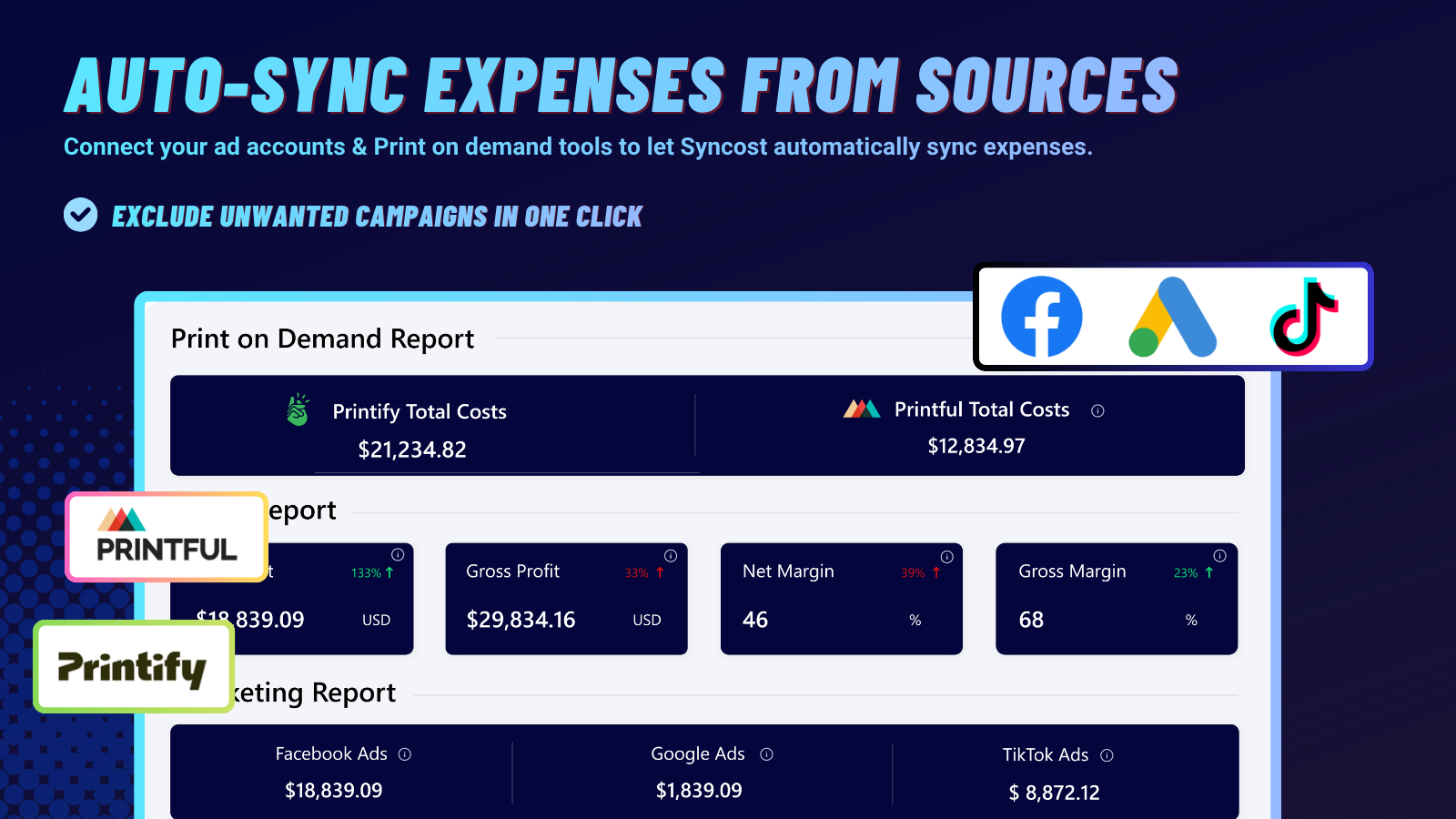
syncost is designed around that workflow. Its current Shopify listing includes real-time profit by order, product, and day, shipping-cost tracking, COGS management, advertising synchronization, and automatic POD cost synchronization through supported integrations.
That matters because shipping problems are much easier to identify when they appear inside the profitability calculation instead of living in a separate fulfillment dashboard.
From Financial Chaos to Verified Profit
The biggest mistake POD merchants make with shipping is treating it as a checkout setting.
It is not.
Shipping is part of the product economics.
A product generating:
$10 contribution before shipping
can become:
$5 contribution
with $5 shipping.
Or:
$2 contribution
with $8 shipping.
Or:
-$1 contribution
with $11 shipping.
Nothing about the design changed.
Nothing about demand changed.
The logistics changed.
That means your POD profitability system should connect:
Product Revenue
      ↓
Production COGS
      ↓
Shipping
      ↓
Transaction Fees
      ↓
Advertising
      ↓
Contribution
This is also where syncost becomes useful for a POD store. Syncost's current Shopify listing says it brings together product costs, shipping, fees, advertising spend, recurring expenses, order-level profit, product-level margins, and P&L reporting in one profitability view. It also supports automated POD COGS synchronization through its listed integrations.
The objective is not another dashboard.
It is knowing that a $35 shirt produced:
Revenue = $35
Production = $14
Shipping = $6
Fees = $1.50
Ads = $9

Contribution = $4.50
instead of assuming:
$35 - $14
=
$21 profit
Those are completely different businesses.
And once shipping is measured correctly, the merchant can finally answer the questions that matter:
Should shipping be charged separately?
Should it be built into the product price?
Does free shipping actually increase total profit?
Which products are expensive to fulfill?
Which countries are destroying margin?
Do bundles improve shipping efficiency?
Can the product still support its current CAC?
Shipping may look like a five-dollar operational detail.
Across thousands of POD orders, it becomes a five-figure financial variable.