The 100% Margin Myth: How to Sell Digital Products on Shopify Without Bleeding Cash to Hidden Fees
Digital products boast the allure of 100% gross margins, tricking Shopify merchants into ignoring the silent bleed of delivery app subscriptions, payment gateway fees, and scaling ad costs. Learn how to set up, accurately price, and track the true unit economics of digital goods so your high-margin empire actually generates liquid cash.

The Hook & The Silent Problem
Let’s not sugar-coat the reality of the "info-product" gold rush: the idea that digital goods generate 100% pure profit is the most dangerous mathematical illusion in modern e-commerce.
You read the success stories on Twitter. You package your expertise into a premium PDF guide, an exclusive video course, or a bundle of digital templates. You set up your Shopify store, price the item at $50, and launch your Meta ad campaigns. Because you don't have to pay a factory for physical inventory, deal with ocean freight, or pay a 3PL to put items in a cardboard box, you assume that every $50 sale is $50 directly into your bank account.
Armed with this spreadsheet fantasy, you tell your media buyer they can spend up to $45 to acquire a customer. You assume you will pocket a clean $5 on every single transaction at massive scale.
Then the end of the month arrives, and your operating account is overdrawn.
Where did the cash go? It vanished into the rigid, invisible architecture of e-commerce variable costs. You assumed a digital product has zero Cost of Goods Sold (COGS). But you forgot about Shopify Payments taking 2.9% + $0.30 off the top. You forgot about the monthly recurring fees of your digital download delivery app. You ignored the rising cost of your email marketing software as your list grew.
By ignoring the hidden overhead attached to non-physical goods, you optimized your ad account to scale negative margins. If you do not know exactly how to sell digital products on Shopify using bottom-up unit economics, your "100% profit" business will aggressively scale straight into bankruptcy.
Core Concept Explained (The Quick Answer)
Selling Digital Products on Shopify requires bypassing traditional shipping configurations and utilizing specialized third-party delivery applications (like SendOwl or Shopify Digital Downloads) to securely distribute files upon checkout. The Digital Profit Trap occurs when merchants treat digital goods as having zero variable costs, thereby overspending on customer acquisition and failing to deduct gateway fees, hosting infrastructure, and platform taxes from their true net margin.
The Deep-Dive Reference Guide
To stop bleeding cash on digital goods, you must stop treating them as magical assets exempt from operational costs. Elite operators map the distinct financial differences between physical and digital catalog items.
| Operational Vector | Physical Product Reality | Digital Product Reality (The Hidden Trap) | CFO Net Impact |
|---|---|---|---|
| Cost of Goods Sold (COGS) | Factory manufacturing, freight, and customs duties. | Content Creation & Hosting: Upfront production costs, plus amortized monthly SaaS fees for delivery apps (e.g., $15-$99/mo). | The SaaS Bleed. You don't pay per unit, but fixed monthly software costs silently eat your margins if volume drops. |
| Fulfillment Logistics | 3PL pick, pack, dunnage, and outbound carrier shipping rates. | Bandwidth & Gateway Fees: No physical box, but digital delivery apps charge based on file storage size and download bandwidth. | The File Size Penalty. Large video files can trigger expensive software tier upgrades, acting as a hidden fulfillment fee. |
| Return Management | Reverse logistics, damaged inventory write-offs, and restocking fees. | Chargeback Vulnerability: Digital products are highly susceptible to "friendly fraud" and immediate refund requests with zero asset recovery. | The Dispute Tax. High chargeback rates on digital goods will incur $15+ penalty fees and threaten your Shopify Payments account. |
| Pricing Strategy | Target-margin pricing based on rigid landed COGS and shipping zones. | Value-Based Arbitrage: Pricing based entirely on the perceived outcome the product delivers, restricted only by your CAC. | The Margin Illusion. Allows massive flexibility, but tricks founders into ignoring gateway fees and overbidding on ad platforms. |
Technical Breakdown & Formulas
You cannot run a digital product business on intuition. Even with near-zero COGS, if you do not run these specific mathematical formulas before launching your ads, you are flying blind.
Step 1: Calculate the Digital Variable Cost (DVC) per Order
DVC = Payment_Gateway_Fee_$ + Amortized_Software_Cost_Per_Order + Digital_Delivery_Bandwidth_Fee

Step 2: The Digital Contribution Margin Formula
Digital_Contribution_Margin_$ = Retail_Price - DVC
Digital_Contribution_Margin_% = (Digital_Contribution_Margin_$ / Retail_Price) * 100

Step 3: True Net Profit (The Reality Check)
True_Net_Profit_$ = Digital_Contribution_Margin_$ - Customer_Acquisition_Cost (CAC)

Amortized Software Cost Calculation:
Amortized_Software_Cost = Total_Monthly_SaaS_Overhead / Forecasted_Monthly_Orders
The Math in Action (The Invisible Bleed): Let’s rigorously audit a $49 digital workout program.
- Retail Price: $49.00
- Raw COGS: $0.00
- Gross Margin Illusion: $49.00 (100%)
Now, let's deduct the actual variable costs:
- Shopify Payments (2.9% + $0.30): $1.72
- Digital App Delivery Fee (Amortized per order): $0.15
- Total Digital Variable Costs (DVC): $1.87
- Digital Contribution Margin:
$49.00 - $1.87 = $47.13
Finally, let's factor in Meta ad acquisition:
- Target CAC (Meta Ads): $45.00
- True Net Profit per unit:
$47.13 - $45.00 =+$2.13 (4.3% Net Margin)
The Financial Truth: Your spreadsheet said you made $49 of pure profit. The reality is you made $2.13. If your Meta ad costs fluctuate by just $3 over the weekend, you are instantly losing cash on every single digital download.
The Scaled Financial Impact (What It Actually Costs You)
Let’s look at what happens when two different businesses attempt to scale the exact same $49 digital product to 5,000 units, but manage their margins with entirely different philosophies.
Store A: The "Zero COGS" Gambler
Store A believes they have a 100% margin. They tell their agency to push ad spend as hard as possible, allowing a Customer Acquisition Cost (CAC) of up to $48, assuming they will still make $1 per sale. They ignore gateway fees and app costs.
- Total Revenue (5,000 units): $245,000
- Ignored Gateway & App Fees ($1.87/unit): -$9,350
- Total Ad Spend ($48 Average CAC): -$240,000
- The Reality: Store A scaled to nearly a quarter-million dollars in revenue. But because they ignored the rigid math of gateway fees and digital fulfillment, their True Net Profit is -$4,350. They literally paid thousands of dollars out of pocket to give their digital product away for free.
Store B: The Unit Economics Sniper
Store B operates with CFO-level financial hygiene. They know their exact Digital Contribution Margin is $47.13. They enforce a strict CAC cap at $30 to guarantee a highly liquid cash return on every sale.
- Total Revenue (5,000 units): $245,000
- Tracked Gateway & App Fees ($1.87/unit): -$9,350
- Total Ad Spend ($30 Average CAC): -$150,000
- The Reality: Store B generates the exact same $245,000 in top-line revenue. However, by strictly pacing their ad spend against their true contribution margin, their True Net Profit is a massive +$85,650.
The Catastrophic Reality: Store A and Store B sold the exact same digital file. Store A is cash-negative and frantic; Store B generated over $85k in pure liquid profit. The only difference was accurate, real-time margin analytics.
Strategic Execution (How to Apply This to Your Business)
To launch a highly profitable digital offering, you must execute a strict operational setup workflow. Do not skip these configurations, or your customers will be charged for shipping on a PDF.
-
Disable Physical Shipping Settings: Fix the native checkout flow. Shopify defaults all new items to physical products. Go to your Product page, scroll to the "Shipping" section, and explicitly uncheck "This is a physical product." This ensures the customer bypasses the shipping address and shipping rate calculations at checkout, drastically increasing your conversion rate.
-
Install a Digital Delivery App: Automate the file delivery. Native Shopify does not host or email downloadable files to customers. You must install a specialized app. For basic single-file PDFs, the free "Shopify Digital Downloads" app works. For large video files, license keys, or multi-file bundles, you must install a robust third-party app like SendOwl or SkyPilot.
-
Lock Down Download Limits: Configure fraud protection. Digital products are easily pirated. Inside your delivery app, you must set strict parameters. Limit the number of times a customer can click the download link (usually 3 times is safe), and set an expiration date on the link (e.g., 30 days). This prevents a single customer from sharing their unique link on Reddit.
-
Establish the Non-Negotiable CAC Cap: Arm your media buyers. Subtract your payment gateway fees and amortized app costs from your retail price. Establish the exact dollar amount of your Digital Contribution Margin. Give your media buyers a strict Maximum CAC that is at least 30% lower than this number. If ad costs cross that threshold, campaigns must be paused.
Frequently Asked Questions (FAQ)
How to sell digital products on Shopify step by step?
First, create your product listing and uncheck "This is a physical product" to remove shipping requirements at checkout. Second, install a digital delivery app (like SendOwl) from the Shopify App Store. Third, upload your digital files (PDFs, MP3s, MP4s) directly into the app and attach them to the corresponding Shopify product variant. Finally, customize the automated email template the app uses to deliver the secure download link to your customer post-purchase.
Can you sell both physical and digital products on the same Shopify store?
Yes, absolutely. By unchecking the physical product setting on your digital SKUs, Shopify's checkout logic will automatically adapt. If a customer has a t-shirt and an eBook in their cart, the checkout will charge shipping only for the t-shirt. The physical item will route to your 3PL for fulfillment, while your delivery app will instantly email the eBook link.
What are the hidden costs of selling digital products?
The most dangerous hidden costs are Payment Gateway Fees (e.g., 2.9% + $0.30 per transaction), monthly SaaS fees for advanced digital delivery apps, increased bandwidth charges if hosting large video files, and the Customer Acquisition Cost (CAC) required to drive traffic. Additionally, digital goods face high chargeback rates, which can incur $15 penalty fees from payment processors.
From Financial Chaos to Verified Profit
Operating a digital product store based on the myth of "100% margins" is an exercise in financial self-destruction. You cannot accurately calculate your scaling ad limits if you are ignoring the rigid transaction fees, software overhead, and fluctuating CAC that silently drain your cash flow. By the time you review your monthly P&L, you’ve already burned thousands of dollars acquiring customers at a net loss.
To survive and scale, you need absolute, unvarnished visibility into your True Net Margin on every single digital order, exactly as it happens.
This is where elite operators deploy Syncost.
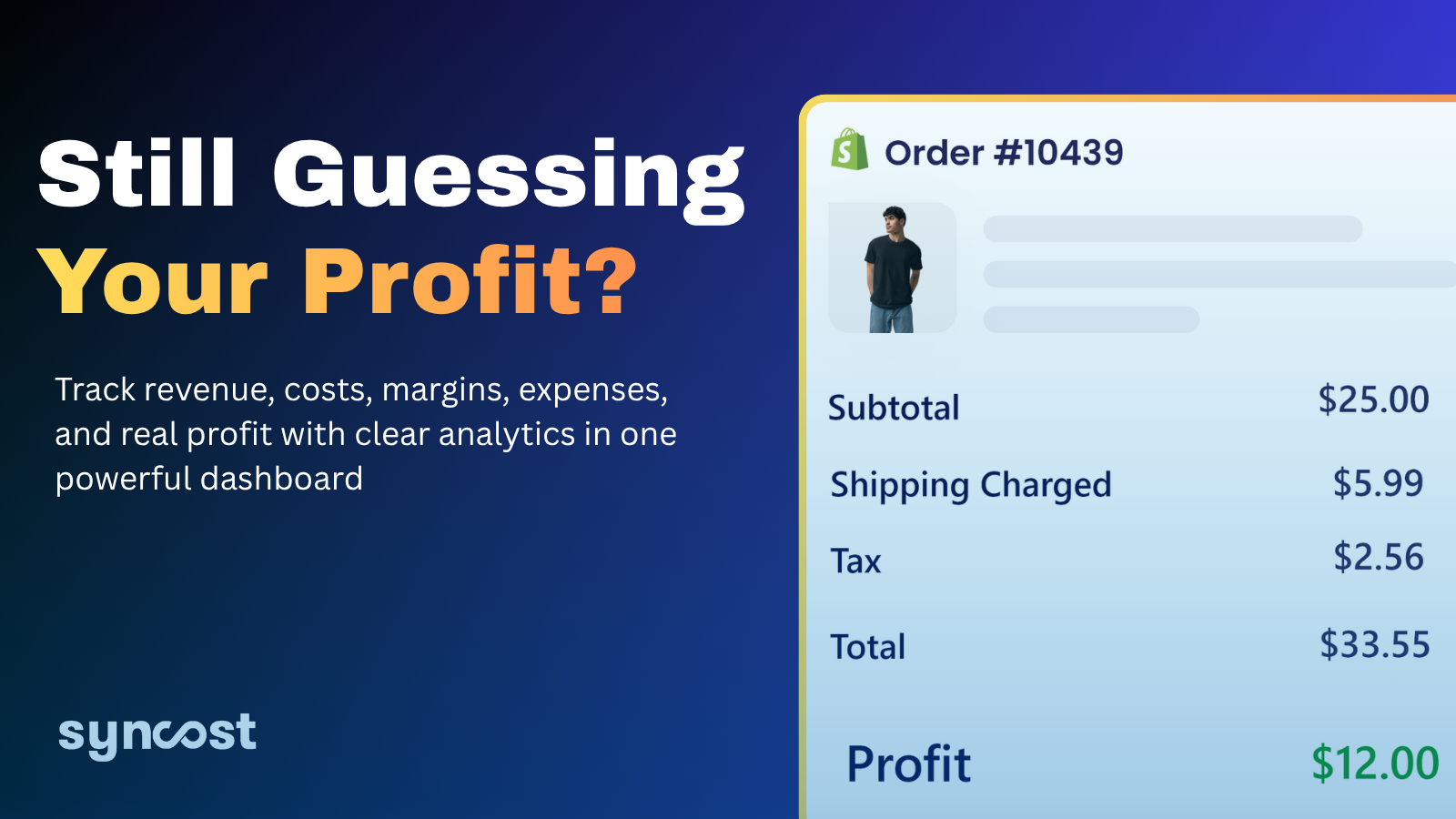
Syncost strips away the top-line illusions of digital e-commerce. While Shopify's native dashboard tells you your digital product is pure profit, Syncost seamlessly connects to your live ad platforms and payment gateways to calculate the absolute bottom line. It automatically deducts transaction fees, custom overhead expenses, and real-time Meta and Google ad spend, giving you the True Net Profit of your digital goods down to the exact fractional dollar.
Stop making critical scaling decisions based on phantom gross margins. Install Syncost today, track the true unit economics of your digital products, and command your financial operations with the absolute authority of a veteran CFO.