How to Price Your Shopify Products for Profit: A Practical Guide
Pricing is the fastest way to change your profit, yet most store owners guess. Learn the main pricing methods, the formulas behind them, and how to choose a price that covers your costs and still sells.

Ask a store owner how they chose their prices and you will often hear: "I looked at what competitors charge" or "it just felt right." That is understandable, because pricing feels like a creative decision. But it is also the biggest lever you have on profit, and it deserves more than a guess.
A small change in price can have a much bigger effect than a small change in sales. If your margin is 20%, raising your price by just 5% can increase your profit by more than 25%, without needing a single extra customer. In this guide, we'll go through how pricing really works, the methods you can use, and how to pick a price you can defend.
Start With the Basics: Cost, Markup, and Margin
Before choosing a price, you need to understand three terms that are often mixed up.
Cost is everything it takes to sell one unit: the product itself, shipping, payment fees, packaging, and any other cost tied to the order.
Markup is how much you add on top of your cost, shown as a percentage of the cost.
Markup % = (Price − Cost) ÷ Cost × 100
Margin is how much of the selling price is profit, shown as a percentage of the price.
Margin % = (Price − Cost) ÷ Price × 100
These two are not the same. If an item costs $20 and you sell it for $40:
- Markup = (40 − 20) ÷ 20 = 100%
- Margin = (40 − 20) ÷ 40 = 50%
A lot of pricing mistakes come from mixing them up. If you want a 50% margin but apply a 50% markup, you will end up with a margin of only 33%. Always decide which one you are using before you set a price.
Know Your Real Cost First
You can't price correctly if you don't know your true cost. Many store owners only use the product cost and forget the rest. Your cost per order should include:
- Product or manufacturing cost
- Shipping you pay (not what the customer pays)
- Payment processing fees
- Packaging and handling
- Average refund and return losses
- Ad cost to get the customer (for a complete picture)
Here is an example. A product costs $18 from your supplier. After adding $6 shipping, $2 in fees, and $1 packaging, your real cost is $27, not $18. If you priced using $18, you may think you have a healthy margin when you actually have a thin one.
6 Pricing Methods You Can Use
1. Cost-Plus Pricing
You take your cost and add a fixed markup. For example, a cost of $27 with a 100% markup gives a price of $54.
Price = Cost × (1 + Markup)
This is the simplest method and a good starting point. Its weakness is that it ignores what customers are willing to pay. You might be charging too little for something people value highly, or too much for something they see as common.
2. Target Margin Pricing
You decide the margin you want and work backward.
Price = Cost ÷ (1 − Target margin)
If your cost is $27 and you want a 50% margin: 27 ÷ 0.5 = $54. If you want 60%: 27 ÷ 0.4 = $67.50. This is more accurate than markup for planning your profit.
3. Competitor-Based Pricing
You look at similar products and price near the market. This helps you stay realistic, but it has risks. Your competitors may have lower costs, different shipping, or may be losing money without knowing it. Copying their price can mean copying their problems.
Use competitors as a reference point, not as your only rule.
4. Value-Based Pricing
You price based on the value the customer feels, not just your cost. A handmade, personalized, or hard-to-find product can often be priced higher than its cost suggests. Strong branding, good photos, reviews, and a clear story all raise how much customers are willing to pay.
This method often gives the best margins, but it needs a real brand and good positioning.
5. Psychological Pricing
Small details change how a price feels. Examples include:
- Prices that end in 9 or 7, such as $19.99 or $49.97
- Showing a higher "compare at" price next to a sale price
- Bundles, like "3 for $50," that make the single price feel more expensive
These tricks work best when the product and offer are already good. They are not a replacement for a healthy margin.
6. Tiered and Bundle Pricing
Offering small, medium, and large options, or bundles, can raise your average order value. Customers often pick the middle choice, so you can design your options so the middle one has the margin you want.
Don't Forget Discounts, Ads, and Shipping
A price that looks fine on paper can fail in real life. Check these three things before finalizing any price.
Discounts. If your margin is 40% and you give a 20% discount, your margin does not drop to 20%. It drops to 25%, which can cut your profit per sale by more than a third. Always calculate the margin after the discount.
Advertising. If you pay for ads, your real margin is the margin after the ad cost per order. A product with a $54 price, $27 cost, and $15 ad cost per order leaves only $12 of profit.
Shipping. Free shipping is attractive, but you pay for it. Either build the shipping cost into your price, set a free-shipping threshold, or charge shipping separately, but never ignore it.
How to Test and Adjust Your Prices
Good pricing is not set once and forgotten. A simple process:
- Set your starting price using target margin pricing.
- Compare it to similar products in your market.
- Run it for 2 to 4 weeks and watch conversion rate and profit per order, not just sales.
- Change one thing at a time, such as a price increase of 5 to 10%.
- Compare the results. If sales stay about the same while profit rises, keep the new price.
Don't be afraid to raise prices. Many stores find that a small increase barely changes how many people buy, while profit grows noticeably.
Common Pricing Mistakes
- Pricing by gut feeling without calculating the real cost
- Mixing up markup and margin
- Being the cheapest and having no room for ads, discounts, or mistakes
- Never reviewing prices, even when supplier or shipping costs change
- Ignoring refunds and returns, which reduce real profit
- Discounting too often, which teaches customers to wait for sales
Tools That Make Pricing Easier
You don't need complicated software to price well. A markup calculator can quickly turn a cost and a target into a price, and a profit margin calculator lets you check what a price really earns you.
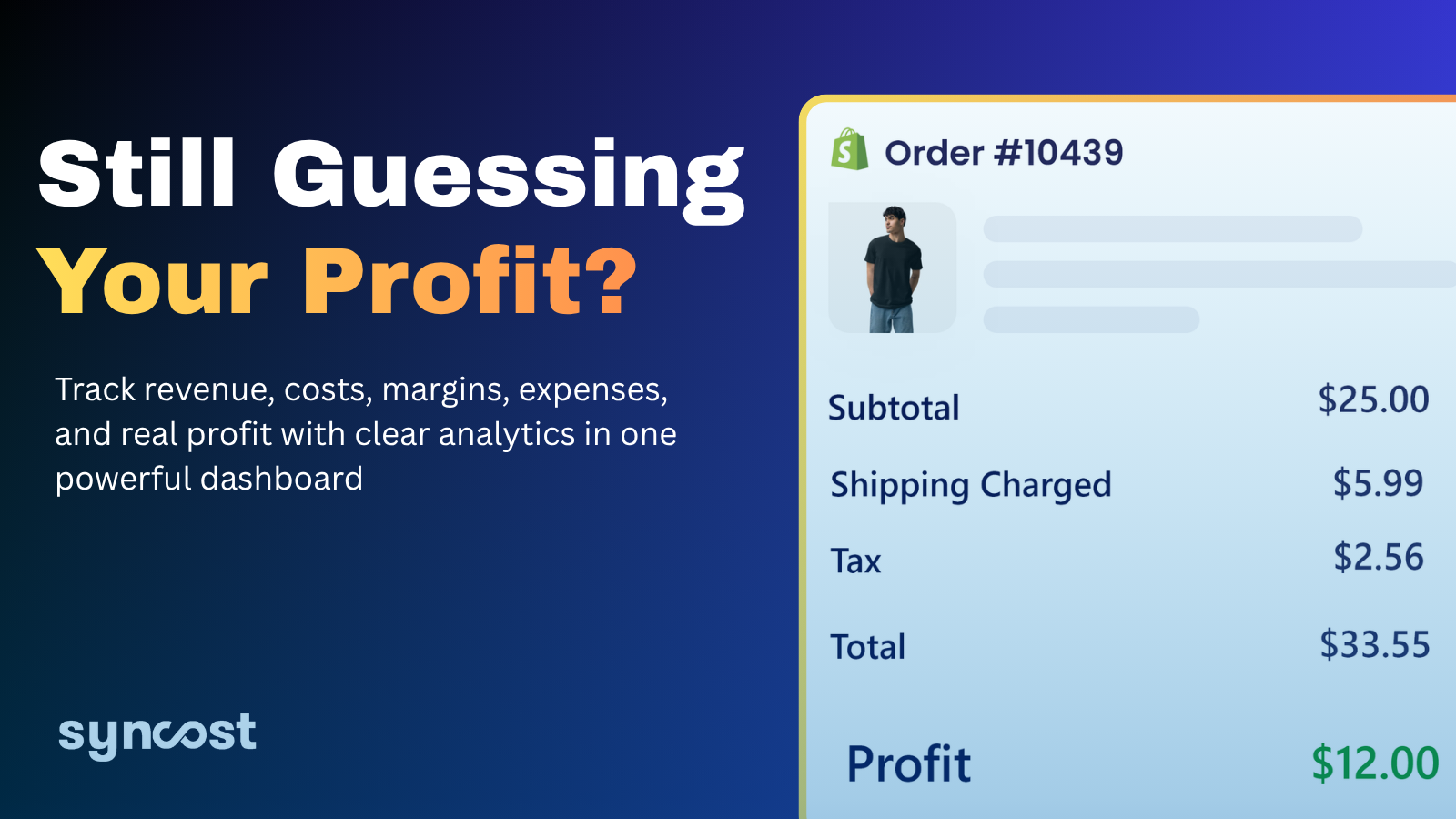
As your store grows, it also helps to see what each order actually earned after costs, so you know which prices work. Tools like Syncost can show profit per order inside Shopify, which makes it easier to spot products that are priced too low.
Key Takeaways
- Pricing is one of the most powerful ways to increase profit.
- Know the difference between markup and margin before you calculate anything.
- Use your full cost, not just the product price.
- Target margin pricing is the most reliable starting point.
- Check your margin after discounts, shipping, and ad costs.
- Test small price changes and review them regularly.
A good price is one that customers accept and that leaves you with a real profit. Take an hour this week to recalculate the price of your top three products using their full costs. You may find that a small change is all it takes.