Competitive Pricing Without Killing Your Margins (The Volume Trap)
“We’ll make it up in volume” is the most dangerous lie in e-commerce. Slashing your prices to match competitors might boost top-line revenue, but it triggers a mathematical trap that silently annihilates your net margin. Learn the break-even math behind discounting and how to compete without racing to the bottom.

The Hook & The Silent Problem
There is a fatal delusion that plagues mid-market e-commerce founders: the belief that matching a competitor's discount will be offset by a surge in sales volume. You see a rival brand drop their flagship product by 15% for a weekend flash sale. Panic sets in. To "stay competitive," you immediately mirror their pricing. Your conversion rate spikes, your Shopify dashboard lights up with orders, and top-line revenue looks phenomenal. You think you won the weekend.
Then, the end-of-month reconciliation hits.
You paid the exact same amount for your landed inventory (COGS). You paid the same pick-and-pack fulfillment fees. Your customer acquisition cost (CAC) on Meta and TikTok barely budged, and the payment gateway still took their flat percentage. By the time you deduct your fixed operational costs from the newly discounted price, your net profit margin hasn't just shrunk—it has collapsed.
You didn't win market share; you subsidized a stranger’s purchase using your own operating capital. The silent problem is that e-commerce operators treat discounting as a marketing lever rather than a structural change to their unit economics. When you lower your price, you don't just lose the discount amount in profit; you trigger an exponential requirement for new sales just to break even. If you are blindly competing on price without knowing your absolute price floors, you are actively driving your brand into bankruptcy at high speed.
Core Concept Explained (The Quick Answer)
Competitive Pricing is the strategic positioning of your retail price to maximize perceived market value and conversion rate while fiercely defending your Net Profit Margin. It is not the act of being the cheapest; it is the discipline of optimizing your price-to-value ratio so you can out-spend competitors on acquisition (CAC) while remaining highly profitable.
The Deep-Dive Reference Guide
To stop bleeding cash, you must understand the different pricing frameworks and the actual financial toll they take on your operations. Not all pricing strategies are created equal.
| Pricing Strategy | How Founders Use It | The Financial Reality (CFO Perspective) | Profit Impact |
|---|---|---|---|
| Cost-Plus Pricing | Adding a flat 50% markup to Landed COGS to set the retail price. | Completely ignores variable costs like CAC, shipping surcharges, and gateway fees. | Creates false confidence; actual net margin is usually near zero. |
| Competitor-Based | Mirroring a rival's price to avoid losing market share. | Assumes the competitor knows what they are doing. They might be liquidating dead stock or operating at a loss. | Triggers a race to the bottom, destroying unit economics for both brands. |
| Loss-Leader Pricing | Selling a core item below cost to acquire a customer. | Only works if you have a historically proven, high-converting backend funnel (LTV) that guarantees a second purchase. | Highly dangerous. Destroys immediate cash flow and relies entirely on speculative future revenue. |
| Value-Based Pricing | Pricing based on brand equity, perceived quality, and distinct market positioning. | Requires disciplined marketing and exceptional product quality, allowing you to ignore competitor discounts. | Maximizes gross margin, giving you the cash flow to out-compete rivals on ad spend. |
Technical Breakdown & Formulas
Before you ever touch the discount dial in your Shopify backend, you must calculate the exact amount of extra sales volume required to justify the price cut. This is known as the Break-Even Sales Increase (BESI).
To calculate this, you need a precise grasp of your baseline unit economics:
Current Contribution Margin = Retail_Price - (Landed_COGS + Fulfillment_Cost + CAC + Gateway_Fee)

Break-Even Sales Increase (BESI) % = [ Discount % / (Current_Margin % - Discount %) ] * 100

Where:
- Discount %: The percentage by which you are reducing the retail price.
- Current_Margin %: Your true profit margin percentage before the discount is applied.
If you do not run this formula before running a sale, you are gambling. Every percentage point you discount comes directly out of your net profit, not your gross revenue. Because your variable costs (COGS, shipping, pick/pack) remain fixed regardless of the retail price, the discount disproportionately impacts your bottom line.
The Scaled Financial Impact (What It Actually Costs You)
Let’s strip away the theory and look at the brutal mathematical reality of a "harmless" 10% discount.
The Baseline Unit Economics (Pre-Discount):
- Retail Price: $100.00
- Variable Costs (COGS, Shipping, CAC, Fees): $60.00
- Net Profit per Unit: $40.00
- Net Margin: 40%
You decide to run a 10% off sale to match a competitor. Your new retail price is $90.00.
- New Retail Price: $90.00
- Variable Costs (Unchanged): $60.00
- New Net Profit per Unit: $30.00
You only discounted the product by 10%, but your actual profit per unit dropped by 25% (from $40 down to $30).
Now, let's look at the BESI formula:
[0.10 / (0.40 - 0.10)] * 100 = 33.3%
This means you must sell 33.3% more units just to make the exact same amount of money you were making before the discount.
The Scaled Devastation
- At 1,000 Units (Pre-Discount): You make $40,000 in net profit.
- At 1,000 Units (Post-Discount): You make $30,000 in net profit. You just burned $10,000 of cash to "stay competitive."
- To break even on the discount: You now have to pick, pack, and ship 1,333 units just to get back to your original $40,000 profit.
Here is the CFO-level trap: Acquiring those extra 333 customers requires more ad spend. So your CAC actually goes up, squeezing that $30 margin even tighter. You are doing 33% more operational work, putting strain on your 3PL, and depleting your inventory faster, all for literally zero additional financial gain.
Strategic Execution (How to Apply This to Your Business)
You do not have to race to the bottom to win market share. Instead of liquidating your margins, restructure your offers to increase perceived value without touching the core retail price.
-
Shift to Bundle Pricing (Volume Minimums): Never discount single units. If you must discount to compete, force the customer to earn it. Instead of offering 15% off a single $50 item, offer 15% off only when they buy a 3-pack for $150. You sacrifice a percentage of margin, but you massively reduce your shipping and CAC ratios per unit, resulting in a higher net dollar profit per order.
-
Implement High-Margin Value Adds: Perceived value beats cash discounts. Instead of dropping your price by $10, offer a "Free Gift With Purchase." Source a high-perceived-value accessory that costs you $1.50 in landed COGS. The customer feels like they are getting a premium deal, but you only surrendered $1.50 of margin instead of $10.00.
-
Calculate Your Hard Price Floor: Define the floor before you adjust the ceiling. Audit every single SKU. Add your exact landed COGS, average shipping, baseline CAC, and merchant fees. If your total variable cost is $42, your absolute price floor is $42.01. Anything below that means you are paying customers to take your inventory. Lock this floor into your pricing strategy and never breach it.
-
Compete on Logistics, Not Retail Price: Isolate the variable causing the squeeze. If competitors are drastically undercutting you, audit your supply chain. Are you paying dimensional weight penalties on shipping? Is your 3PL overcharging for pick-and-pack? Shaving $3 off your fulfillment costs allows you to drop your retail price by $3 without losing a single cent of your net margin.
Frequently Asked Questions (FAQ)
What is MAP pricing, and how does it protect margins?
MAP stands for Minimum Advertised Price. It is a legally binding agreement between manufacturers and retailers that dictates the lowest price a product can be publicly displayed for sale. If you manufacture your own goods and wholesale them to other retailers, strictly enforcing a MAP policy prevents third-party sellers from starting a price war that devalues your brand's core positioning.
How should I respond when a direct competitor slashes their prices by 30%?
Do nothing immediately. Let them bleed their own inventory dry. Often, massive sudden discounts indicate cash-flow desperation or a frantic need to liquidate dead stock to pay a supplier. If you maintain your price, your conversion rate may dip temporarily, but your margin remains intact. Pivot your ad creatives to highlight product quality, superior shipping times, or better customer service rather than engaging in a suicidal price war.
Is dynamic pricing safe for standard Shopify stores?
Dynamic pricing (algorithmically changing prices based on demand and competitor pricing) is highly dangerous unless you have real-time, bottom-up cost tracking. If a dynamic pricing app lowers your retail price to match a competitor, but fails to account for a recent spike in your Facebook CAC or a carrier fuel surcharge, the algorithm will automatically scale your store into negative unit economics.
From Financial Chaos to Verified Profit
You cannot confidently price your products if you don't know exactly what they cost to sell. Most founders rely on gut feelings, static spreadsheets, or flawed top-line Shopify analytics to make pricing decisions. They see a high ROAS on an ad account and assume they have the margin to run a 20% off sale, completely blind to the fact that hidden shipping zones and packaging costs have already eaten their profit.
This is where Syncost changes the game.
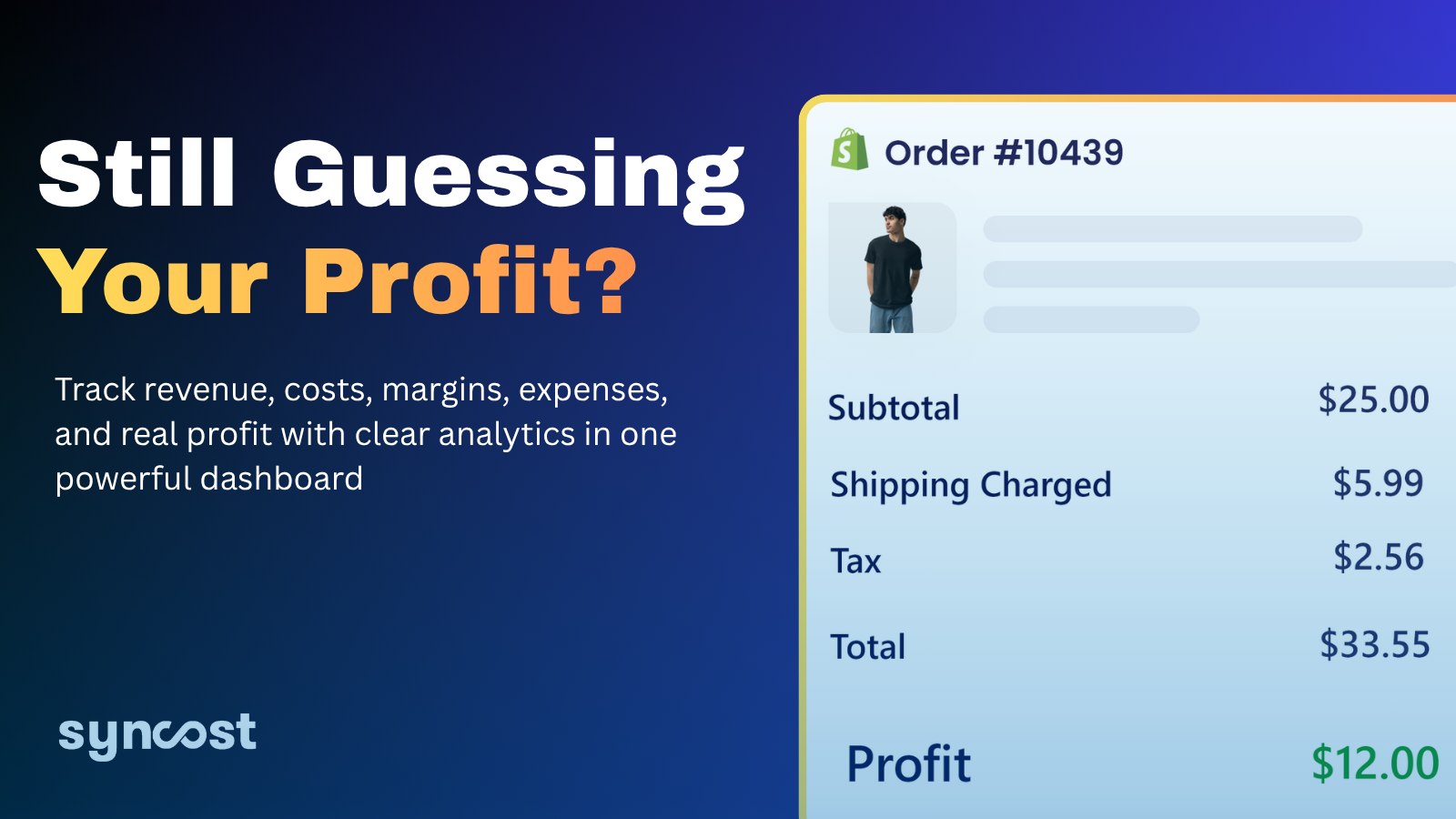
Syncost eliminates the fatal guesswork of pricing strategy by giving you absolute, real-time visibility into your true unit economics. It automatically aggregates your live ad spend, exact payment gateway fees, and dynamic fulfillment costs to reveal your exact net profit on every single order. When a competitor drops their price, you won't have to guess if you can afford to match them—Syncost will show you your precise price floor instantly. Stop playing guessing games with your margins and start pricing with the lethal precision of a veteran CFO.