The 3PL Fulfillment Fee Trap: How Hidden Warehouse Surcharges Are Bleeding Your Shopify Profits
Most Shopify merchants look at their base shipping charges and assume their fulfillment costs are locked in. In reality, hidden pick-and-pack surcharges, dimensional weight adjustments, packaging markups, and long-term storage penalties silently drain your operating margins as you scale.

The Hook & The Silent Problem
Picture this scenario: You are reviewing your end-of-month financial reports for your rapidly growing direct-to-consumer skincare brand. Your Shopify dashboard indicates you processed 5,000 orders last month with an Average Order Value (AOV) of $75, resulting in $375,000 in gross revenue. You subtract your factory product costs, your ad spend on Meta and Google, and your merchant processing fees. On paper, your net profit margin looks healthy, hovering around 18%.
Then, your third-party logistics (3PL) provider uploads their monthly invoice.
When you reconcile the itemized warehouse bill against your projected fulfillment expenses, you discover a massive, unbudgeted discrepancy. While your base pick-and-pack rate was quoted at $4.50 per order, the actual invoice reveals an average fulfillment cost of $9.20 per order. Why? Because the base rate didn't account for additional pick fees on multi-item orders, custom branded tape surcharges, box dimensional weight adjustments, void-fill material markups, pallet receiving labor, and a sudden storage penalty tier for slow-moving SKUs.
For e-commerce founders, 3PL fulfillment costs are frequently treated as a fixed utility. Because warehouse invoices are complex, multi-page data tables filled with industry jargon, merchants rarely audit them line by line. Instead, they accept the lump-sum deduction as a necessary cost of doing business.
Yet, when your operating margins are razor-thin, a hidden $4.70 fulfillment variance across 5,000 monthly orders equates to $23,500 in pure cash vanishing from your bank account every thirty days. If you are not actively auditing your warehouse contracts and tracking fully burdened fulfillment expenses at the unit level, your 3PL is quietly siphoning away the exact capital you need to scale.
Core Concept Explained (The Quick Answer)
Base Fulfillment Rate is the nominal quote a 3PL gives you for picking a single item and placing it in a standard box. Fully Burdened Fulfillment Cost per Order (FBFO) is the actual, comprehensive expense required to ship an order—incorporating base pick-and-pack labor, multi-item pick charges, packaging materials, postage labels, inventory storage allocations, and seasonal surcharges—providing the true baseline for your operational profitability.
The Deep-Dive Reference Guide
To eliminate warehouse cash leaks, you must dissect the complex fee structure that 3PLs use to bill your brand. If your financial model omits even two of these line items, your unit economics are fundamentally distorted.
| 3PL Cost Component | Operational Definition | The Margin Impact (Why Founders Miss It) |
|---|---|---|
| Base Pick-and-Pack Rate | The quoted labor cost to retrieve the first item and place it into a standard carton. | The Bait. Looks attractive on initial contract proposals, but represents only 40% of your actual monthly fulfillment invoice. |
| Additional Item Pick Fees | Surcharges ($0.50 to $1.50 per extra unit) for orders containing multiple SKUs or bundles. | The Bundle Trap. Punishes brands that successfully increase AOV through cross-sells and product kits. |
| Packaging & Void-Fill Markups | The retail cost of boxes, bubble mailers, dunnage, and custom branded packing tape. | Material Inflation. 3PLs often markup packaging materials by 100% to 300% over wholesale manufacturing costs. |
| Dimensional Weight (Dim Weight) Surcharges | Carrier penalty fees triggered when a lightweight product ships in a box larger than necessary. | The Empty Space Penalty. Dramatically inflates postage costs on bulky or oddly shaped consumer goods. |
| Inventory Storage Tier Penalties | Monthly fees charged per pallet or bin, escalating sharply during Q4 peak season. | Dead Stock Bleed. Slow-moving SKUs quietly drain operating capital through compounding warehouse rent. |
| Goods Inbound Receiving & QC | Labor fees for unloading floor-container shipments, palletizing, and counting incoming inventory. | Hidden Setup Costs. Often billed hourly or per carton, reducing the net margin of incoming manufacturing batches. |
Technical Breakdown & Formulas
Calculating your true fulfillment drag requires moving beyond static estimates and establishing a fully burdened fulfillment equation.
Fully Burdened Fulfillment Cost Per Order (FBFO) Formula:
FBFO = Base_Pick_Pack + (Additional_Items_Count * Per_Item_Pick_Fee) + Packaging_Unit_Cost + Postage_Label_Cost + Allocated_Storage_Per_Unit + Inbound_Receiving_Allocation

Where:
- Base_Pick_Pack: The primary labor cost for the initial SKU in an order.
- Additional_Items_Count: Number of extra units in multi-item orders or promotional bundles.
- Packaging_Unit_Cost: Total cost of the box, bubble mailer, dunnage, and branded tape.
- Allocated_Storage_Per_Unit: Total monthly warehouse storage rent divided by total units shipped that month.

True Contribution Margin 2 (CM2) Formula (Fulfillment-Adjusted):
CM2 = Gross_Revenue - Landed_COGS - Gateway_Fees - Total_FBFO - Return_Processing_Cost
When modeling your unit economics, failing to incorporate FBFO means your contribution margin is artificially inflated. An order that looks profitable on a basic gross margin spreadsheet can quickly plunge into negative territory once multi-item pick fees and dimensional weight surcharges are applied.
The Scaled Financial Impact (What It Actually Costs You)
Let’s examine how hidden warehouse surcharges compound as an e-commerce brand scales from a modest 500 monthly orders to an aggressive 10,000 monthly orders.
Scenario A: The Startup Brand (500 Monthly Orders)
- Monthly Volume: 500 Orders (Average 1.5 items per order).
- Quoted Base Fulfillment Rate: $5.00 per order.
- The Basic Assumption: The founder expects total monthly fulfillment costs to be $2,500.
- The Hidden Reality (Fully Burdened FBFO of $8.10 due to packaging markups and extra pick fees):
- Actual Monthly Fulfillment Cost: 500 × $8.10 = $4,050.
- Monthly Variance: $1,550 unexpected cash drain. While manageable at low volume, it eats directly into founder salary and bootstrapping reserves.
Scenario B: The Scaling Enterprise (10,000 Monthly Orders)
As volume expands, operational complexity multiplies, and warehouse friction points compound rapidly.
- Monthly Volume: 10,000 Orders (Average 2.2 items per order due to bundling strategies).
- Quoted Base Fulfillment Rate: $4.20 per order (Volume-discounted).
- The Illusion: The founder budgets $42,000 a month for 3PL operations.
- The Reality (Fully Burdened FBFO climbs to $9.50 due to multi-item pick surcharges, dim-weight box penalties, and Q4 storage tier spikes):
- Actual Monthly Fulfillment Cost: 10,000 × $9.50 = $95,000.
- Monthly Variance: $53,000 in unexpected monthly cash outflow.
- Annualized Warehouse Bleed: $636,000 drained annually from operating capital.
The Financial Devastation: A $636,000 annual fulfillment discrepancy can bankrupt an otherwise fast-growing brand. Because basic Shopify dashboards do not automatically parse and ingest 3PL itemized invoices, founders continue scaling ad spend under the false impression that their unit economics are robust, completely unaware that warehouse surcharges are devouring their net profit.
Strategic Execution (How to Apply This to Your Business)
Eliminating fulfillment bleed requires rigorous invoice auditing, packaging redesigns, and structural renegotiations with your 3PL partner.
-
Cross-Examine Your Last 3 3PL Invoices: Perform a line-item invoice audit. Pull your itemized warehouse statements and match them against your Shopify order logs. Calculate your exact Fully Burdened Fulfillment Cost per Order (FBFO) by dividing total monthly warehouse charges by total shipped orders. If your true FBFO is more than 20% higher than your quoted base rate, you have an active margin leak.
-
Eliminate Dimensional Weight Penalties: Optimize box dimensions. Audit your top 5 selling SKUs and evaluate their packaging. If you are shipping small items in oversized corrugated boxes with excessive air pillows, you are paying heavy dimensional weight carrier penalties. Standardize to custom-fit mailers or right-sized cartons to drop postage costs instantly.
-
Account for Multi-Item Pick Fees in Bundles: Restructure bundle pricing. If your 3PL charges per additional pick, offering aggressive "Buy 3, Get 1 Free" bundles can destroy your unit economics. Ensure that your bundle pricing strategy absorbs the extra pick-and-pack labor fees before you launch promotional campaigns.
-
Sync Warehouse Costs to Your Profit Dashboard: Automate fulfillment expense tracking. Stop relying on manual spreadsheets to estimate fulfillment expenses. Integrate your operations so that every picking fee, storage allocation, and packaging surcharge is dynamically factored into your daily net profit calculations.
Frequently Asked Questions (FAQ)
How do dimensional weight surcharges impact e-commerce fulfillment costs?
Carriers (such as UPS, FedEx, and DHL) calculate shipping rates based on either actual physical weight or volumetric (dimensional) weight—whichever is greater. If your product is lightweight (e.g., a cotton t-shirt) but shipped in a large box, the carrier charges you for the space the box occupies rather than its grams. This hidden surcharge can instantly double your outbound postage cost.
Why do multi-item orders disproportionately destroy my fulfillment margins?
Most 3PL contracts quote a competitive base rate that covers the first scanned item. However, every subsequent item in that same order incurs an "additional pick fee" (typically $0.50 to $1.50 per unit). If a customer purchases a 5-item bundle, the warehouse labor required to walk, pick, scan, and pack each item multiplies your fulfillment cost, turning a high-revenue order into a low-margin transaction.
What is the difference between storage fees and pick-and-pack labor?
Storage fees represent the rental cost of warehouse real estate (measured by pallet spaces or bin locations) required to house your inventory inventory month-over-month. Pick-and-pack labor represents the active human effort required to retrieve items off those shelves, pack them into boxes, and apply shipping labels the moment a customer places an order. Both must be combined to calculate your true inventory holding and fulfillment costs.
How often should I renegotiate my 3PL contract?
You should review your 3PL contract and benchmark your rates against competing fulfillment centers at least once a year, or whenever your monthly order volume crosses significant scaling thresholds (e.g., crossing 2,000, 5,000, or 10,000 monthly orders). As your volume grows, you gain immense leverage to negotiate lower base pick rates, waived receiving fees, and discounted packaging materials.
From Financial Chaos to Verified Profit
Operating a modern direct-to-consumer brand while guessing your fulfillment costs is a guaranteed path to a cash flow crisis. When you scale your advertising spend and push volume through your warehouse without tracking itemized pick fees, dimensional weight penalties, and storage tier surcharges, you are flying blind.
You cannot out-market bad fulfillment economics, and you cannot fix what your basic dashboards refuse to show you.
This is precisely why top-tier DTC operators rely on Syncost.
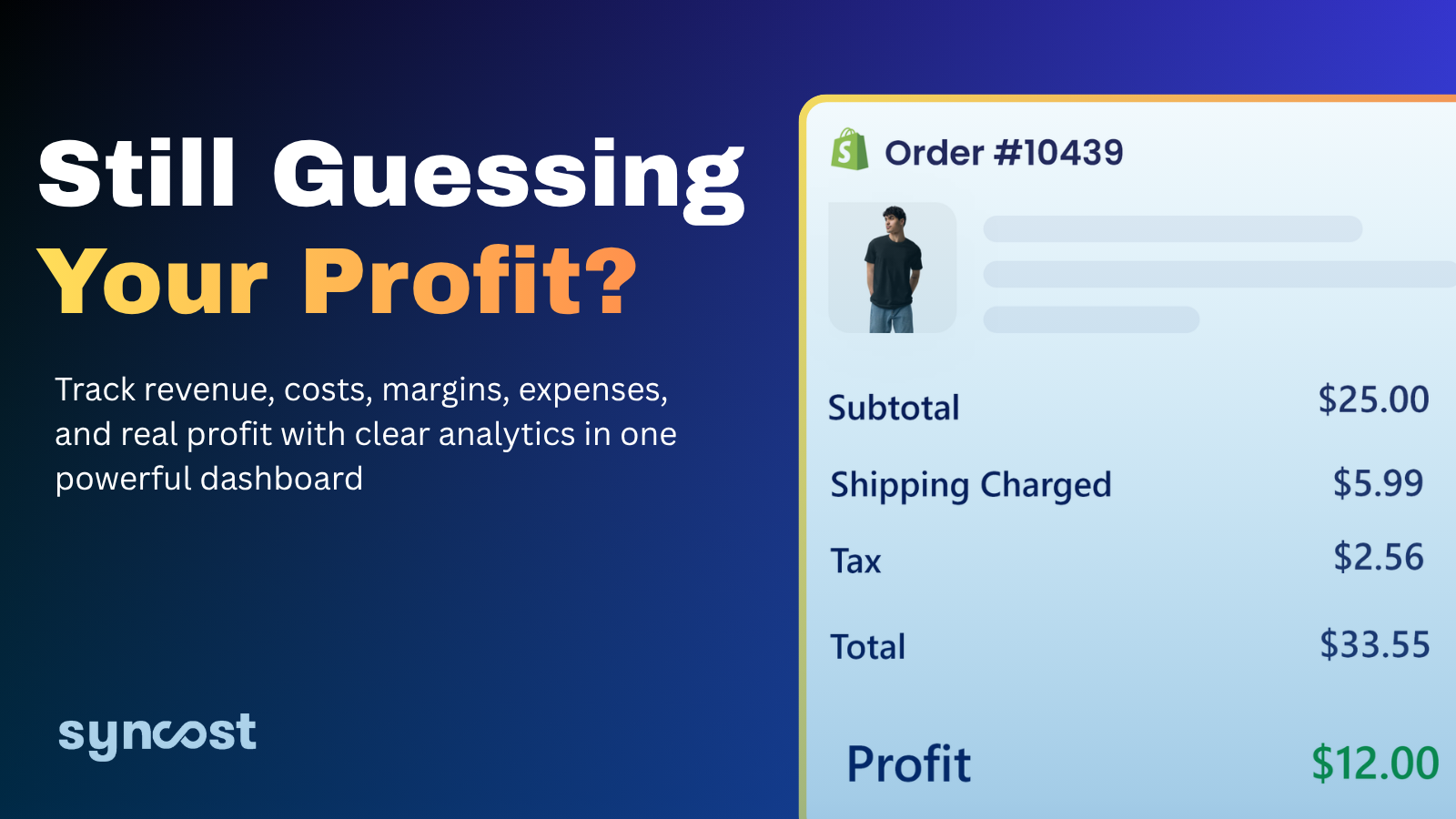
Syncost brings absolute clarity to your supply chain by replacing flawed manual spreadsheet calculations with automated profit intelligence. By integrating directly with your Shopify store, ad platforms, and custom cost inputs—including fully burdened fulfillment and 3PL expenses—Syncost reveals your exact net profit on every single order, down to the penny.
Stop letting hidden warehouse surcharges drain your operating capital while your top-line revenue grows. Install Syncost, uncover your true operational unit economics, and scale your e-commerce brand with total financial mastery.