How Much Does It Really Cost to Sell on Shopify?
Shopify starts at $29/month (May be less or more based on Store Location) — and that's the smallest part of what selling on Shopify costs. Here's every cost layer: subscription (and its per-order impact at different volumes), payment processing (and why your real rate is higher than 2.9%), apps, shipping, and advertising — assembled into a single $45 order showing 23% net margin on paid traffic and 54% on organic.

The answer you'll find most often: "Shopify starts at $29/month." May be less or more based on Store Location) That number is real and it's the smallest part of the story.
The actual cost of selling on Shopify is the subscription plus payment processing on every order, plus apps you need to run the store, plus shipping costs if you're not passing them entirely to customers, plus the advertising you spend to bring buyers to a store that won't find them on its own. Put all of that together and the real cost of Shopify — per month, per order, and as a percentage of revenue — looks very different from the plan sticker price.
This is the complete breakdown of every cost layer, with a worked per-sale example showing what actually comes out of a $45 order before you keep anything.
Layer 1 — The Subscription Fee
Shopify charges a fixed monthly fee regardless of how many orders you process. In 2026, on annual billing:
| Plan | Monthly (annual) | Monthly (month-to-month) | Best for |
|---|---|---|---|
| Starter | $5 | $5 | Sell via links only, no storefront |
| Basic | $29 | $39 | New and early-stage stores |
| Grow | $79 | $105 | Growing stores, 500+ orders/month |
| Advanced | $299 | $399 | High volume, advanced reporting |
| Plus | From $2,300 | From $2,500 | Enterprise |
Annual billing saves 25%. On Basic that's $10/month saved — $120/year back in your pocket for a simple billing change. If you're committed to building a store, pay annually from the start.
What the subscription buys: Your storefront, hosting, SSL, CDN, unlimited products, checkout, Shopify POS (basic), abandoned cart emails, discount codes, and all standard analytics. Everything infrastructure-related is included — you never receive a separate hosting or SSL invoice.
What it doesn't buy: Apps with specific functionality (email, reviews, upsells), custom domains, and lower processing rates on higher plans.
The per-order cost of the subscription: Divide your monthly subscription by your order count. At 100 orders/month on Basic ($29), the subscription adds $0.29 per order. At 500 orders, it's $0.06. At 50 orders, it's $0.58. The subscription cost per order is significant at low volume and negligible at scale.
Layer 2 — Payment Processing Fees
Every card transaction processed through your store carries a fee. This is the cost layer that scales directly with revenue — and the one most sellers underestimate because it feels like a small percentage on each transaction.
Shopify Payments Rates
When you use Shopify Payments (Shopify's built-in processor), you pay only the card rate below — no additional transaction fee on top.
| Plan | Standard cards | Premium cards | International cards |
|---|---|---|---|
| Basic | 2.9% + 30¢ | 3.5% + 30¢ | +1.0% |
| Grow | 2.7% + 30¢ | 3.3% + 30¢ | +1.0% |
| Advanced | 2.5% + 30¢ | 3.1% + 30¢ | +1.0% |
| Plus | From 2.25% + 30¢ | Negotiated | Negotiated |
Standard cards are Visa and Mastercard debit and credit cards. Premium cards are Amex, corporate, and rewards cards — charged at the higher rate. International cards (issued outside your country) carry an extra 1% on top of the standard rate.
If a meaningful portion of your customers pay with Amex or from international addresses, your real blended processing rate is higher than the headline plan rate. Check your Shopify Payments dashboard for your actual blended rate — it's almost always higher than what the plan page shows.
The Third-Party Gateway Fee
If you use a payment gateway other than Shopify Payments — Stripe directly, PayPal, any other processor — Shopify charges an additional transaction fee on top of whatever your gateway charges:
| Plan | Third-party fee |
|---|---|
| Basic | 2.0% per transaction |
| Grow | 1.0% per transaction |
| Advanced | 0.6% per transaction |
On a $45 order processed through a third-party gateway on Basic: $45 × 2% = $0.90 extra to Shopify, on top of your gateway's own rate. At 200 orders/month that's $180/month in fees you wouldn't pay if you switched to Shopify Payments.
The decision is usually simple: Use Shopify Payments. The third-party transaction fee is almost never justified by whatever advantage the alternative gateway provides. Enable Shopify Payments in Settings → Payments the day you open your store.
The Processing Fee on a Real Order
On a $45 order through Shopify Payments on the Basic plan, with a standard card: $45 × 2.9% + $0.30 = $1.31 + $0.30 = $1.61
That's 3.6% of the sale price — not 2.9% — because the 30¢ flat fee is proportionally larger on lower-value orders. The effective rate is always higher than the percentage figure alone, especially on orders under $50.
Layer 3 — App Fees
Shopify's core platform deliberately leaves room for a rich app ecosystem. Many of the features you expect from a complete ecommerce store — email marketing, product reviews, upsell offers, subscription management, advanced inventory, loyalty programmes — require paid apps from the Shopify App Store.
Realistic Monthly App Costs by Store Stage
| Stage | Typical paid apps | Monthly app cost |
|---|---|---|
| Just starting | 0–2 paid apps | $0–$60 |
| 3–6 months in | 3–5 paid apps | $60–$200 |
| Growing store | 5–8 paid apps | $150–$400 |
| Established | 8–12 paid apps | $300–$600+ |
The most commonly purchased app categories and their typical costs:
| App category | Example | Monthly cost |
|---|---|---|
| Email marketing | Klaviyo | $0–$45+ (by list size) |
| Product reviews | Judge.me Pro | $15 |
| Upsell / cross-sell | ReConvert | $29–$79 |
| Subscription management | Recharge | $99+ |
| Inventory management | Sumtracker | $59 |
| Abandoned cart / SMS | Postscript | $25+ |
| Site speed | Superspeed | $29+ |
The app accumulation trap: stores add apps incrementally and never audit them. An app added in month three for a specific campaign, cancelled in month five but re-enabled by accident, an app charging $49/month that was replaced by a better $20 solution six months ago — these silently inflate your monthly cost base. Run an app audit quarterly. Cancel anything you don't actively use.
The per-order impact of apps: At $200/month in apps and 200 orders, each order carries $1.00 in app overhead. At 50 orders, it's $4.00 per order. App costs hit hardest at low volume.
Layer 4 — Shipping Costs
Unless you pass 100% of shipping cost to customers, you absorb some or all of the cost of delivering orders. Even if you charge for shipping, you may be absorbing the gap between what you charge and what carriers actually charge.
Outbound Shipping Cost Ranges
| Order type | Typical US domestic cost |
|---|---|
| Small item (t-shirt, accessory) | $3.99–$6.50 |
| Medium item (shoes, small electronics) | $6.00–$12.00 |
| Large item (home goods, furniture) | $15.00–$40.00+ |
Shopify Shipping provides pre-negotiated carrier discounts (USPS, UPS, DHL) that reduce rates below walk-in prices. At low volume, these are the best rates available. At higher volume (200+ shipments/month), negotiating a direct carrier account often produces better rates.
Free shipping: Offering free shipping is the highest-converting approach — customers respond strongly to $0 at checkout — but it means absorbing 100% of carrier cost. Build the cost into your product price before offering free shipping, or set a free shipping threshold above which the incremental margin on the qualifying product covers the shipping cost.
The per-order cost: Assume $5.00 in outbound shipping cost per order if you're selling standard-weight items domestically and offering free shipping. This is the most commonly under-modelled cost in new-store unit economics.
Layer 5 — Customer Acquisition Cost (Advertising)
No ecommerce store sends itself traffic. Every customer either costs money (paid ads) or time (content, SEO, social). Once you're running paid advertising — which most stores eventually do — your customer acquisition cost becomes the largest single variable cost in your business.
2026 Ad Cost Reality
Meta and Google CPMs and CPCs have risen 20–40% over the past two years. Realistic customer acquisition costs for ecommerce stores on paid channels in 2026:
| Category | Typical paid CAC range |
|---|---|
| Pet products | $12–$25 |
| Apparel & fashion | $15–$35 |
| Beauty & personal care | $20–$40 |
| Home goods | $20–$45 |
| Electronics | $40–$100+ |
A $20 CAC on a product with $22 gross profit leaves you $2 per order before any fixed cost allocation. That's a business in name only. A $20 CAC on a product with $35 gross profit leaves $15 — a viable margin for a store building at scale.
Calculate your break-even CAC before you run your first ad:
Break-even CAC = Gross profit per order
                (after COGS, shipping, processing fee)
If gross profit per order is $24 and your Meta ads are generating a $26 CAC, you're losing $2 on every ad-driven sale. No volume solves this. Fix the CAC or the unit economics before scaling.
The True Cost on a Single $45 Order
Here's every cost layer assembled on one order. A $45 product sold through Shopify Basic with Shopify Payments, shipping included in the price (seller absorbs shipping), acquired through Meta ads. Store doing 200 orders/month.
| Cost | Amount | % of revenue |
|---|---|---|
| Sell price | $45.00 | 100% |
| Product cost (COGS) | −$13.00 | −28.9% |
| Outbound shipping | −$5.00 | −11.1% |
| Payment processing (2.9% + 30¢) | −$1.61 | −3.6% |
| Subscription per order ($29 ÷ 200) | −$0.15 | −0.3% |
| App fees per order ($180 ÷ 200) | −$0.90 | −2.0% |
| Customer acquisition cost | −$14.00 | −31.1% |
| Net profit per order | $10.34 | 23.0% |
Without advertising (organic, email, or repeat customer):
| Cost | Amount | % of revenue |
|---|---|---|
| Sell price | $45.00 | 100% |
| Product cost | −$13.00 | |
| Outbound shipping | −$5.00 | |
| Payment processing | −$1.61 | |
| Subscription per order | −$0.15 | |
| App fees per order | −$0.90 | |
| Customer acquisition cost | $0.00 | |
| Net profit per order | $24.34 | 54.1% |
The $14 CAC is the biggest single line in the paid-traffic scenario — bigger than COGS, bigger than shipping, bigger than processing. This is why traffic source mix is one of the most consequential decisions in ecommerce: the same product at the same price on the same platform generates 54% net margin on an organic sale and 23% on a paid one.
What Shopify Doesn't Tell You About These Costs
Shopify's analytics dashboard shows you the $45 sale. It shows you the estimated gross profit if your cost fields are current. It does not show you the shipping you paid, the processing fee on that specific transaction, the allocated subscription cost, the app overhead, or the advertising spend attributable to that customer.
The number you see in Shopify is gross revenue. Every cost listed above — except a rough COGS estimate — is invisible in Shopify's native reporting. This is why merchants who run their business from the Shopify dashboard routinely overestimate their profitability. The dashboard shows what you sold. It doesn't show what you kept.
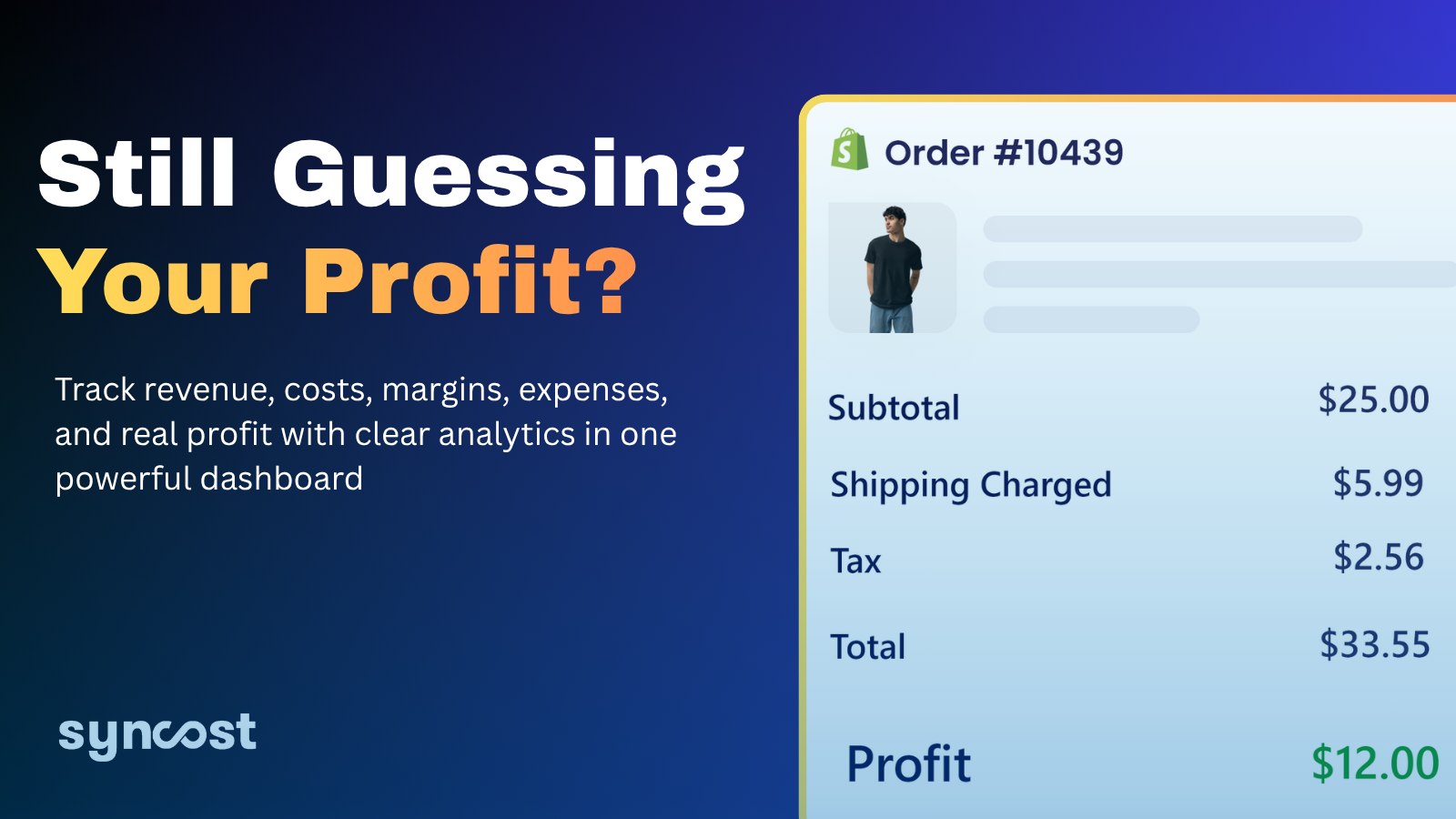
Syncost closes this gap for Shopify merchants by automatically combining your product costs, Shopify fees, shipping, and ad spend into a single per-order view — so the number you see on every sale is net profit, not gross revenue. The real cost of selling on Shopify isn't the plan price. It's the sum of everything in this article, calculated per order, per product, and per channel, in real time. Syncost is what makes that number visible — so you can manage your margins instead of guessing at them.
Shopify plan pricing, processing rates, and app costs reflect 2026 published rates. Actual costs vary by transaction volume, card mix, order weight, carrier, and advertising efficiency. Verify current Shopify pricing at shopify.com/pricing before making plan decisions.